

The turkey’s gone, the sink is a disaster, and your grandmother’s forks are sitting on the counter waiting on a decision. You drop them into the dishwasher basket with the everyday stainless, the way you have for years. Then they come out with dark, cloudy blotches that look like bruises on the metal, and the polish cloth does nothing. The detergent gets blamed for that. So does the heat. The real offender is simpler and dumber: silver touching stainless steel inside a wet machine.
Your Flatware Basket Turns Into A Battery
Two different metals touching in a liquid that conducts electricity is not a cleaning problem. It is a circuit. The more reactive metal becomes the anode and dissolves faster than it otherwise would, which is galvanic corrosion, named after the Italian physician Luigi Galvani. Single-use batteries run on the exact same principle on purpose.
A dishwasher supplies the missing ingredient beautifully. The wash water is hot, alkaline and loaded with dissolved minerals and detergent, 120 to 150 degrees Fahrenheit of near-perfect electrolyte. Silver is the nobler of the two, so the stainless is what corrodes, and on silver plate the base metal showing through pores and worn spots corrodes with it, undermining the plating from underneath. It happens fastest where the two are actually touching, which in a crowded silverware basket is everywhere.
Those Dark Spots Are Not Tarnish
Tarnish is silver sulfide. It forms in open air, it forms on silver you hand wash religiously, and it comes off with polish and a few minutes of work. Nobody needs to panic about tarnish.
Contact damage is a different animal. The blotchy gray and black marks, and the odd rainbow streaks that show up where a spoon nested against a steel fork, are not tarnish at all, and polish will not lift them. On silver plate the reaction removes actual material, so there is nothing left to shine. At that point the fix is professional refinishing, which means electro-cleaning tanks full of strong chemicals and high-speed buffing lathes. That is a shop job, not a Sunday afternoon.
The Same Reaction Went After The Statue Of Liberty
Routine maintenance checks in the 1980s found corrosion between the statue’s outer copper skin and the wrought iron support structure underneath. The builders had seen it coming when Gustave Eiffel put the frame together for Frédéric Bartholdi’s design in the 1880s, and they separated the metals with shellac-coated asbestos cloth. The shellac gave out over the decades and the iron supports rusted. The 1980s renovation replaced the iron bars with stainless steel and taped them off from the copper with PTFE.
The Royal Navy learned it earlier and harder. In 1761 it sheathed the hull of the frigate HMS Alarm in 12-ounce copper plating, fixed on with iron nails. When she came back from the West Indies the copper was fine, but the nails were “found dissolved into a kind of rusty Paste”, except where scraps of brown paper had accidentally been left under the nail heads. The conclusion sent to the Admiralty in 1763 was that iron and copper should not touch in sea water. Your dinner fork is losing the same argument.
You Don’t Have To Run A Separate Load
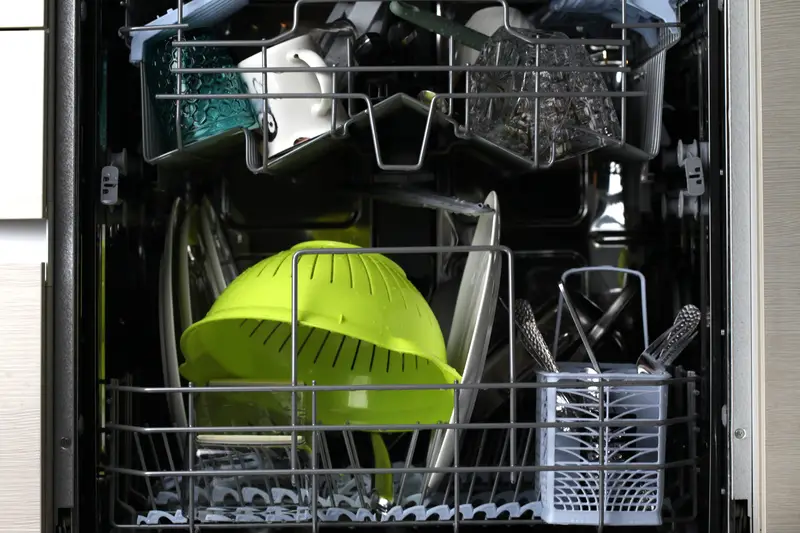
This is where most people overcorrect and then give up. Silver and stainless can ride in the same wash. What they cannot do is touch each other. Put the silver in its own compartment of the basket, on its own, with nothing steel leaning against it. Distance is the entire trick.
Watch the rack too. Dishwasher racks are plastic-coated steel wire, and once the coating chips, carbon steel tines are touching your flatware in conductive water all cycle long. Those orange-brown specks people find on perfectly good cutlery often are not the cutlery’s fault: iron particles shed elsewhere in the machine land on the metal and oxidize on contact in hot water, a thing called free iron contamination.
The Sanitize Button Is The Worst One On The Panel
Normal cycles run somewhere between 120 and 150 degrees, which silver handles reasonably well. A sanitize cycle has to hit 150 in the final rinse to certify under NSF/ANSI Standard 184, and machines run it to about 162. Every chemical reaction in that box speeds up with heat, including the one eating your flatware.
Time is the other half of it. A dishwasher cycle runs an hour and a half to four hours, so your silver sits in hot chemistry for the length of a movie. Hand washing exposes it to soap for a minute or two at whatever your hands will tolerate. High drying heat paired with certain detergents also leaves silver with a cloudy, whitish cast that looks like hard water spotting but is not.
There’s Citrus Hiding In Your Detergent
Citrus-derived additives are everywhere in dishwasher pods and rinse aids, where they are there to bind hard-water minerals. The pods around them are strongly alkaline, closer to oven cleaner than to anything you would willingly put on soft metal. Price does not save you here. Expensive pods sold as gentle can be just as rough on soft metal.
If you are going to machine wash silver at all, the detergent needs to be phosphate-free and citrus-free, and the rinse aid needs checking as well, since citric acid turns up in a lot of them. The alkaline salts and bleach in standard formulas are built for baked-on lasagna, not for an alloy that scratches easily.
Salt Does More Harm Than Grease Ever Will
Of everything that lands on silver at dinner, salt is the most corrosive. Antique salt cellars and shakers are the proof, often pitted and corroded, with caps seized on so tight they cannot be twisted off by hand.
Which means the damage starts before the machine does. Salty sauce left sitting on a fork overnight while the load fills up is doing quiet work on the surface, and pitting does not buff out. Rinse silver right after the meal, even if the actual wash happens later.
Hollow-Handled Knives Never Survive
The blade in a hollow-handled knife is set into the handle with cutler’s cement, usually pitch or a cement compound. Dishwasher heat softens and expands it, and eventually the blade rattles, wobbles or comes out entirely. There is no careful way to do it. Those get washed by hand, every time, forever.
Same verdict for anything with wood, bone, pearl or mother-of-pearl handles, which crack because the materials expand at different rates under heat and moisture and literally pull apart from each other. Ornate serving pieces have their own problem: the dark shadows sitting in the scrollwork are often intentional oxidation, and detergent strips them out, leaving a flat, shallow-looking pattern that only a silversmith can put back.
Flip The Fork Over And Read It
Most people have no idea what is actually in their drawer. Sterling is stamped “925” or “sterling,” or carries a hallmark like the English Lion passant, and it is 92.5% silver with the other 7.5% usually copper. That copper is the troublemaker, since it corrodes in ways pure silver does not, alongside the silver sulfide.
Plated pieces are stamped “EPNS,” “silver plate,” or maker names like Rogers, and they are a thin silver coating electroplated over a base metal, usually nickel silver, which contains no silver at all. Unmarked, lightweight, shiny stuff is base metal or stainless, and it can go through the machine all day without a second thought.
That Drawer Is Worth Real Money
With silver around $66 an ounce in September 2026, a 32-piece sterling flatware set is worth well over $1,000 in metal alone. Silver plate is a different story, with essentially no melt value and maybe $50 for a complete service secondhand, though it can keep looking good and working fine for decades.
The honest question is whether you would cry or just be annoyed. Modern makers have taken a side on this: Robbe & Berking builds a stainless steel line designed to be dishwasher-safe, because they know people want to actually use the stuff instead of admiring it through a velvet-lined box twice a year.
The Foil Trick Runs The Reaction Backward
For tarnish that has gone deep, line a bowl with aluminum foil, dissolve a spoonful of baking soda in very hot water, and rest the silver so it is touching the foil. Sulfur compounds move off the silver and onto the foil while you watch. No metal is rubbed off, which matters for old pieces that have already been polished many times, though it can leave a dull matte finish. For everyday cleaning, a baking soda paste with the texture of damp sand, worked in with a soft cloth and dried completely, is all most pieces need.
Run the same reaction somewhere you did not intend and it costs you. Salty lasagna in a steel baking pan, covered with foil, becomes a “lasagna cell”: within a few hours the foil has small holes in it where it touched the food, and the food is dotted with corroded aluminum. Salty food is the electrolyte, foil is the anode, pan is the cathode.
So use the silver. Put it in its own compartment, press normal instead of sanitize, skip the citrus, and pull it out to dry by hand. One habit ruins it, and it is the one nobody thinks twice about: letting it touch the stainless.

