

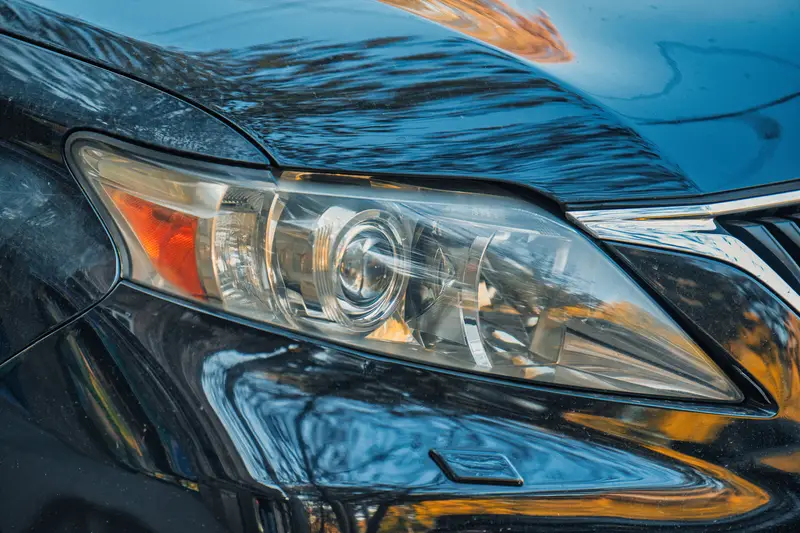
Walk down any row of cars at a Target parking lot and you can guess their age from twenty feet away. The older sedans have lenses the color of weak iced tea. The newer ones have a faint milky film creeping in from the edges. Almost nobody thinks about it until they are driving a dark two-lane road at night and realize they cannot see much past the hood. There is a number behind that feeling, and it is uglier than most drivers would guess: clouded or yellowed headlights put out only 22 percent of the light that new ones do.
That figure comes from lab testing, not a guess, and the fix that actually restores the most light is not the one most people try.
You Are Driving On A Fifth Of Your Headlights
AAA sent headlight assemblies from two popular sedans, roughly 11 years old, to an accredited lab and measured them against new ones under the federal standard the Department of Transportation uses, FMVSS-108. On low beam, the degraded lenses delivered just 22 percent of what a new headlight puts out at full capacity.
About half of passenger-vehicle occupant deaths happen at night, on a quarter of the driving. Greg Brannon, AAA’s director of Automotive Engineering and Industry Relations, said the problem is visible in any parking lot. “Walk through any parking lot and it is evident that deteriorated headlights are a problem for most vehicle owners,” he said. “Headlights on the road in the U.S., even when new, don’t produce a sufficient amount of lighting, so any reduction in performance is a real safety issue.”
That last part is the quiet insult. Even brand new American headlights are not great. Earlier AAA testing found halogen headlights fail to properly light unlit roads at speeds as low as 40 mph, and high beams only bought back about 28 percent more distance. The best headlights in that test lit up only 40 percent of the sight distance you get in daylight.
New Lenses Win, But The Cheap Fix Still Works
Swapping in original equipment manufacturer headlights brought light output all the way back to 100 percent in AAA’s testing. Aftermarket replacements landed between 83 and 90 percent, but they failed certain light intensity requirements and were more likely to throw glare at oncoming drivers.
Restoration is the budget route, and it does less. DIY restoration returned light output to 69 percent and a professional job to 73 percent. Both also produced more glare than DOT criteria allow. So the honest ranking: new factory assemblies are the real fix, restoration is the practical one, and anything that just wipes the lens is not a fix at all.
For most people staring at a 12-year-old car, a restoration kit from an auto parts store is what is actually going to happen. Those kits generally run about $16 to $30, some have enough material to be used again, and the shelf is full of familiar names like 3M, Meguiar’s, Sylvania and Mothers. Most drivers can get through the job in under 30 minutes on lightly hazed lenses.
Check Whether The Haze Is Inside Or Outside
Sanding the outside of a lens that is fogged on the inside is a waste of a Saturday. Run a finger across the lens. If you can feel the roughness, and the tint is yellowish or brownish, the damage is on the outside where the sun hits it. That is the common case.
Internal fogging looks different. It spreads as a uniform haze across the whole lens rather than streaks or patches, and you may see actual water droplets or debris sitting behind the lens. That means the seal on the housing has failed and moisture got in. Fixing it means pulling the assembly, wiping the inside with a microfiber cloth, drying it completely and resealing, or replacing the assembly outright. No amount of polishing the front will touch it.
The Factory Coating Is Thinner Than A Hair
Every plastic headlight leaves the factory wearing a thin hard coating, and that coating is the only thing protecting the polycarbonate underneath from ultraviolet light. It is typically a few microns thick, far thinner than a human hair. Nobody reapplies it, and from the day you drive off the lot it is wearing away.
Once it thins, which AAA says starts to show at three to five years, UV reaches the bare plastic and changes its chemistry. The yellow is not dirt sitting on top of the lens. The lens material itself has changed, which is exactly why washing your car for ten years straight never made a bit of difference.
Older cars did not have this problem because older headlights were glass. Glass does not oxidize or yellow. Manufacturers moved to polycarbonate starting in the mid-1980s because it is lighter, cheaper, moldable into complicated shapes and does not shatter into shards when a rock hits it. The tradeoff was the sun.
Skipping The Sealant Means Doing It Again By Spring
Sanding a headlight removes the oxidized layer. It also removes whatever is left of that factory coating, which leaves raw polycarbonate sitting in the sun with zero protection. A restoration that stops at polishing looks incredible for a few weeks and then clouds over faster than it did the first time.
The sealant step is the whole job. A UV sealant or ceramic coating replaces the protection the sandpaper took off, and it needs refreshing every several months since it wears too. Done properly, the full clean, sand, polish and seal routine only needs repeating every couple of years.
Toothpaste Works, For About Two Months
The internet’s favorite hack is not fake. Toothpaste can contain calcium phosphate, aluminum oxide and silica, all fine abrasives, so rubbing it on a lens does buff away part of the oxidized surface. Use paste, not gel.
The catch is that you removed a thin skin of damaged plastic and replaced the UV protection with nothing. The improvement holds for maybe two months before the cloudiness comes back. It is a fine trick the night before you sell the car or before an inspection. It is not a repair, and the people who swear by it are usually doing it again every couple of months without noticing.
Bug Spray Does Not Belong On Your Car
Mosquito repellent gets passed around as a miracle headlight cleaner because the lens does look clearer for a minute. What is actually happening is that the chemicals in it can melt and destroy plastic. Keep it off the vehicle entirely, not just the lenses.
Acetone gets the same treatment online and does more damage than good. Brushing on clear coat paint is a time-consuming patch that eventually oxidizes and cracks anyway, since that product was never designed to sit on a headlight, and it can leave visibility worse. Household stuff like Windex, Bar Keepers Friend, Murphy’s Oil Soap and oven cleaner will clean a lens, but repeated use can damage paint and colored plastic around it. Even dish soap is a bad idea on the lens itself. Use car wash soap.
Luxury Badges Yellow Just The Same
Shops that do this work every day see foggy lenses on Lexus, BMW and Mercedes as often as on Hondas and Fords. The plastic does not care what the sticker price was.
Where you park matters far more than what you drive. Cars left facing the sun develop lopsided damage, with the sun-facing side hazing over while the other stays relatively clear. Hot, high-altitude and coastal spots run through the timeline faster. A garaged car in a cloudy state can go a decade before it looks rough.
The progression is predictable. Years one through three, the coating holds. Years three to five, it thins and you see a slight yellow in direct sun. Years five to eight, the hazing is obvious and light output measurably drops. Past eight years, you are looking at heavy clouding and possible cracking, and past twelve the damage may run too deep to polish out.
What It Costs You On A Dark Road
Dirty and heavily oxidized lenses cut light output by about 78 percent compared with clear ones. Put that in road terms: clear headlights might show you 300 feet of pavement ahead, and a clouded pair a fraction of that. At 55 mph you are covering about 80 feet every second.
There is a second problem nobody expects. A hazed lens does not simply dim the beam, it scatters it. The light goes everywhere instead of down the road, which means oncoming drivers get more glare while you get less usable light. You are seeing worse and annoying everyone else at the same time.
Do This, In This Order
Park in the shade so nothing dries on the lens mid-job. Wash the headlights with car soap and dry them, because sanding over grit just grinds contaminants into the plastic. Mask the paint around the lens with blue painter’s tape. Wear nitrile gloves and safety glasses.
Light haze may come out with polish alone in 15 to 30 minutes. Moderate haze calls for wet sanding starting around 1000 grit, then polishing compound, then sealant, roughly one to two hours by hand. Heavy yellowing means starting as coarse as 400 grit and working up through finer grades, one to three hours. Sand horizontally, then vertically, and keep the pads wet the whole time.
Then protect what you just did. Wax the headlights whenever you wax the car, reapply a UV protectant every few months, and wash road salt off during winter rather than letting it sit. If your seals are shot or the plastic is cracked and pitted, stop shopping for kits and price out new assemblies. That is the only route back to the full 100 percent.

