

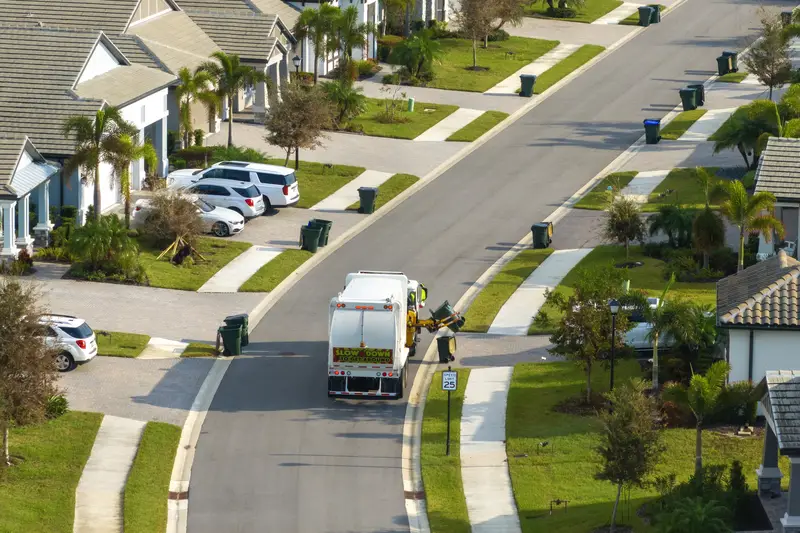
Somewhere in your house there is a drawer with dead batteries rolling around in it. Somewhere in the garage there is a paint can with two inches of dried eggshell white at the bottom. Both of those things get dropped into the curbside bin every single trash day in America, and both of them are why sanitation crews keep having very bad mornings.
In late May 2026, the cities of Troy, Michigan and Roseville, California reported trash truck fires six days apart. Same cause in each case. Not a dropped cigarette, not a hot barbecue coal. A battery.
Batteries and leftover paint are the two items that should never go in your regular household trash, and the reasons are stranger and more specific than most people realize.
One Battery, One Truck, One Street Full of Burning Garbage
A garbage truck is a compactor on wheels. Whatever goes in the back gets crushed by a hydraulic blade with enough force to flatten a couch. A lithium-ion battery cell that gets punctured in that process short circuits internally, heats up almost instantly, and can ignite in seconds.
When that happens, the driver’s only real option is to dump the entire load onto the pavement to keep the truck from burning. That is why you occasionally see photos of a smoking pile of household trash sitting in the middle of a residential street. The fire department in Troy, Michigan posted exactly that after a lithium battery pack ignited inside a truck.
Roseville, California put out a notice on May 21, 2026 after a battery ignited inside one of its collection trucks. The city’s message was blunt: one battery can start a fire, and if it has a battery, keep it out of your bin. The city listed the costs beyond the flames, including truck downtime, delayed pickups for entire neighborhoods, and repair bills.
New York has it worse than anywhere. According to FDNY figures published by the National Fire Protection Association, the city has seen 800 lithium-ion battery fires since 2022, resulting in 30 deaths and 400 injuries. In late May 2026, a garbage truck caught fire in Brooklyn and two Department of Sanitation workers were moderately injured. A department spokesperson said a lithium-ion battery was the likely culprit, even though throwing them in the trash or recycling is already illegal there.
You Are Probably Throwing Batteries Out Without Knowing It
Most people who cause these fires never handled a battery at all. They threw out a thing that had one inside it.
“Many people don’t realize they’re throwing away a battery when they toss a problem toy, an old pair of earbuds, or a cordless power tool or household device,” said Ryan Nordt, executive director, recycling operations, WM.
The list of everyday items running on lithium cells is longer than you would guess. Smartphones and laptops, obviously. But also fitness trackers, electric toothbrushes, electric shavers, e-bikes, wireless doorbells, and every cordless drill in the garage. Roseville’s photos showed the remains of a lithium-ion pack of the type found in power tools and laptops.
In June 2026, WM added a fourth rule to its Recycle Right guide: no batteries in the recycling or the trash. Not a suggestion buried on page nine. A headline rule, next to the basics about cardboard and cans.
July and August Are the Worst Months for This
Battery fires happen year-round, but they cluster hard in the summer. July and August consistently record the highest number of fires at waste and recycling facilities, a pattern the industry has nicknamed the summertime spike.
July and August 2025 set a record, with more than 100 fires reported across North America over that two-month stretch.
The reason is basic physics. Temperatures inside garbage trucks, roll-off containers and sorting facilities climb fast in summer heat. Heat makes a damaged battery less stable and more likely to ignite. And the rest of the load is paper, cardboard and plastic, which in August is bone dry and ready to carry a flame across a whole pile.
Batteries also get wrecked in more ways than just the compactor. They get crushed or punctured by sorting equipment at the facility, and they short out when the terminals touch loose metal or another battery in the same bag.
The AA Battery Rule Is Not What You Think
Here is where the advice splits, and where almost everyone gets it wrong.
The EPA recommends recycling alkaline and zinc-carbon batteries, but those are typically allowed in household trash. Lithium batteries are governed by stricter rules and should never go in the bin.
Your hauler may be stricter than that. WM’s guidance names alkaline AA, AAA, C, D and 9-volt batteries alongside lithium-ion packs, rechargeables from power tools and vacuums, and the button and coin cells in watches and key fobs, and says none of them belong in the trash or the recycling.
The gap matters because lithium-ion cells get singled out for a chain reaction called thermal runaway, where a cell rapidly overheats itself. Any battery, though, can spark if it is crushed or damaged. Coin cells are the sneakiest offenders because they are tiny, they are everywhere, and nobody thinks of a watch battery as a fire risk.
Taping the Ends Takes About Ten Seconds
Before a battery goes anywhere, put tape over the terminals or seal it in its own plastic bag away from other trash. That single step stops the contact sparking that causes a lot of these incidents in the first place.
Free drop-off points are more common than people assume. Electronics stores like Best Buy take rechargeables, along with many hardware stores and some office supply stores. Earth911 and BatterySafetyNow.org both have location finders. New York City points residents at the national Battery Network locator, and a lot of its city sites sit inside Staples stores and Duane Reade pharmacies, meaning the errand takes a five-minute detour.
Roseville goes further and offers free doorstep pickup. Placer County residents can also drop household hazardous waste at the Materials Recovery Facility in Lincoln free of charge, daily from 8 a.m. to 5 p.m. The National Waste & Recycling Association sponsors National Battery Take-Back Day each September.
One exception worth knowing: if the battery is visibly damaged, do not take it to a recycling drop-off. Contact the battery or device manufacturer and ask what to do with it.
The Paint Can Is the Other One
Leftover paint is the second item that should never make it into your curbside bin, and the rules around it are genuinely confusing, which is exactly why so much of it ends up at the curb anyway.
Paint is treated as household hazardous waste, and dumping it can bring fines. Oil-based paint is the strictest category. It has to go to a certified disposal facility, full stop. It contains volatile organic compounds including toluene, xylene and mineral spirits, and you cannot dry it out and toss it the way you can with water-based paint. Doing that may violate local and federal waste laws.
Chris Batterson, key account manager of construction and projects at Rubicon, says unused or discarded paint can usually be dropped off at participating local paint suppliers and at community nonprofit organizations, and that local municipalities will have guidelines for bringing it to a facility.
Dried Latex Paint Is the Exception Nobody Knows
Latex paint, the stuff most people use on interior walls, can legally go in household trash in most states once it is completely dried out and solid. It is water-based, and it is not classified as hazardous waste in solid form.
For a small amount, pull the lid off and let the can air-dry. To speed it up, stir in cat litter, sawdust, shredded newspaper, or a paint hardener product sold at hardware stores. Once it is a hard mass with no liquid left, it goes out with the regular garbage. California is the exception. It treats latex as hazardous waste and bars drying it at home, so there the can goes to a drop-off.
The one thing you never do is pour liquid latex paint down the drain. It can damage plumbing and it ends up in local waterways. Latex contains compounds including titanium dioxide and ethylene glycol.
Acrylic craft paint follows the same playbook. Dry it fully, then bin it, and check your local sanitation rules first, because some places treat even small amounts as hazardous waste.
Spray Cans Have Their Own Rulebook
A spray paint can with anything left in it is hazardous waste and belongs at a household hazardous waste site. A completely empty one is a different story: most curbside recycling programs will take it with the metal or mixed recyclables, as long as the nozzle is intact and the can has not been punctured or crushed.
That nozzle detail trips people up constantly. So does the urge to puncture a can to empty it. Never puncture, burn or incinerate an aerosol can, and never try to pierce one for any reason. Leftover propellant inside a can is what makes it explode in a trash compactor.
The EPA added aerosol cans to its universal waste rules in 2019, and some states, California in particular, had special disposal rules for them even earlier.
Where the Paint Actually Goes
PaintCare runs a drop-off locator, and in participating states including California, Colorado and New York you can hand over both oil-based and latex paint at taking-part stores even if you did not buy it there. That last part surprises people. You are not stuck driving back to the retailer whose sticker is on the can.
In PaintCare states, Lowe’s, Home Depot, Sherwin-Williams and Ace Hardware stores often double as PaintCare drop-off sites that take oil-based paint. Call ahead anyway, because availability is regional and nobody wants to load a trunk full of cans for nothing.
Some recycling centers will simply take usable paint off your hands, especially if the can is unopened or close to full.
Twenty Pounds a Year, Per House
The volume here is bigger than any one drawer of dead AAs suggests.
“The average household generates more than 20 pounds of household hazardous waste a year, and Americans generate 1.6 million tons of household hazardous waste a year, meaning it is necessary for consumers to have a plan in place for how to dispose of these items,” said Wade Scheel, then director of governmental affairs for Stericycle Environmental Solutions, now Clean Earth.
Neither of these items asks much of you. Tape the ends of the batteries and keep a bag of them by the door for your next trip to a store that takes them. Leave the latex can open in the garage until it sets, and put the oil-based and spray cans in the trunk for the next hazardous waste day.
The alternative is a burning truck on your street and a crew dumping your neighborhood’s garbage on the asphalt to save it. Ten seconds of tape is a better trade.

