

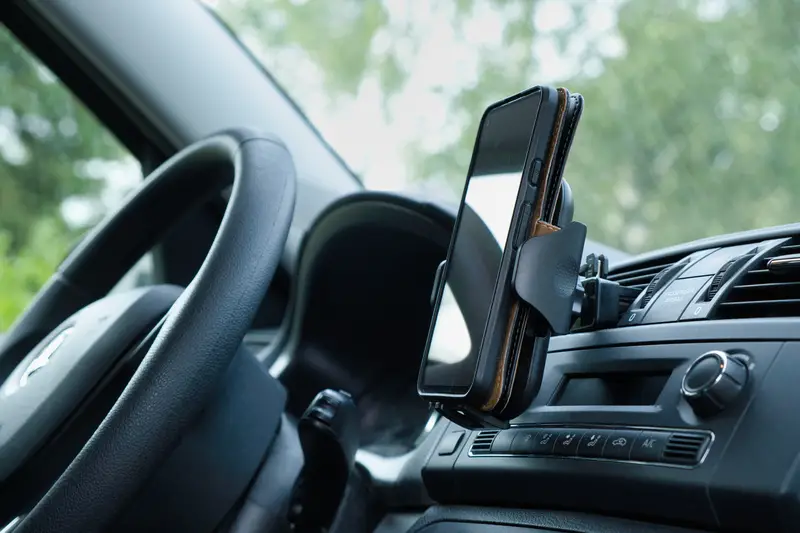
About twenty minutes into a summer drive, the screen dims to almost unreadable. The map stutters. The battery percentage has barely moved in half an hour even though the cable has been plugged in the whole time, and the back of the phone is warm enough that you notice it when you unclip it.
Almost every version of that story starts in the same place. The phone was on the dashboard, under the windshield, in the sun.
Most phones are built to run up to about 95°F and to sit idle up to roughly 113°F, and the lithium-ion cells inside them are happiest somewhere around 62 to 72°F. A closed car clears all of those numbers on an ordinary afternoon. Where you set the phone decides how fast.
8. The Dashboard, Especially Under a Windshield Mount
A 2018 research paper parked cars in the Arizona sun on days in the 100s. Cabin air averaged around 116°F after an hour. The dashboards themselves averaged 157°F. That is the surface a suction mount holds your phone against, or a few inches above, with the windshield acting as a magnifying panel over the top of it.
The climb starts immediately. On an 80°F day, the cabin around a phone left on the dash reaches 114°F within 30 minutes and about 123°F inside an hour. Apple’s own support documentation is blunt about what that means for a device: “Don’t leave your device in a car, because temperatures in parked cars can exceed this range.” Samsung tells owners not to leave a device “in hot environments, like a hot car on a summer day, for extended periods of time.”
Arnoldas Lukošius, an innovation expert at Tele2, calls the dashboard one of the worst places to leave a phone in summer, because the device catches hot cabin air and direct sunlight at the same time. “At first it may look like a small inconvenience, such as the phone slowing down or stopping charging,” he says. “But if such situations happen often, heat can accelerate battery wear and shorten the life of the device.”
The cruel part is that mount manufacturers put the phone there on purpose, because it is where you can see it.
7. The Glove Box
Out of sight, out of the sun, and roughly four inches of plastic away from the panel that just measured 157°F. Storage compartments built into the dash absorb that heat and hold it, which is why the glove box is not the clever workaround it looks like.
One writer at How-To Geek locked his phone and his wife’s in the glove box on a sunny 100°F day while they went to the pool. His came back completely dead. Her Samsung Galaxy S23+ was down to about 15 percent with an overheating warning on screen, and he reports her battery life was never the same afterward.
There is a real argument that for a five minute stop, any enclosed compartment beats the open dashboard, and that is true as far as it goes. It is a lower risk, not an eliminated one. The glove box also has a behavioral problem: a phone you cannot see is a phone you forget, and five minutes becomes ninety.
6. A Wireless Charging Pad or Magnetic Puck
Inductive charging wastes a serious share of the energy it moves, and it throws it away as heat, in the gap between the phone and the pad where nothing can carry it off.
Drivers who use them describe pulling the phone off the puck hot, and the fan-equipped models do not solve it. Airflow across the outside of a pad does not undo the inefficiency of the transfer happening inside it. Pair wireless charging with turn-by-turn navigation and streaming audio and you have built a small heater and strapped your phone to it.
Wired charging over USB Power Delivery runs cooler and fills the battery faster. If the pad is the only option in your car, run the air conditioning on high and get the phone onto a vent rather than the console.
5. Loose on the Passenger Seat
Guidance on this is unusually specific: do not leave a device on the dashboard, on the seat, or in direct sunlight, even for a few minutes. The seat is an open surface that catches light through the side glass, and upholstery holds heat well once it has it.
Your case makes it worse. Most phone cases are plastic or silicone, both of which insulate, so the heat the phone generates has a harder time leaving the chassis and the heat around it has an easier time staying put. If the phone is already warm, taking the case off is the fastest free improvement available to you.
The seat has a second failure mode that has nothing to do with temperature. A phone on a flat seat slides into the footwell at the first hard stop, and then you are a driver leaning sideways at 55 mph.
4. The Cupholder or Your Lap
Thermally, both are fine. They sit low, shaded, away from the glass, and nothing radiant is pointed at them. That is the whole case for them, and it is not enough.
A phone in your lap is a phone you will pick up, and hands-free rules now in force across much of the country draw the line at holding it. Mounted navigation is generally permitted as long as it does not obstruct your view, which is precisely the opposite of a phone lying flat where you have to look down and grab it to read a turn.
The cupholder also has no airflow to speak of. For a phone that is already hot and needs to shed heat, a deep plastic well is a poor place to do it.
3. The Center Console Bin, Armrest Compartment or Door Pocket
These are the spots Lukošius names as the better options when the phone genuinely has to stay in the car for a short stop. They are shaded, they are away from the windshield, and they are far enough from the dash to miss the worst of the radiated heat.
Before you shut the door, unplug the charger, turn the screen off and take the phone out of any holder near the glass. A phone that is still running and still charging when you walk away is generating its own heat on top of everything the cabin is doing to it.
There is a simple check for whether the car is a reasonable place for a device at all: touch the steering wheel. If it is too hot to hold comfortably, conditions are not suitable for your phone either.
2. The Floor in Front of the Passenger Seat
The footwell is significantly less hot than the glove box, and the reason is structural. The dash and the seat block most angles of direct light, the floor sits at the bottom of the cabin where hot air is not collecting, and carpet insulates from below.
For a longer stop, power the phone down, wrap it in a light-colored cloth or towel and put it in an insulated pouch before it goes on the floor. Turning it off is worth doing because it stops the device generating internal heat, but it is not armor. Ambient temperature still reaches the battery whether the screen is on or not.
Do not try to shortcut the cooldown afterward. A refrigerator or freezer causes condensation inside the phone, and moisture in the internals is a worse outcome than the heat was. Let a heat-soaked phone come back down over 30 to 60 minutes, longer if the exposure was severe, and do not plug it in while it is still hot.
1. Clipped to an Air Conditioning Vent, With the Air Running
A vent mount turns chilled cabin air into a heat sink. Cold air moving across the back panel pulls heat out of the processor and the battery continuously, which is the same principle as the fan in a laptop, and a vent-mounted phone runs cooler than one baking on the dash.
That margin matters most for the people who cannot just put the phone away. CarPlay and Android Auto are the heaviest load most phones ever carry: the handset runs the whole projected interface, rendering the car’s display, while running live navigation, streaming audio and holding a cellular connection.
Run the vent mount with a wired PD cable, screen brightness down, and background apps closed. Avoid aiming the coldest possible air at a phone that is already baking in humid weather, since rapid swings in either direction invite condensation.
The Verdict
The vent mount wins while you are driving, and it wins by a distance. It does nothing at all once the engine is off, because the cold air stops and the cabin starts climbing.
For a parked car, taking the phone with you is the only step worth calling reliable. A windshield sunshade paired with ceramic tint on the side and rear glass lowers the whole cabin, and manufacturers claim ceramic blocks 99.9 percent of UV, but that is general relief rather than a number you can plan around.
Emily Thomas, associate director of auto safety at Consumer Reports, has made the point that cars heat up quickly even on cloudy days. Bright sun is not the warning sign. On a mild day under 75°F with the car in shade, a short stop carries comparatively little risk, and that is the narrowest exception in this entire article, not a general permission slip.

