

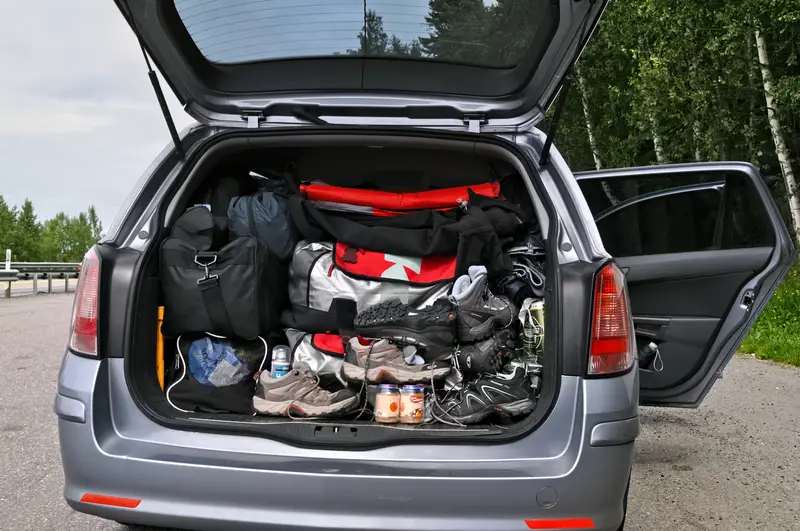
Most American trunks are a junk drawer on wheels. Jumper cables, a folding lawn chair, a case of water somebody bought three weeks ago, a gym bag that has seen things. Nobody straps any of it down, because the trunk feels like a different room with a door that shuts.
It is not a different room. And the single worst thing back there is usually the item you bought specifically to keep yourself safe: the fire extinguisher rolling around next to the spare tire. A 5-pound extinguisher is a steel bottle with a metal valve on top, and in a hard stop or a sharp turn it does not stay put. Loose, it turns into the heaviest, hardest thing in the car. Mounted in a bracket, it stays where you left it and you can actually find it when something is on fire, which is the entire point of owning one. An extinguisher buried under a beach umbrella and two Amazon returns is decoration.
A 20-Pound Object Hits With 1,000 Pounds Of Force
The number that should stop you cold is a rule of thumb safety educators use: at 50 miles per hour, a 20-pound object hits with about 1,000 pounds of force. In crash testing, a suitcase at that speed can take the arm off a crash test dummy.
Safety Research and Strategies, an accident investigation firm, estimated for Good Morning America in 2010 that ordinary loose items in cars and trucks cause 13,000 injuries a year. Not exotic cargo. Half-filled water bottles, canned goods, laptops. The stuff sitting in your car as you read this.
Your Trunk Is Not A Sealed Box
Here is what almost everyone gets wrong about trunk storage. People assume the back seat is a wall. It is a door. Most sedans have only a thin steel bulkhead behind the seat, and in any car with fold-down rear seats that panel is a seatback on a latch, a few inches from the back of your head.
SUVs and hatchbacks are worse, because there is often no partition at all. Cargo in the back of an SUV can shift forward and reach the people in the seats. Putting something in the trunk is a good first step, but it is not the same as securing it. Unsecured cargo in a trunk is still unsecured cargo.
The Water Bottle Math Nobody Wants To Do
Newton’s first law applies to your Yeti tumbler. An object in motion stays in motion. When your car is doing 50 and stops in a tenth of a second, everything inside is still doing 50 until something stops it. Weight times speed is the rough rule safety educators use.
Run the numbers on the most innocent item in your car. A full 16-ounce plastic water bottle weighs about a pound. By the same rule it arrives with roughly 50 pounds of force. A hardcover book, a can of soup that escaped the grocery bag, a travel mug, a phone left on the seat: all of them turn into the same problem with different packaging.
There is a blunt rule of thumb from Greg Durocher, a former paramedic who has trained child passenger safety technicians for more than 20 years: if you would not be willing to throw it at your kid at 50 miles per hour, do not have it loose in the car. Try applying that to your back seat. It ruins the drive to Target a little, but it works.
A Computer Killed A Driver In 2009
Heather Storey was driving in 2009 when a tow truck hit her car. Her computer became a projectile and flew into her head and neck. She died of those injuries.
Injuries from unsecured objects run the full range: cuts and lacerations, fractures, head and neck injuries. Laptops are a particularly bad offender because they are heavy for their size and have hard corners, and they almost always ride on the passenger seat instead of in the back. Same with tablets handed to a kid in the second row.
Something Rolling Under The Brake Pedal Is The Sleeper Risk
Projectiles get all the attention. The quieter danger is the item in the driver’s footwell that slides forward and wedges itself under the brake pedal. At that point you are not in a crash yet. You are in a car you cannot stop.
This is why the empty Gatorade bottle you keep meaning to throw out is a bigger deal than it looks, and why a loose floor mat or a shopping bag that tipped over on the passenger side is worth ten seconds of your attention before you pull out of the parking lot.
A Trunk Gets Hotter Than You Think
The temperature inside a parked car can climb almost 20 degrees in the first 10 minutes, according to the National Highway Traffic Safety Administration. The American Veterinary Medical Association measures the rise at 43 degrees in an hour, which turns a 95-degree day into 138 inside. A trunk can reach well above 100 degrees on a merely warm day, and it has no vents and no airflow to shed it.
Pressurized cans do not like that. Hairspray, deodorant, spray paint and the rest carry a storage temperature range printed right on the label, and outside that range the contents expand and the can can crack or burst. A driver told GEICO she left an unopened bottle of wine in her car overnight and came back to find the heat had pushed the cork out and wine spilled across the back seat. Wine is the funny version. Spray paint in a hot trunk is not.
Loose Batteries And Loose Change Are A Terrible Combination
This one genuinely surprises people. Nine-volt batteries rolling loose in a center console or glovebox with coins, paperclips and spare keys can bridge their own terminals, short out and spark. Heat makes it worse, since high temperatures can push batteries to leak.
Disposable lighters are packed with liquid butane under pressure in a thin plastic shell, and heat softens that casing while raising the pressure inside it. Vapes and e-cigarettes are small cases wrapped around high-output lithium batteries, which is not what you want cooking in a console all afternoon. And that clear plastic water bottle on the seat is not only a projectile: fire departments have documented bottles focusing sunlight tightly enough to burn holes straight through upholstery. Idaho Power posted video of it in 2017, after a bottle burned two small holes in the seat of a technician’s work truck.
Your Clutter Can Follow You Into Court
Say someone else runs a red light and hits you. Clear fault, clear case. Except the other side’s lawyers get to argue about how badly you were hurt, and if your injuries were made worse by the toolbox sliding around in your back seat, that becomes their argument. They will say your own negligence in leaving items loose should reduce what they owe you.
It is an ugly argument and it gets made anyway. Unsecured objects that hurt a passenger can also raise questions about the driver’s own responsibility, depending on what happened. Nobody thinks about the legal side while tossing a bowling ball in the back, which is exactly why it works as a defense strategy.
The Car Seat Numbers Are Rough
Car seats reduce the risk of fatal injury by 71 percent for infants and 54 percent for toddlers in passenger cars, according to NHTSA. And NHTSA’s own survey found 46 percent of car seats are not used correctly, which means plenty of parents doing everything they think they should be doing are still short of the full benefit.
The top tether is the piece people skip. That strap on the back of a forward-facing seat cuts forward head movement in a crash by 4 to 6 inches. Safe Kids Worldwide found in 2016 that 64 percent of forward-facing seats brought to its checkup events were not tethered. Unused, on seats without a storage spot for it, the tether hook is itself a loose metal object attached to your kid’s seat.
One more thing worth knowing: not every fire station or police department has a trained technician on staff. Look for a certified Child Passenger Safety Technician, or use NHTSA’s inspection station locator. And if a kid needs something to hold on a long drive, soft toys beat hardcover books and metal die-cast cars every time.
How To Pack A Car So None Of This Matters
Heavy things go low, centered, and against a fixed part of the vehicle, with lighter items stacked on top. That keeps them from building momentum. If your vehicle came with cargo nets, tethers or anchor points, they exist for a reason and most owners have never touched them. Small stuff (phone, glasses, garage remote) belongs in the glovebox or console, not the seat next to you.
The most effective step costs nothing: if you do not need it for this trip, leave it home. A trunk organizer or a couple of cheap totes will keep the rest from sliding. Shelia Dunn, the communications director at the National Motorists Association, offers a habit that handles the rest: “Every time you get out of the car, empty out the trash,” she says, “especially after long trips.”
Then go buy a bracket for that extinguisher. An ABC-rated dry chemical unit is the right kind for a car, covering ordinary combustibles, flammable liquids like gasoline, and electrical fires. Bolted down, it is a safety device. Rolling free in the trunk, it is a steel cylinder waiting for a reason to move.

