

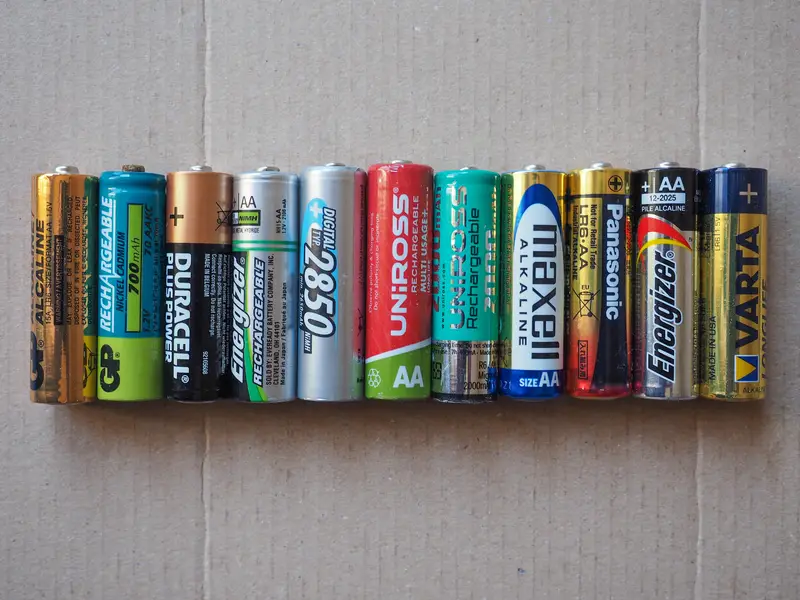
The price spread in a battery aisle makes no sense. A 48-pack of AAs from one brand listed at C$43.05 on Amazon Canada last November while a 24-pack from another, 12 AAs and 12 AAAs together, went for $9.99 in the US, and neither figure tells you which cells will still be holding voltage in your camera flash next spring. Humans get through billions of alkaline batteries a year, and most of that buying is done on the logo alone.
The logo is the one shortcut that does not work. Performance tracks chemistry far more closely than branding: carbon zinc cells perform poorly across the board, alkalines handle high-drain devices better, and lithium wins in every category if you can stomach the price. That is how a single brand ends up selling one genuinely excellent cell and one worthless one under the same name and the same font.
A handful of names, though, deserve a flat refusal whatever the sticker says. The worst of them is not a store brand or a bargain-bin alkaline. It is UltraFire. The list below starts there and climbs, ending with the three brands worth your money.
10. UltraFire
UltraFire is a Chinese brand so tightly bound up with poor-quality knockoffs that there is no version of it worth recommending. The specifications are the giveaway. Two cells wrapped as UltraFire, measured in a study Battery Bro wrote up, carried ratings of 4200 and 4900 mAh and delivered 757 and 579. UltraFire itself does not sell an 18650 claiming more than 3400 mAh, so those two were fakes of a brand already at the bottom of the barrel. The real ceiling for a mass-produced 18650 is about 3600 mAh.
Inflated numbers are the least of it. Cells sold under this name have been advertised as protected, meaning they carry a circuit that guards against problems like over-discharge, when in fact no such circuit is inside. Worn-out older cells also turn up rewrapped and resold as new. Nothing about the price makes that acceptable.
9. GTF, GTL, TrustFire And Efest
These four sell 14500 lithium-ion cells, which are close enough to AA in size and shape to fool you and nothing like AA electrically. A 14500 runs at a nominal 3.7 volts. A rechargeable NiMH AA is nominally 1.2 volts, and a standard AA is 1.5 volts, lithium AAs included. Much of the 14500 class is either poor or counterfeited so routinely that buying one amounts to the same thing, though some of these firms do turn out serviceable cells, with capacities nowhere near the ratings and steep drop-offs at even the smallest loads.
Missing protection is one major cause of lithium-ion cells catching fire, and in 2021 Amazon barred its third-party sellers from listing standalone 14500 and other cylindrical lithium-ion cells. Industrial CT scanning firm Lumafield put 1,054 lithium-ion cells through its scanners and found 33 with a defect called negative anode overhang. Every single one came from the low-cost or counterfeit category, with knockoff brands defecting at nearly 8%, or one in 13, and the worst of them, bought through Temu, at 15%. None of the 300 brand-name cells from Murata, Samsung and Panasonic carried the defect.
8. Gelivita
Gelivita holds an unusual distinction: it was ranked the worst lithium brand by Project Farm, whose testing found the lithium AAs delivering less than half the capacity of the top lithiums and performing dismally below freezing. The alkaline AAs sit under four stars on Amazon, which is marginal in a market where ratings are massaged in every direction available.
The brand’s overall 3.7-star rating drew a bogus-review flag from Fakespot, the review checker that shut down in July 2025, and one Amazon customer’s review describes receiving 32 batteries dead on arrival. The lithium AAs no longer appear to be sold. A brand this scarce and this badly tested is simply not worth the click.
7. Fuji And Fujitsu
Fujitsu batteries come from FDK, a Fujitsu Group company that traded as Fuji Electrochemical until 2001 and bought two Sanyo battery subsidiaries in 2010. Fuji EnviroMAX is a different outfit, run out of Mahwah, New Jersey. CinemaSound found Fuji’s EnviroMax AA the worst value of any alkaline it tested, at $1.09 an hour, while the Duracell Procell finished in its top ten.
Buyers report a pattern that matters more than any test bench: cells corroding inside devices or still in the packaging after a few months, chemicals leaking out, and shelf life nowhere near the advertised decade. Fujitsu is consistent only in that almost the entire range clusters at the bottom, with the single odd exception of the Fujitsu Universal Power AA, which has low capacity at modest drains but holds up better than the rest of the line at high current. One good cell in a line does not redeem the line.
6. Deleepow
Deleepow’s AA rechargeables are sold on a 3,300 mAh figure. Wirecutter, the New York Times review site, measured them closer to 2,000 mAh, which is the difference between a controller lasting a weekend and a controller dying mid-session. An 8-count with the charger runs $16.99 on Amazon.
Owners describe long charge times followed by short runtimes, and cells that stop holding a charge entirely within months of purchase. The charger is its own irritation: it needs a USB-C cable and arrives without an outlet plug, so the real price is higher than the listing. Rechargeables generally beat alkalines and cost less over their lifetime, which is exactly why buying bad ones is such a waste.
5. VARTA
VARTA is the brand most likely to catch out someone who thinks they are buying carefully. It is old, it is European, and every VARTA battery on Amazon carries good reviews. In 2025 it also managed poor scores across multiple battery chemistries from several testing sources, on top of a long history of inconsistent quality.
Where VARTA holds up is narrow. Longlife AA alkalines test respectably as low-drain cells on performance, endurance and value. Push them into high-drain work and the case falls apart. Gigazine has recorded good results in the past for the High Energy and Industrial lines and for some rechargeables, while the carbon zinc cells were panned, but there is no recent testing to confirm the good lines are still good. Playing the odds means skipping it.
4. Eveready
Eveready coasts on recognition. The Super Heavy Duty line is poorly rated by consumer organisations including CHOICE and Consumer NZ, which is what usually happens to carbon zinc. Eveready Gold alkalines do not fare much better, turning in reasonable numbers only in low-drain jobs like remote controls; Consumer NZ recommends the Gold AAs, but specifically for low-to-moderate drain devices, because high-drain performance and capacity are poor.
Price is what sinks it. Eveready Gold cells run $1.19 to $3 each, against Amazon Basics, Duracell, Energizer Max and Rayovac, which are often far cheaper and better. If all you need is remote-control power, Walmart’s Great Value AAs cost less and land around average once you reach the 1 to 1.5 amp range typical of an LED flashlight, holding mid-pack from there up.
Treat every “Heavy Duty” label as a warning, whoever prints it. Carbon zinc cells are the cheapest thing on the shelf, lose voltage quickly under load, and leak more often once expired. For smoke detectors, carbon monoxide detectors and emergency radios, alkaline is the chemistry you want.
3. Rayovac
Rayovac reads like a relic, and the numbers say otherwise. Its carbon zinc cells were everywhere for decades and were never much good, but they perform at least as well as anyone else’s carbon zinc, which is the fairest thing you can say about that chemistry. Nothing in the range tests badly for the technology it uses.
The Fusion alkaline line is the reason to bother. Rayovac Fusion AA alkalines test very well, and Rayovac itself is owned by Energizer, one of the two brands that actually deserve their shelf space. It is the value play here: name-brand engineering without the name-brand markup.
2. Energizer
Energizer Max is recommended by Consumer NZ and was CNET’s pick for best AA alkaline battery. That is about as clean a consensus as this category produces, and the brand is on every shelf in America, which matters when you need four AAs at 9pm.
Two things keep it off the top. The alkalines have consistently subpar high-drain performance, and Energizer is among the most expensive major brands. The Ultimate lithium AAs are the ones everyone agrees are excellent, rated extremely well by buyers at big box hardware stores, and they cost $1.85 to $3.50 each depending on quantity. Lithium will nearly always outrun alkaline and carbon zinc. You pay for the privilege.
1. Duracell
Duracell wins on consistency, which is the only thing worth buying a battery brand for. The alkaline AAs test well rather than spectacularly, but there is more independent testing data on Duracell than on almost any competitor, and it shows the brand outperforming most of the field: good capacity, strong shelf life, and superior sub-freezing performance.
The Coppertop line is excellent in low-drain devices and slightly better than Energizer in high-drain ones, which settles the argument between the two for most households. Nothing in the range is a trap, and that is rarer than it sounds in a market where the same badge covers a good alkaline and a useless carbon zinc.
Buy Duracell if you want to stop thinking about it. Buy Amazon Basics or Rayovac Fusion if you want most of that performance for less. And treat any unfamiliar brand, any impossible capacity claim and any price far below the real thing as the same piece of information: UL’s own guidance notes that counterfeiters copy a major brand’s logo and typeface and change a letter or two, and that fakes leave out the safety mechanisms a real cell is built around. U.S. Customs and Border Protection seized nearly 32 million counterfeit items in fiscal 2024. Some of them are sitting in a battery aisle somewhere.

