

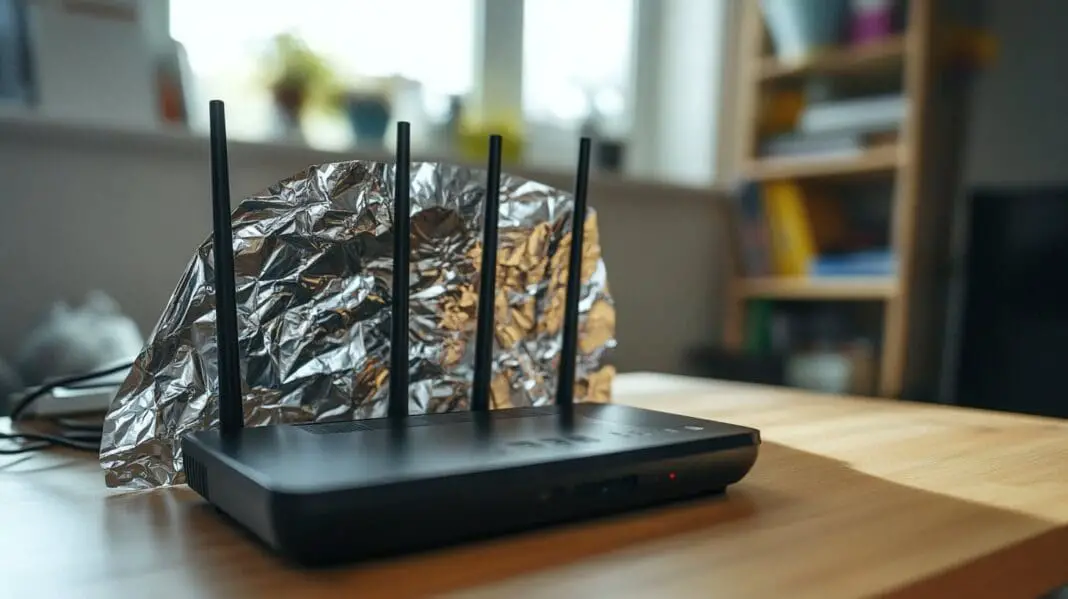
You ever walk into your back bedroom, watch your phone drop from full bars to one sad little flicker, and seriously consider throwing it across the room? Same. So when I first heard that people were bending kitchen foil into a little curved wall and propping it up behind their WiFi router, I rolled my eyes hard enough to strain something. It sounded like one of those tricks your weird uncle swears by right before he tells you about gas station coupons. But here’s the part that shut me up fast. There’s real science behind it. Like, university-lab, peer-reviewed, actual-numbers science. Let me walk you through why your neighbors might be doing arts and crafts with Reynolds Wrap.
It Started In a College Lab, Not a Reddit Thread
Back in 2017, computer scientists at Dartmouth College built a system they named WiPrint. The official project was called Customizing Indoor Wireless Coverage, and the idea was simple but clever. They wrote software that studied the shape of a room, figured out exactly where you wanted your signal to go, and then designed a custom reflector. They 3D-printed that shape and covered it in plain aluminum foil. The results were not small. The reflector could push signal in your target direction by as much as 55 percent while cutting it by around 63 percent in directions you didn’t care about.
The kicker came from lead researcher Xia Zhou, who said that for about $35 in materials, you could build a reflector that outperformed antennas that cost thousands of dollars. Read that again. Thirty-five bucks beating gear that costs more than your couch. That study got picked up everywhere, and that’s the spark behind every viral foil video you’ve scrolled past since.
Your Router Is Basically a Lawn Sprinkler
Here’s the thing most people never realize. Your standard home router blasts signal out in every direction at the exact same time. One expert described it as a sprinkler head spraying water everywhere it can reach. Sounds great until you do the math. Half of that signal is going into your walls, out through your windows, and straight into your neighbor’s living room where it does you absolutely no good.
My favorite way to picture it is a flashlight versus a laser pointer. A bare router is a flashlight, throwing light all over the room with no aim. Foil bent into a curve turns it more into a focused beam, sending the energy where you actually want it. That curved shape is doing the same job as the mirror behind your car’s headlight or the dish on a satellite. It’s catching waves that would scatter uselessly and bouncing them forward. Aluminum is great at this because it reflects roughly 95 percent of the radio waves your router uses on both the 2.4GHz and 5GHz bands.
The Real-World Numbers Are Wilder Than You’d Guess
Okay, lab results are nice, but does it work in a normal house with normal foil and zero PhD involved? One writer actually tested it and posted the receipts. With the foil in place, their download speed jumped by over 200 Mbps, which worked out to about a 58 percent boost. Upload crept up about 3 percent. Now, it wasn’t all sunshine. Their ping got 12 milliseconds worse, and they admitted they didn’t feel a night-and-day difference during a normal workday. But the speed gain itself was real and measurable, not imaginary.
Another tech site ran a 30-day experiment with a TP-Link router in an 1,800 square foot home, tracking the signal with an analyzer app and testing three different foil shapes. Their takeaway matched the lab. Regular kitchen foil got results in the same ballpark as the fancy 3D-printed versions, for pennies. That’s the part that gets people excited. You probably already have the only ingredient sitting in a drawer next to your trash bags.
There’s a Sneaky Security Reason Too
This one I did not see coming. When your signal sprays in every direction, it’s also spraying out past your walls where strangers can pick it up. By aiming the beam inward and choking off the part that leaks out the back, the foil shrinks the area where someone parked outside could even reach your network. The Dartmouth team called this physically confining the signal, and they framed it as a bonus layer on top of your password and encryption.
Think about it on a practical level. That foil wall blocks signal from drifting into your neighbor’s place, which means nobody’s quietly leeching your bandwidth while you’re trying to stream the game. It won’t replace a strong password, and you should still have one. But it raises the barrier for anyone trying to snoop, and a free side benefit is a free side benefit.
Here’s the Catch Nobody Mentions
Now let me be the honest friend here, because the viral videos always skip this part. The Dartmouth researchers did not crumple up a sheet of Reynolds Wrap and call it a day. They used precisely shaped reflectors designed by an algorithm and printed in a lab. Your hand-bent kitchen version is a crude imitation of that. Shape matters a ton, and most home testers report gains in the 10 to 20 percent range, not the dramatic lab numbers. Still helpful, just not magic.
Two more things. First, foil does not add power to your router. It just takes the energy that’s already there and points it. So you get stronger signal in front and weaker behind, period. There’s no free boost in total juice, partly because the FCC caps how much power a router can throw in any one direction anyway. One researcher said he couldn’t officially recommend it mostly for regulatory reasons. Second, and this is the big one, do NOT wrap your whole router in foil like a baked potato. Foil traps heat, your router runs hot, and you can shorten its life or tank its speed. Reflector behind it, yes. Foil cocoon, absolutely not.
How To Actually Do It the Right Way
If you want to try it, it takes about two minutes. Unplug the router first. Cut a sheet of foil roughly 8 to 12 inches long and about as tall as your router. If your router has antennas sticking up, let the foil reach a couple inches above them. Then bend it into a gentle C-shaped curve, with the shiny side facing inward toward the router.
Stand it up behind the router so the open part of the curve points toward the room with the bad signal. If it won’t stay upright, fold the bottom edge to make a little base or tape it to a piece of cardboard. That’s literally it. If you want to get nerdy, download a free WiFi analyzer app and watch your signal numbers while you nudge the foil around. Small adjustments can make a real difference, so play with the angle until the room you care about lights up.
A Cut-Open Soda Can Works Too
Fun fact that ties the whole thing together. The original Dartmouth experiments were inspired by an even older trick of sticking an aluminum can behind a router to push the signal away from a deadening wall. So if you’ve got an empty soda can, you can cut it open, flatten the curve a bit, and use that as a tidier reflector. Some people even 3D-print a small dish shape and cover it in foil if they want it to look less like a science fair project on their TV stand. The metal is what does the work. The packaging is just preference.
So Should You Bother?
Here’s my honest read. This trick is not going to save you if your internet plan is slow or your router is a decade old. Foil can’t manufacture speed you’re not paying for. But if your signal is solid in some rooms and garbage in one specific spot, this is a genuinely smart, free experiment. The worst case is you waste two minutes and a foot of foil. The best case is you finally get a real connection in the back bedroom without buying a mesh system. For something sitting in your kitchen right now, that’s a pretty wild little hack. Go aim your sprinkler.

