

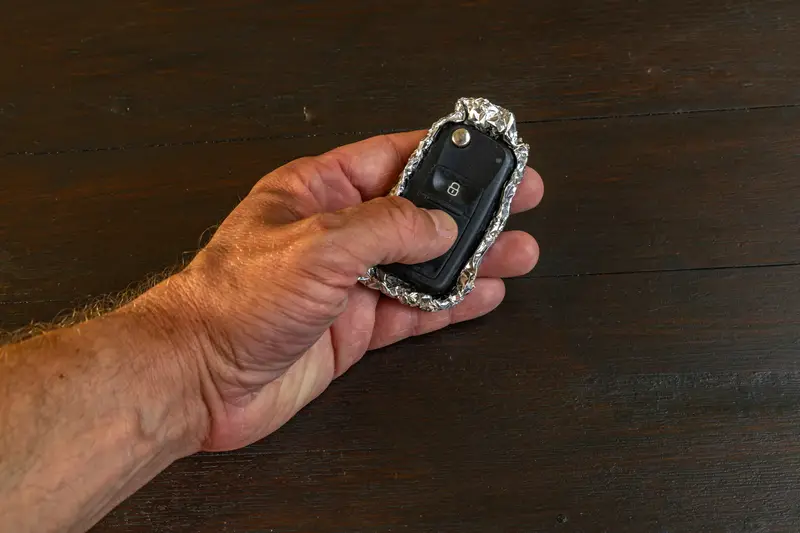
The first time a buddy told me to wrap my car keys in aluminum foil, I laughed at him. It sounded like the kind of advice you get from a guy who also lines his hat with foil. But he wasn’t joking, and after I went down the rabbit hole, I felt a little dumb for laughing. It turns out a strip of the same stuff you use to cover leftover lasagna can genuinely throw a wrench in one of the fastest car thefts happening in American driveways right now.
And the wild part is that the thieves never touch your car until the very last second. No crowbar, no smashed window, no jiggling a coat hanger in the door. Just two people, a couple of cheap gadgets, and your keys sitting innocently on the kitchen counter. Let me explain why this works, because once you understand it, the foil thing stops sounding crazy.
The Theft That Leaves No Broken Glass
If your car has a push-button start or unlocks when the fob is just near the door, the key is basically chatting with your car all the time. It quietly broadcasts a short-range radio signal so the car knows you’re close. Thieves figured out how to cheat that conversation with something called a relay attack. One person stands near your house with a signal booster, grabs the faint signal from your key sitting inside, and passes it along to a second person standing by your car. The car thinks the key is right there in your pocket. The door pops. The engine starts. They drive off.
The numbers behind this are not small. More than 1 million vehicles were reported stolen in the United States in a single recent year, and the head of the National Insurance Crime Bureau flat out said criminals are using more sophisticated methods than ever. What gets me is the range. The boosted signal can reach 33 to 49 feet into your home, which is plenty to wake up a key sitting on a table just inside the front door.
Why a Sheet of Foil Actually Does Something
Here’s the part that surprised me most. The foil trick is real science, and it dates back to the 1800s. A physicist named Michael Faraday discovered that a metal enclosure blocks electromagnetic fields from passing through it. We call it a Faraday cage now, and your microwave door, that little mesh window, is one too. That’s why your phone signal dies when you stick it in there.
Aluminum happens to be a great electrical conductor. When the radio waves from your key hit the foil, they generate electrical currents that run along the outside of the metal instead of pushing through to the key inside. Some waves bounce back, and the rest get canceled out, turning into a tiny bit of harmless heat. The folks who broke down the actual physics of this note that two or three layers usually do the job. Wrap the fob completely, fold the edges, and the key basically goes mute. It can’t hear the car, and the car can’t hear it. No signal for a thief to steal.
Somebody Actually Tested It on Three Cars
I didn’t want to just trust internet wisdom, and luckily someone did the homework. A real-world test wrapped key fobs from three different cars in foil to see what happened. The results were honestly kind of fun to read. A Toyota fob wrapped in foil couldn’t reach the car even sitting inches away. Total blackout. A Mazda fob quit working from just a few feet out.
The Subaru was the interesting one. Wrapped up, it couldn’t reach the car from 20 feet away, but it still worked from 10 feet. So the foil weakened the signal a lot but didn’t completely kill it on that model. The takeaway from that hands-on testing was clear: foil cuts the signal strength way down, but how well it works depends on your car’s make and how carefully you wrapped the thing. For relay thieves who need to grab your signal from outside the house, even cutting the range that much can be the difference between losing your car and keeping it.
The Thieves’ Gear Costs About as Much as Lunch
You’d assume the equipment for this kind of high-tech heist would cost a fortune. Nope. Some relay devices, including ones capable of breaking into a Tesla, sell online for as little as $20. Twenty bucks. That’s the whole barrier between a thief and your $40,000 SUV.
And these attacks really do work on most cars on the road. Germany’s largest auto club has been running ongoing relay tests, and after checking more than 800 vehicles, only around 15% were properly protected against this method. That means 85% could be opened and driven away with cheap signal gear. One security expert pointed out that the problem is only getting worse because there are now more ways into a car than ever, from the fob to online connections to phone-based keys. More doors mean more ways to slip inside.
Foil Is a Starter Move, Not the Final Answer
Now let me be straight with you, because I’m not here to sell you on something that’s perfect. Foil has real downsides. It tears. It looks ridiculous in your pocket. And you have to unwrap and rewrap it every single time you grab your keys, which gets old by about day two. Lab testing also found that even triple-layered foil only blocks roughly 22 to 34 decibels of signal, while the benchmark to reliably stop a relay attack is around 60 decibels. The foil also degrades the more you handle it.
That’s why most locksmiths treat foil as the free thing you do tonight while you order something better. The upgrade is a Faraday pouch, a little fabric case lined with conductive material made specifically for key fobs. They last for years, you just drop the keys in and snap it shut, and there’s nothing to rewrap. Basic ones start at just a few dollars, and the certified, heavy-duty versions run about $30 to $50. The comparison testing I read crowned the certified pouches as the only consumer option that hit that 60-decibel mark consistently. Foil gets you protection right now. A pouch gets you protection you’ll actually stick with.
Your Kitchen Has a Backup You Already Own
If you can’t stand the idea of wrapping and unwrapping foil at home, there’s an even lazier hack that works. Toss your keys in an old metal coffee can when you walk in the door. The metal acts as a makeshift Faraday cage, the same as the foil, except you’re just dropping the keys in a tin and walking away. A metal box or even a sturdy cookie tin does the trick too.
One more thing that costs nothing: where you keep your keys matters a ton. That boosted relay signal can only reach so far, so storing your keys near the front door, a window, or an exterior wall is basically handing thieves the easy version of the job. Push them toward the center of your home instead. The coffee can tip plus smart key placement gives you two free layers of protection before you spend a dime.
The Cars Sitting at the Top of the Hit List
Some cars get hammered way more than others. The Hyundai Elantra is a magnet for thieves, with 11,329 stolen in just the first half of one recent year, putting it over 2,000 ahead of the next car on the list. Older Hyundais and Kias from before the 2022 and 2023 model years are especially easy targets because many lacked proper immobilizers.
But it’s not just budget cars. Tesla’s Model 3 and Model Y have been proven vulnerable to Bluetooth-based relay attacks, letting thieves drive off in seconds unless the owner turns on extra security like a PIN to drive. American pickups like the Chevy Silverado and Ford F-150 are targeted too, along with newer push-button versions of the Toyota Camry, Honda Accord, Honda Civic, and Dodge Charger. The list of cars worth protecting is basically anything with keyless entry. If your fob unlocks the door without you pressing a button, you’re on it.
The 30-Second Test to See If It’s Working
Don’t just assume your foil or your new pouch is blocking the signal. Test it, because it takes half a minute. Wrap or pouch your key, then walk up to your car and try the door handle. If it unlocks, your shield failed and you’ve got a gap somewhere. A tougher version: stand right next to the car and try pressing the unlock button through the wrapping. If the car responds at all, the signal is leaking. A police department in England actually recommends this exact walk-up test, and it works the same whether you’re using foil or a fancy case.
Here’s a bonus nobody mentions. When your key is properly blocked, it stops constantly broadcasting, which actually saves a little battery life on the fob compared to leaving it near the car where it chatters all day. The people who sell these pouches point that out, and it tracks. So you protect your car and squeeze a few more months out of that annoying little fob battery. Not a bad trade for a strip of foil from the drawer.
I started out thinking the foil thing was tinfoil-hat nonsense. Now my keys go in a pouch the second I walk in the door, and on trips where I forget it, yeah, I’ve wrapped them in foil at a gas station like a weirdo. Cheap, fast, and a whole lot less painful than filing a stolen car report. Try the test tonight and see for yourself.

