

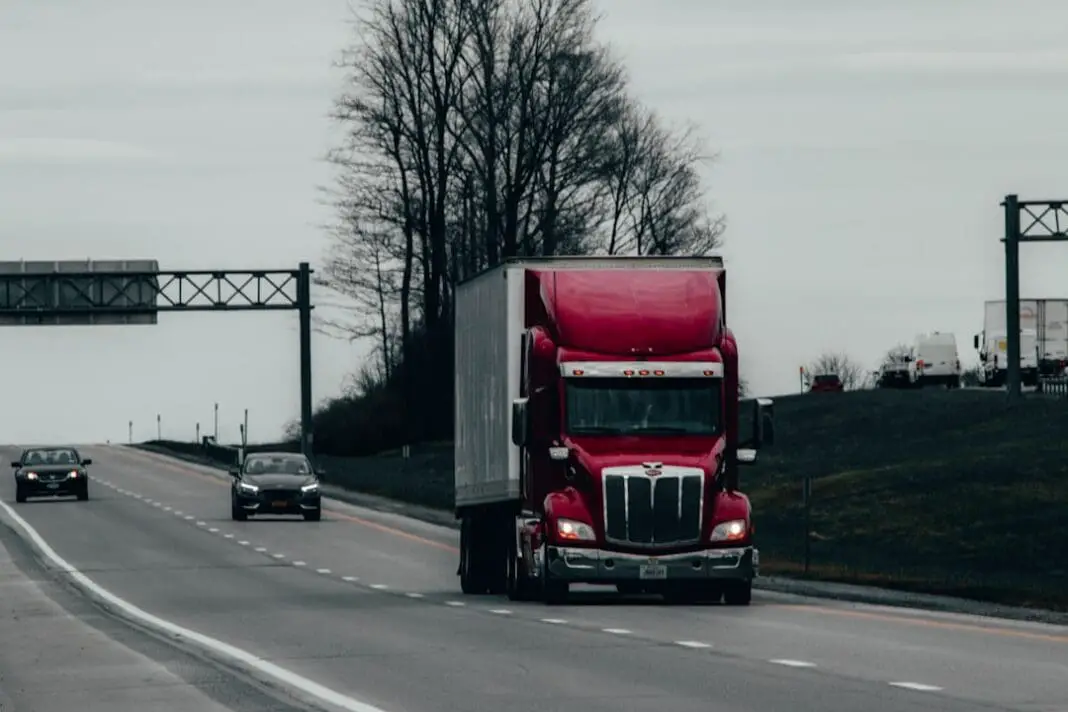
Here’s something I think about every time I’m stuck behind an 18-wheeler on the interstate: that driver knows things I don’t. They’re sitting way up high, they’ve been on this road since 4 a.m., and they’re quietly talking to other trucks in a language most of us never learned. Flashes, taps, hand waves, weird turns. It all means something. And once you know what they’re saying, driving on the highway feels a little less like guesswork and a lot more like being let in on a secret club.
So let’s go through the stuff truckers actually do out there, why they do it, and how you should react. Some of this surprised me, and I’ve been driving for years.
When a truck swings left to turn right, it’s not lost
This one trips up new drivers constantly. You’re sitting at a light, a semi is in front of you, and suddenly it drifts to the left like it’s changing lanes. Your instinct? Sneak into the gap it just opened on the right. Do not do that. When a big rig pulls left before a right turn, it’s making room for the back end of that long trailer to clear the corner. If you slip up the right side, you’ve just parked your car exactly where the trailer is about to swing.
Truckers signal these turns way earlier than the rest of us, too. A lot of rigs don’t even have the automatic blinker shut-off that your car has, so the driver is manually flipping it on and off. According to the folks at Bay and Bay, an early signal from a truck is your cue to back off and give them the whole corner. The federal government agrees, and we’ll get to that.
The double headlight flash that says cops ahead
This is the most famous one, and it’s real. If a truck coming the other direction flashes its headlights at you twice, slow down. There’s a good chance there’s a speed trap up ahead, an officer parked with a radar gun, or some other reason to ease off the gas. Truckers have been doing this for decades, and it crosses over from the CB radio world where the old phrase was “brush your teeth and comb your hair,” meaning straighten up because someone’s watching.
Now here’s the part people argue about: is warning other drivers about police even legal? In 2014, a Missouri man got ticketed for flashing his lights to warn oncoming cars, and a U.S. District judge tossed the ticket out. The court basically said a quick flash is a form of speech. So that little courtesy blink has actually been tested in a real courtroom, and it held up.
Why truckers see trouble before you do
A flash from a truck ahead of you doesn’t only mean police. It can mean an accident, a stalled car, road debris, or traffic backing up around a curve you can’t see yet. The reason truckers are so good at spotting this stuff early is simple. They sit much higher than you do, so they can see way down the road and over the cars in front of them.
On top of the better view, a lot of them are chatting on CB radio, swapping live updates about what’s going on miles ahead. So when a trucker gives you a heads-up, they might be working with information you have no access to. The smart move, according to drivers in the business, is to treat any flash as a reason to lift your foot, scan the road, and figure out what they’re seeing that you aren’t.
The flash that helps a truck change lanes
This is the trucker signal I wish more regular drivers knew, because it makes everyone’s life easier. When a semi puts on its blinker to merge into your lane, you can flash your headlights once or twice to tell them, “Go ahead, you’ve got room.” It’s basically the road version of waving someone in at a four-way stop.
There’s a second half to this trade. After you pass a truck and you’re fully clear of it, a flash from the truck behind you means it’s safe for you to move back over into their lane. Some truckers even flash to thank you. It’s a two-way conversation, and once you start participating, you’ll notice truckers driving a lot more smoothly around you. One tip from trucking communication guides: use a quick on-off tap, not your high beams blasting full strength.
Sometimes that flash is a scolding
Now for the flip side, because not every flash is friendly. If you just cut a truck off, merged without signaling, tailgated, or did something sketchy, those flashing lights might be the trucker telling you to knock it off. There’s no official rulebook here. The meaning depends entirely on the situation and what you just did behind the wheel.
One thing worth knowing: truck high beams are far more powerful than the ones in your car. The team at Mortons on the Move points out that during the day a bright flash won’t bother anyone, but at night a full blast of truck high beams can briefly blind an oncoming driver. That’s exactly why the good truckers keep it to a soft, quick flick. If you get a flash and you genuinely have no idea why, do a quick mental check of your own driving before you assume they’re just being rude.
The horn tap that means you’ve vanished
If a trucker gives you a short toot of the horn and you’re driving right next to their trailer, they’re not being a jerk. They might be telling you that you’re sitting in a spot where they literally cannot see you. Semis have huge blind spots, and they’re bigger than most people think. The worst ones are along the entire right side, directly behind the trailer, and right in front of the cab.
Here’s the number that stopped me cold: blind spots play a part in nearly one-third of all big truck crashes, according to federal data cited by the Driver Resource Center. And that old saying about how if you can see the truck’s mirrors, the driver can see you? Only partly true. Linger beside that trailer and you can be totally invisible. Pass on the left, do it quickly, and never hang out in the no-zone. A horn tap might be your only warning that you’re a ghost to them.
The old-school arm signals that still hold up in court
Before electric blinkers existed, every driver, truckers included, talked with their arms out the window. And get this: those hand signals are still legally required in plenty of states if your turn signals or brake lights are broken. Three basics: left arm straight out means left turn. Left arm bent up at the elbow means right turn. Left arm pointed down with your palm back means stopping or slowing.
There’s a fun bit of history here. The very first signal lights back in 1907 were actually shaped like hands, because drivers were so used to seeing arm gestures that a glowing hand just made sense. The folks at Road Legends note these signals work as a backup when your lights die, and learning to read them from other drivers matters just as much as making them yourself.
Bears, gators, and the fist pump every kid loves
Truckers have a whole secret vocabulary that explains why they signal the way they do. A “bear” is a cop, usually a state trooper. A “bear in the bushes” is one hiding with a radar gun. A “plain wrapper” is an unmarked police car. A “gator” is one of those big chunks of blown tire tread lying in the road, and a “black eye” means a vehicle with a headlight burned out. When a trucker flashes or taps the brakes, they’re often warning about exactly these things.
And then there’s the best signal of all, the one you probably did as a kid. Pump your fist up and down as a truck rolls by, and most drivers will blast that big air horn for you. According to trucker culture guides, it’s a tradition they love honoring, especially for children. Just be sure the driver isn’t busy with a tricky merge when you do it.
What the government actually wants you to do
All these signals point to the same handful of rules. The Federal Motor Carrier Safety Administration boils it down for car drivers in a short list, and a few items stand out. When a truck signals a turn, back off right away and let it have the space. After you pass a rig, don’t pull back in front until you can see the whole truck in your mirror, because they need way more room to stop than you do.
The official guidance also says to stay out of those blind spots, pass only on the left, and be patient because trucks cannot dodge trouble the way a small car can. Truckers are some of the most careful drivers out there, and they’ve built this whole system of flashes, taps, and codes for one reason: to keep everyone on the road in one piece. Learn to read it, flash back when they merge, and you’ll suddenly feel like part of the conversation instead of just another car in the way.

