

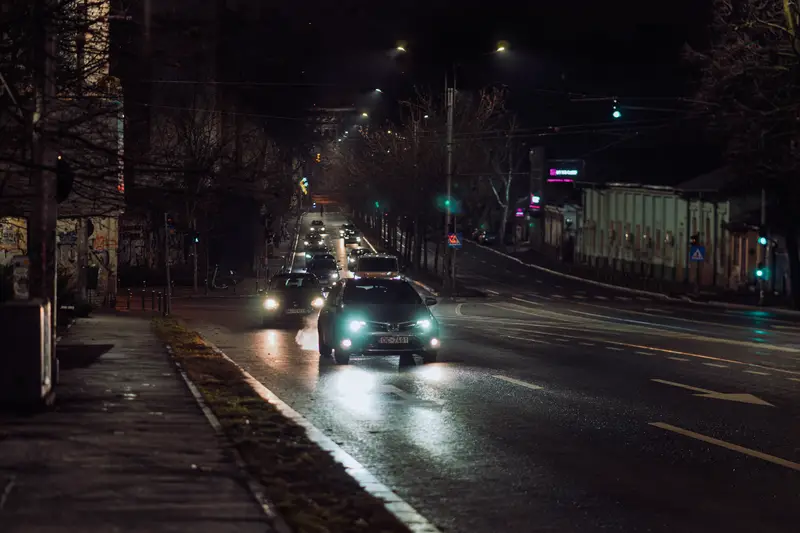
A driver coming the other way blinks their headlights at you. Two quick flashes, then they are gone. Your first instinct might be to get irritated, or to flash right back. Don’t. That little signal almost always means something specific, and most of the time the stranger behind those lights is trying to do you a favor.
At night, the single most common reason someone flashes you is your own high beams. They are on, and you have no idea. What you do in the next few seconds depends on where the flash came from, what time it is, and whether the other driver seems friendly or furious. Get the read wrong and you can turn a helpful heads-up into a fight on the interstate.
Check Your Own Headlights First
State driving manuals differ on this, and several do not endorse flashing at all. California’s tells you the opposite: when someone’s lights are dazzling you, look toward the right edge of your lane, and do not answer them by leaving your own high beams on. Even so, at night your own brights are the prime suspect. If two or three drivers flash you in a row, it is nearly a sure thing that your high beams are up when they should be down.
Glance at your dashboard. The high-beam telltale is a little headlight symbol, usually blue, though US rules also allow green. If it is lit, click them off. If you are certain your low beams are set and drivers keep flashing anyway, your headlights may be aimed too high. That is a quick fix at a mechanic, and worth doing before you blind a dozen more people.
A Flash From Behind Usually Means Move Over
If the flashing is coming from a car riding your bumper, the message changes completely. A driver tailgating you and blinking their lights is almost certainly telling you to speed up or get out of the way. It feels rude, and honestly it often is. But there is a right way to handle it.
Move to the right lane only when you can do it safely. Do not stomp the gas to satisfy someone tailgating you, and do not brake-check them to teach a lesson. Once they blow past, let it go. Trying to get even is how a two-second annoyance becomes a police report.
Something Might Be Falling Off Your Car
Here is one people forget. A flash can mean there is a problem with your vehicle that you cannot see from the driver’s seat. A tire going flat, a trunk that popped open, a trailer coming loose, or something dragging under the car and throwing sparks.
If you cannot figure out why someone flashed you and everything on your dash looks normal, find a safe spot to pull over and walk around the car. Thirty seconds in a gas station parking lot beats losing a wheel at 70 miles an hour because you assumed the other driver was just being nosy.
Yes, It Is Often a Speed Trap Warning
The most classic American use of the headlight flash is the cop warning. An oncoming driver who just passed a patrol car or a speed camera flashes you as a friendly tip to ease off the gas. It is one of the oldest unwritten courtesies on the road.
Treat it as a reason to check your speed. And if you come up on an officer who already has someone pulled over on the shoulder, slow down and move over a lane if you can. Every state and the District of Columbia has a Move Over law, and failing to give police space on the roadside can land you a serious ticket.
Warning Others About Cops Is Legal in More Places Than You Think
People assume flashing to warn about a speed trap is against the law. In much of the country, courts have said the opposite. Judges have repeatedly ruled that a headlight flash is a form of speech protected by the First Amendment.
In 1999 a New Jersey appellate panel ruled, in an unpublished decision, that flashing to warn of a speed trap is not a misuse of headlamps under state law, though it did not reach the free speech question. A Tennessee judge did reach it in 2003, clearing a Franklin driver in State v. Walker on First Amendment grounds, and an Oregon justice court came to a similar conclusion in 2014 under that state’s own free expression clause. The oldest case is the starkest. In 1976 an Ohio driver named Wallace Wason was convicted of interfering with an officer after flashing his lights to warn oncoming cars about the officer who had just ticketed him. An appeals court threw the conviction out, finding he had not stopped anyone from writing tickets. And in 2014 a federal judge ordered police in Ellisville, Missouri to stop citing drivers for the warning flash altogether.
That does not mean anything goes. Michigan and California both require you to dim your high beams within 500 feet of an oncoming vehicle, and within 300 feet of one you are following, so the glare does not reach the other driver’s eyes. Neither law bans the flash itself, and California’s rule is not limited to multi-lane highways. Penalties in the cases above have run anywhere from ten dollars to a thousand. The real risk is blinding someone head-on, not the free-speech part.
When the Flash Is Actually Road Rage
Sometimes the flash is not a warning at all. It is a threat. Read it alongside the rest of the picture: obscene gestures, yelling out the window, a car that will not leave your bumper. And angry drivers are everywhere. In a survey run in 2014 and published by the AAA Foundation for Traffic Safety in 2016, 78 percent of drivers said they had done at least one aggressive thing behind the wheel in the previous year.
The move here is to give them nothing. Do not flash back, do not honk in anger, do not stare, do not make a gesture. Even something you think is minor can read as a challenge to someone already boiling. Ease off the accelerator, leave more room, and let the vehicle move ahead of you.
If you think you are being followed, do not drive home. Head for a busy, well-lit place instead: a police station, a fire department, or a packed grocery store parking lot. Call 911 if you feel unsafe, and stay in your car. The smartest response to an aggressive flasher is not to win the exchange. It is to put distance between you and get home in one piece.
How to Handle Headlights That Blind You
Whether they are flashing you on purpose or just riding around with their brights stuck on, blinding light coming your way is dangerous. NHTSA analysis has put the fatal crash rate at night at roughly three times the daytime rate, and the National Safety Council notes that half of traffic deaths happen after dark even though only a quarter of driving does. Bright glare makes it worse.
Do not look straight at the lights coming toward you. That glare sticks in your vision even after the car has passed. Instead, aim your eyes at the right edge of your lane so you can hold your line without staring into the burn. And never flip your own high beams on to punish them. Blinding the other driver back just doubles the danger.
When the glare is coming from behind, reach up and flip your rearview mirror to the night setting, that little tab at the bottom of the mirror. It knocks the reflection down so the light stops bouncing into your eyes. Then get some space between you and the car by slowing gently, turning off, or letting them pass.
The Signal Nobody Actually Agrees On
The reason all of this gets confusing is that the flash has no fixed meaning. The same blink can mean the other driver is yielding to you or that they intend to keep coming, and there is no reliable way to tell which. A flash while someone is slowing down usually reads as go ahead and merge. The same flash while they hold their speed reads as stay back, I am not letting you in. Two opposite messages, one gesture.
Geography changes it too. In North America the flash usually points to police or high beams. In Europe it often means I am about to pass you. In Australia it can carry any of those meanings, or you go first at a junction, though a wave is the far more common thank you there. The pattern matters as well: a single quick blink tends to be a greeting, while a long, steady glare of the brights leans aggressive.
Car makers even have a name for it. Some owner’s manuals call the flash the optical horn, a translation of the German Lichthupe, because it grabs attention the way a horn does. Moving the beam selector from a floor button to the steering column made it easy: you could flick your brights with the stalk instead of hunting with your foot. That small design change turned headlights into a language, one we all sort of speak and constantly misunderstand.
So the next time you catch a flash in your windshield, run the quick checklist. Nighttime and oncoming? Check your brights. Coming from behind? Move over when it is safe. Broad daylight? Watch for a cop or a hazard ahead, and take a second to make sure nothing is falling off your car. Do all that and stay calm, and you will almost always read the message right.

