

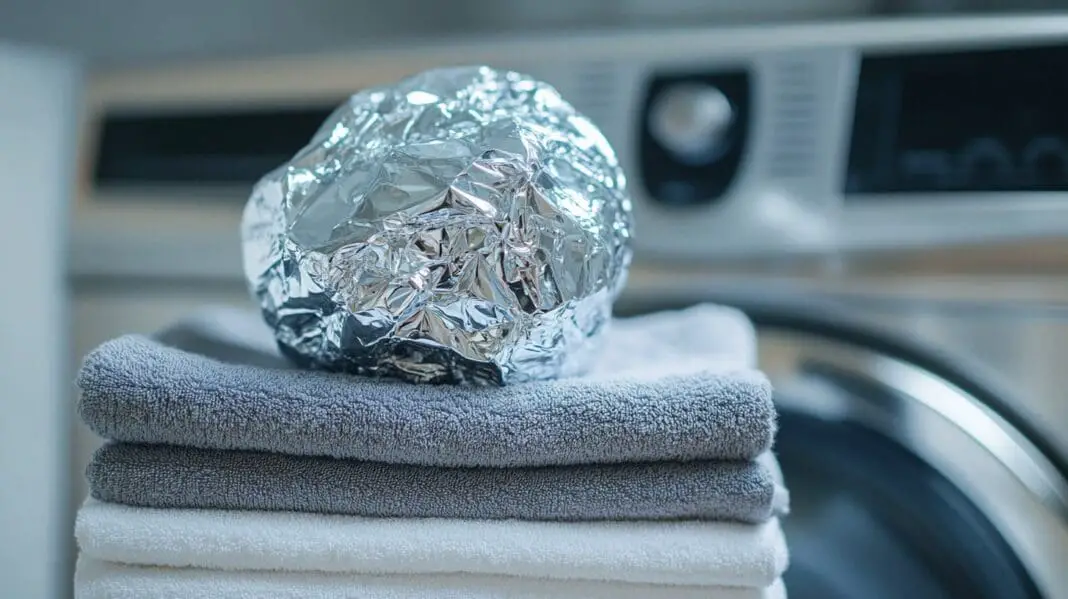
Here is a laundry trick that sounds fake but actually works. Grab a sheet of aluminum foil from that drawer you have had since you moved in, crumple it into a tight ball, and throw it into your dryer with the wet clothes. That is the whole thing. No gadget. No monthly subscription. Just a wad of foil bouncing around with your socks and t-shirts.
I will be honest, the first time I heard this I rolled my eyes. It smelled like one of those social media tips that works for exactly one person on camera and nobody else. But this one has real science behind it, and Reader’s Digest actually put it to the test. Once you understand why it works, you will wonder why you ever paid for a box of dryer sheets.
Why static cling happens in the first place
You know that shock you get when a fitted sheet grabs a bath towel and refuses to let go? That is basic physics happening inside your machine. When your clothes tumble around in a hot, dry drum, they rub against each other constantly. That rubbing shuffles tiny electric charges from one item to another. Some pieces end up positively charged, others end up negatively charged, and opposites stick together like magnets when the cycle ends.
Here is the surprising part. Static is way worse in the winter. Cold, dry air holds less moisture, and moisture is what normally lets those charges leak away harmlessly. So the same dryer that behaves fine in July suddenly turns your laundry into a crackling mess in January. If your clothes only cling in the cold months, you are not imagining it, and the foil trick is especially handy then.
Why a ball of foil actually fixes it
Aluminum is a metal, and metal is a conductor. That is the entire secret. As your clothes build up all that electric charge, the foil ball rolls through the pile and quietly pulls the charge off. Instead of the static staying trapped in your shirts, it gets discharged safely into the metal. No more clinging, no more little zaps when you fold.
What I like about this is how different it is from a dryer sheet. A dryer sheet fights static by smearing a thin, waxy layer of softening chemicals over every fiber so they slide past each other. The foil does not coat anything. It just neutralizes the charge and leaves nothing behind. There is a small bonus too. A hard ball tumbling through the load helps keep pieces separated, which lets air move better and can speed up drying a bit. One thing to set your expectations on: foil kills static, but it will not soften clothes the way a sheet does.
How to make one that won’t wreck your clothes
This takes about ten seconds. Tear off a sheet of regular foil, roughly the size of a piece of printer paper, and crush it into a tight ball somewhere between two and three inches across, about the size of a tennis ball. The word tight matters. You want to press down every sharp point and loose flap so the surface is smooth. A jagged ball can snag or scratch fabric, and that defeats the whole purpose.
Roll it firmly between your palms until it feels solid, almost like a little metal marble. If you notice tiny bits of foil flaking off, you rolled it too loosely, so crumple it tighter or start over. The folks who do this a lot recommend making a smooth, packed ball every time, no shortcuts. Store-brand or dollar-store foil works exactly as well as the name-brand stuff, which keeps the cost near zero.
One ball or three? People genuinely argue about this
This is where the internet splits into two camps, and it is more interesting than it has any right to be. Most sources tell you to use two, three, or even four balls per load so the static gets pulled evenly from every corner of the drum. Bigger or extra-clingy loads might call for five or six. That is the standard advice, and plenty of people swear by it.
Then there is one detailed contrarian take that says use only one. The argument goes like this. The tiny air pockets created when you crumple foil are what actually collect the charge. If you toss in two balls and they bang into each other mid-cycle, they can dump all that collected static right back into your clothes, which is the opposite of what you want. According to this thinking, a single ball works better than a handful. I have not seen a lab settle it, so my honest advice is to try one, and only add a second if you are still getting cling.
The same foil ball can last for months
This is the fact that sold me. A dryer sheet is a one-and-done deal. You use it once and toss it in the trash. A foil ball keeps working load after load after load. Some people report a single ball lasting anywhere from 30 to 60 trips through the dryer before it needs replacing.
Even better, it improves as it ages. Every cycle presses it a little tighter, so it gets smoother and shinier over time. One writer who has used them for a while says the same three balls stuck around for several months. When a ball finally starts crumbling or shrinks down to about an inch, drop it in the recycling bin and roll a fresh one. Do the math on that against a box of dryer sheets and it stops being close.
Gas or electric dryer, it does not care
People ask this one a lot, and the answer is refreshingly simple. It does not matter what powers your dryer. The heat source has nothing to do with why the trick works, because the foil is dealing with electric charge, not the flame or the coil. A conductor is a conductor whether the drum is warmed by gas or electricity.
So a foil ball performs just as well in a gas dryer as it does in an electric one. Same trick, same result, no adjustments needed. That is nice to know if you have ever wondered whether a hack from a video was tested on a machine anything like yours.
It plays nice with wool dryer balls too
A lot of people already switched to those fuzzy wool dryer balls, which are great for softening and cutting down dry time. The catch is that wool balls alone do not always beat static, and folks get frustrated when their laundry still crackles after the upgrade.
Good news: you do not have to pick one. Toss a foil ball in alongside your wool ones and let them all tumble together. Readers who tried this combo say it works like magic, with the wool handling the softening and the foil mopping up the static the wool leaves behind. One tip from that crowd: wad up a longer strip of foil, and once it wears down to about an inch, recycle it and make a new one. It is the rare case where two hacks stack instead of fighting each other.
The stuff nobody warns you about
It is not perfect, and I would be lying if I pretended otherwise. First, the noise. A hard metal ball clanking around a spinning drum is louder than you expect, and if your laundry room shares a wall with a bedroom, it might drive you a little nuts. That is the main complaint people have.
Second, foil can be a bit rough. For everyday cotton and towels it is fine, but keep it away from your delicates. Silk, lace, and fine knitwear do not need a metal ball rubbing against them, so skip the foil for those loads and dry them the gentle way. And always double-check that your ball is packed tight with no sharp edges before it goes in. A loose one can shed little flakes onto your clothes, which is annoying to pick off.
Why so many people quit dryer sheets anyway
Beyond the cost, there are real practical reasons people walked away from sheets. That waxy coating I mentioned earlier does not just soften your shirts. It also builds up on your towels and cuts their absorbency, which is why some people notice their bath towels stop actually drying them off. The same residue collects on your lint screen and inside the drum.
Here is a test worth doing. Take your lint screen to the sink and run water over it. If the water beads up and sits on top instead of flowing through, that is dryer-sheet film clogging the mesh, and it makes your machine work harder. Cleaning experts point to that residue buildup as one of the top reasons to switch. Foil leaves none of it. Nothing on your clothes, nothing on the screen, nothing in the drum. So tonight, roll up a ball, toss it in, and see for yourself. Worst case, you are out one sheet of foil.

