

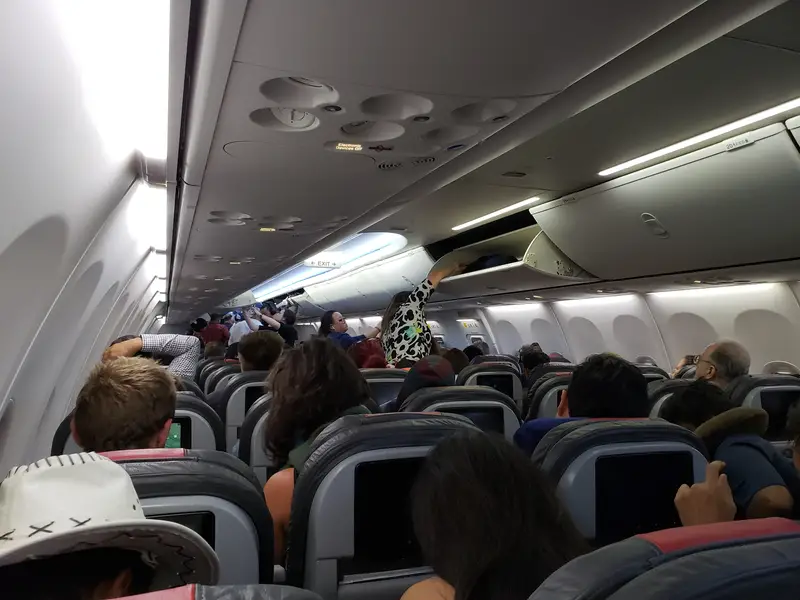
The wheels hit the runway, the engines wind down, and before the plane has even rolled up to the gate, the seat belts start clicking open. People stand in a cabin with no room to stand. Bags come down. And somewhere around row 31, a guy with a backpack starts hunting for a gap in the aisle so he can beat the thirty rows ahead of him to the door.
Flight attendants have a name for that guy, and it is not a flattering one. He is aisle lice. Of all the small rude moves passengers pull when a flight ends, crews say that one is the worst, and there is a decent chance you have done it without ever realizing anybody minded.
Aisle Lice Is The Rudest Way To Get Off A Plane
Aisle lice are the passengers who pop up the second the plane reaches the gate, sometimes before the seat belt sign is even off, shove into the aisle, and try to deplane ahead of the rows in front of them. It is line cutting, except everybody trapped behind you can see exactly what you are doing.
It also does not work. “It’s not just annoying, but it also slows everything down, making them even less likely to get what they want,” said Cecily Anderson, a flight attendant who has worked for all four major U.S. airlines. Planes are built to unload front to back, row by row. One person pushing against that current slows the whole line.
The real damage lands on somebody else. Crews sometimes ask passengers at their final destination to stay seated so people with tight connections can get off first, and aisle lice are the ones who ignore that announcement completely. Those connections are not short walks, either. At Dallas/Fort Worth International Airport, the walk from the entrance to the farthest gate is about 1.5 miles, according to a KURU Footwear analysis. Thirty seconds of elbowing can cost a stranger a night in an airport hotel.
If you are the one with six minutes to make a connection, say something early. Tell the crew when you board or during the flight, not after landing, says Angela McMurray, a flight attendant on an international carrier. Crews can make an announcement asking the cabin to stay seated, and when people actually listen, it works.
Americans Already Agree On How To Get Off A Plane
This is not some niche crew preference. In a nationally representative YouGov survey of more than 2,500 U.S. adults, 65% said leaving the aircraft row by row from front to back is the proper way to exit a plane. Nearly two-thirds of respondents are on the same page.
The same survey found 42% of Americans think passenger behavior has gotten worse over the past five years, and 52% of everyone surveyed blamed passengers, against 8% who blamed the airlines. Fewer seats, tighter rows and longer boarding lines have not helped, but the thing people point at is each other.
Noise Annoys People More Than Reclining Does
Ask Americans what bothers them most in the air and the answer is not legroom. It is volume. Loud conversations and passengers playing music or videos without headphones topped the list at 27%. Reclining too far or without warning came second at 21%. Taking your shoes off or going barefoot got 8%. And 12% said nothing passengers do annoys them at all, which is a level of inner peace most of us will never reach.
What surprised me is how split people are on in-flight phone calls. Only 40% said airlines should ban phone or video calls during flights, against 33% who said they should not. For a behavior that gets screenshotted and posted constantly, that is nowhere near a national consensus. The verdict I would draw: the problem is not the call, it is the speakerphone. Scrolling TikTok on full blast in seat 14C is the same offense in a different costume.
In One Survey, 77% Called A Full Recline Rude
The recline war has a scoreboard. In a 2022 Vacationer survey of about 1,100 U.S. adults, 45.99% said fully reclining your airplane seat is rude and that is why they do not do it, 27.87% said it is rude but they ask politely first, and 3.46% admitted it is rude and they do it anyway without warning. Only 22.68% said it is not rude at all. Add it up and more than 77% of respondents considered a full recline a rude act. In a second 2022 Vacationer poll, 38.25% said they were annoyed when someone fully reclines into them.
You still have the right to do it. You paid for the seat and the button is there. But most people are not objecting to the recline itself, they are objecting to being ambushed by it. In the YouGov poll, a small majority, 51%, said reclining in economy is fine as long as you check behind you first. Just 21% said recline anytime after takeoff, and only 10% said never recline at all.
So the rule is simple and almost nobody follows it: look back, go slow, and do not recline into somebody with their tray table down and a laptop open on it. If you hate being reclined into, buy an exit row seat. The seats directly in front of exit rows usually cannot recline at all, and bulkhead seats have a wall in front of them instead of a stranger’s headrest.
The Famous Armrest Rule Is Not A Rule
Frequent flyers repeat it like scripture: the middle seat gets both armrests as compensation for the worst seat on the plane. Only 11% of Americans actually agree with that. Another 20% said the middle passenger should get priority but everyone should share. The biggest group, 31%, said everyone should simply share the armrests equally, and 26% had no idea what the etiquette even is.
That gap explains a lot of silent elbow warfare over Kansas. One passenger is operating on a rule they assume everybody knows, and a quarter of the plane has never heard of it. Give the middle seat the armrests anyway. It costs you nothing and it is the only kindness available in a row of three.
Seat swapping, for the record, is not the crime people think it is. Asking another passenger to trade seats after boarding was called not rude by 44%, against 34% who said it is rude. Asking is fine. Expecting a yes when you are offering a middle seat in exchange for a window is not.
Boiled Eggs, Manicures And Window Leaners
A June 2026 Opinium poll for Booking.com surveyed 1,000 British adults who had flown internationally in the past year, and the list of modern cabin sins is longer and weirder than the old legroom arguments. Watching videos without headphones and bringing a strong-smelling or messy meal on board tied at 43%. Sushi was named by 38% as a worst offender, garlic-heavy dishes by 32% and boiled eggs by 31%.
Then there is the behavior nobody had to think about ten years ago. Having someone lean over you to photograph or film out of the window bothered 42%. Filming social media content mid-flight bothered 33%, and getting caught in someone else’s video bothered 30%. Going barefoot came in at 25%. Walking laps in the aisle to hit a daily step goal annoyed 24%, stretching or doing yoga in the aisle annoyed 23%, and so did painting, cutting or filing your nails at your seat. Flossing your teeth in your seat landed at 18%.
The reason all this is happening is right there in the data: 67% of those British travelers admitted they behave no differently on a plane than they do at home, even though 89% said passengers should act the way they would on any other form of public transportation. “A little self-awareness at 30,000 feet goes a long way,” said Laura Windsor, the etiquette expert Booking.com worked with on the research.
Do Not Touch The Flight Attendants
Ask working crew what they hate most and the answer is not reclining or bare feet. It is being touched. Veteran flight attendants describe passengers tapping, poking, grabbing and worse to get their attention as a near constant part of the job, to the point that it is unusual for a flight to pass without it happening. Some crew members have started wearing pins or patches on their uniforms asking passengers not to touch them.
The fix is the call button over your head, or your voice. You would never reach out and tap a waiter at Applebee’s to order a refill, and the same instinct should apply at cruising altitude. Grabbing the back of seats to steady yourself on the way to the lavatory counts too. Every yank on that headrest jolts the person sleeping against it.
The Boarding Habits That Jam Up The Whole Plane
Half the misery of boarding comes from people who did not open their bag until they reached their row. Pull your headphones, book, water and snacks out before you get on the jet bridge, stow the bag fast, and sit down. Know your seat number before you are standing in the aisle squinting at the little letters.
Two smaller ones that cause real friction: hogging overhead bin space with a jacket while people behind you circle looking for room, and buckling your seat belt before the window passenger has climbed in. Making a stranger step over a strapped-in person is an awkward start to three hours of sitting six inches apart.
What Crews Are Silently Judging You For
Flight attendants posting anonymously online keep a running list, and some of it is grim. Flossing teeth or cleaning ears in the seat and then dropping the floss or the Q-tip on the floor for crew to pick up between turns. Changing a diaper on the tray table. Ignoring the seat belt sign to wander the cabin, which stops being a manners question the second turbulence hits. Telling a crew member that the last flight attendant allowed it when they ask you to follow a federal aviation rule.
The common thread in nearly all of it is acting like the only passenger on board in a metal tube where nobody has any room to spare.
Nobody Is Going To Tell You
Here is the uncomfortable part of being a passenger: you will almost never be corrected. In the Booking.com survey, 31% of British travelers said they would rather quietly put up with irritating behavior than say anything, and 36% said they vent about it to friends and family after they land. The guy whose knees your seat is pressed into is not going to tap you on the shoulder. He is going to complain about you at dinner.
So the self-check has to be yours. Keep your headphones in, leave the boiled eggs at home, look behind you before you recline, and when that plane finally stops at the gate, stay in your seat until the rows ahead of you have moved. You are not getting off any faster. You are just making sure somebody else does not.

