

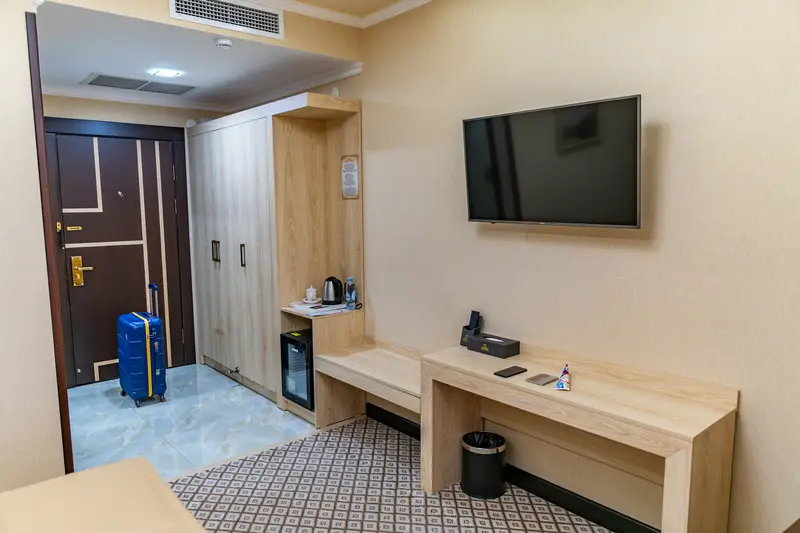
You drop the bag, kick off your shoes, and your hand goes straight for the thing nobody cleaned. Housekeepers often get about half an hour per room, and in that window they strip the bed, scrub the bathroom, vacuum, restock, and move on. Corners get cut. Everybody knows that part.
What surprises people is which corner. When researchers from the University of Houston swabbed hotel rooms for a study presented at the American Society for Microbiology’s General Meeting in 2012, the toilet and the bathroom sink showed up loaded, exactly as you would guess. They had company at the top. The TV remote and the light switches ranked among the most contaminated surfaces in the room.
The Remote Is One Of The Dirtiest Objects In The Room
Ask hotel cleaners what they would never pick up bare-handed and the remote comes up again and again. Studies have found remotes carrying E. coli, staph, and traces of fecal matter. The shape is the problem: buttons, seams, and crevices are nearly impossible to wipe properly, and a rag passed over the top does nothing for the gaps.
There is also a paperwork problem. Cleaning checklists are usually organized by zone, bathroom, bed, surfaces, so a loose handheld gadget that lives on the nightstand or disappears into the covers can fall off the list entirely. The same remote can go years without ever meeting a disinfectant wipe.
Spending more does not solve it. In Travelmath’s surface testing of five-star hotel rooms, the remote control came out germiest of the four items swabbed, with the bathroom counter second. The $600-a-night suite and the highway motel have the same blind spot.
The fix costs nothing. Drop the remote in a clear ziplock bag and the buttons still work fine through the plastic. Or wipe it down at check-in and wash your hands. Frequent travelers have been doing the bag trick for years and it looks ridiculous for about ten seconds.
The Light Switch Nobody Thinks About
Light switches sat right beside the remote near the top of the Houston results, and the bedside lamp switch was singled out. It makes sense when you think about who touches it: everyone, in the dark, right before sleeping and right after waking, usually before washing up.
One AAA hotel inspector has said the switch by the front door is the item that fails inspection most often. Grime does not show on a plastic toggle, so it reads as clean and gets skipped. Charging ports and USB outlets by the bed fall into the same gap.
The Coffee Maker Has A Reputation You Cannot Unhear
Relaying what a 20-year hotel industry veteran told her, TikToker Angela Riihiluoma put it plainly: “Never ever, ever, ever, ever use the coffee machine in a hotel room. Because apparently, some people like to use it as a urinal. So I don’t care how addicted you are to coffee. Don’t touch the coffeemaker.”
Even setting that aside, the cleaning itself has been caught on camera. In a 2008 hidden-camera investigation by local ABC stations, a housekeeper at a Cincinnati hotel was filmed spraying the coffee pot with what appeared to be Lysol mildew remover.
Machines that never get descaled have their own issue. Researchers at the University of Valencia in Spain examined the drip trays of nine Nespresso machines that had been in use for at least a year and found a thriving bacterial community in every one.
Electric kettles are not better. Guests have reportedly used them to heat food and wash clothes, and the inside of a kettle is out of sight, which means it is almost never scrubbed between stays. Lobby coffee exists. Take the elevator.
The Ice Bucket Is Rarely Used For Ice
Brian Labus, an epidemiologist at the University of Nevada, Las Vegas, has called using an ice bucket without a liner one of the grossest things you can do in a hotel room. He pointed to a past norovirus outbreak in which sick guests used the buckets as basins, and the buckets became one of the ways the virus spread.
Former hotel staff have described the buckets being used for pet waste, dirty diapers, and raw meat.
Use the disposable plastic liner if the room provides one. Travelers who want nothing to do with the bucket at all pack a small dry sack and fill that at the machine instead.
Those Glasses By The Sink Probably Never Saw Soap
Phoenix station ABC15 ran an undercover investigation into hotel glassware in 2008, and three of the four hotels it examined failed. Counting sister stations from Kansas City to Baltimore, 11 of 15 hotels tested failed to properly clean and sanitize their drinking glasses.
The footage is the part that sticks. At the same Cincinnati hotel, the dirty glasses got the same spray. At a Kansas City hotel, a worker wiped her hands on the towel she then used to dry the glasses. In Phoenix, staff were observed rinsing and drying used glasses with a rag and putting them back.
Riihiluoma’s warning matched it: housekeepers have so little time to turn a room that the glasses often get wiped with Windex rather than washed. Sealed disposable cups or your own water bottle, every time.
The Bedspread Is Furniture, Not Bedding
Sheets and towels get changed before every arrival. The decorative top layer frequently does not, running instead on a rotating schedule that can stretch weeks. Guests put their feet on it, drag it onto the floor, and pile suitcases on it.
Kelly Reynolds, a germ expert and associate professor of environmental health at the University of Arizona, is blunt about the bedspread. “Your best bet is to avoid contact,” she said. “A lot of people will recommend just folding the bedspread back or throwing it on the chair and don’t use it while you’re there.”
Pillowcases are not automatic either. A 2014 hidden-camera investigation by NBC’s TODAY found that popular chains sometimes left bed linens unchanged even when guests asked. One housekeeper set the pillows aside, changed the sheets, and put the same pillowcases back on. Jacob Tomsky, author of Heads in Beds: A Reckless Memoir of Hotels, Hustles, and So-Called Hospitality, said housekeepers should obviously change the pillowcases: “That’s where you put your face. That’s what you sleep on.”
Decorative Throw Pillows Are Props
The stack of accent pillows and the folded runner across the foot of the bed exist for the photo. Cleaning checklists treat them as staging pieces rather than bedding, so they rarely get laundered between guests and sometimes get skipped during a standard room reset entirely. Hotel inspectors put them in the never-touch pile. Move them to the closet floor on arrival.
The Jetted Tub Is The Hardest Thing In The Suite To Clean
Whirlpool tubs get sold as the reason to book the upgrade. Researchers from Texas A&M University tested 43 water samples from home and hotel whirlpool tubs and found fecal-derived bacteria in 95%, staphylococcus in 34% and fungi in 81%.
The reason is the plumbing. Water drains from the basin but residue stays inside the jet lines, and clearing those requires a full flush cycle with disinfectant, not a wipe of the porcelain. On a 30-minute turnover, that step does not happen.
The Phone Nobody Wipes
Almost nobody uses the nightstand telephone anymore, which is exactly why it sits there untouched by cleaners too. It gets handled by countless guests, held against the face, and routinely passed over during a fast turnover. A 2014 TODAY lab test found the phones at nearly every hotel teeming with bacteria.
Paying More Does Not Buy A Cleaner Room
Here is the counterintuitive result from Travelmath’s lab testing. The dirtiest surface in a three-star hotel room, the bathroom counter, averaged 320,000 CFU per square inch, about an eighth of the level on four-star counters and a third of the level on five-star ones. Across the board, the average room came out dirtier than published figures for a typical home, an airplane, or a school.
The cart in the hallway explains part of it. The Houston researchers, who swabbed nine rooms across three states, found the highest contamination levels of all on the housekeeping cart, specifically the mop and the sponge, which then travel from room to room. The researchers suggested replacing cleaning liquids partway through shifts.
Hidden-camera reporting has caught the other version of this, with the bathroom counter and faucets wiped using the same cloth that just did the toilet, sometimes in multiple rooms down the hall.
The Cleanest Things In The Room Are Not What You Would Guess
Of everything tested, bathroom door handles, curtain rods, and headboards came out among the cleanest surfaces in hotel rooms. The dirtiest patch of carpet, according to a researcher at the University of Houston’s hotel school, is the patch right inside the door, where every guest and every suitcase wheel lands. Vacuuming alone is not enough.
That 2012 study also found that about 81% of the hotel room surfaces analyzed carried at least some fecal bacteria. Hard surfaces, soft surfaces, all of it.
Five Seconds Of Wiping Covers Most Of It
None of this is an argument for sleeping in your car. A travel pack of disinfectant wipes and about a minute of effort handles the worst offenders: the remote, the lamp switch, the switch by the door, the thermostat, the phone, and the bathroom counter before your toothbrush goes anywhere near it.
Then strip the bedspread and the throw pillows onto a chair, skip the glassware for a sealed cup or your own bottle, line the ice bucket or ignore it, and get your coffee downstairs. If you only do one of those, do the remote. It is the thing every cleaner, inspector, and researcher keeps naming, and it is the thing your hand reaches for without thinking.

