

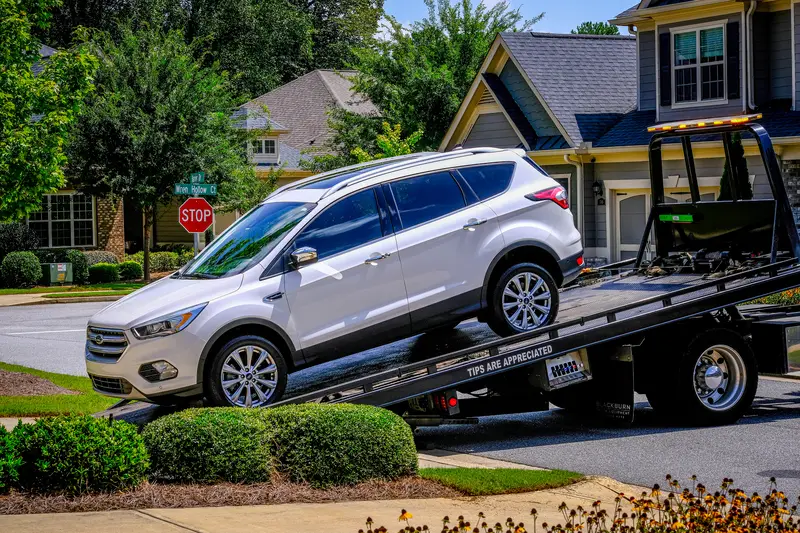
Your car is sideways on the shoulder, your hands are still shaking, and a tow truck rolls up before you have even finished telling the dispatcher where you are. The driver is calm. Friendly. Fast. And he already knows where your car is going: a body shop across town that you have never heard of, run by people you will never meet. That destination is the most expensive decision of the entire night, and it is the one drivers almost never argue about.
Once your car is sitting in a lot that somebody else picked, you are no longer a customer. You are negotiating to get your own property back.
The One Sentence That Should End The Conversation
A driver who names the shop before you do is running a play. The industry calls it steering, and it works because the pitch sounds like help. Don’t worry about the money, the shop will sort it out with your insurer. Just sign here so we can get you off the highway.
California’s Department of Insurance put out a warning to drivers on Feb. 18, 2025, listing the exact tells. The truck shows up within minutes, before you have called anyone. The driver tells you which body shop your car is going to instead of asking where you want it. He says someone will contact you by phone later, or asks you to sign documents. And then the one almost nobody expects: he offers to order you a rideshare.
That last one is not kindness. It is a way to separate you from your car.
Insurance Commissioner Ricardo Lara said the practice is “preying on drivers at their most vulnerable moments,” when people should be thinking about their own safety instead of fighting to get their vehicle back.
Sixteen People, One Repair Shop And 3,500 Crash Reports
Sixteen Southern California residents were arraigned and charged in what investigators described as an organized auto fraud ring that allegedly collected more than $216,932 through fake claims, collusive collisions and holding vehicles hostage.
The part that should make every driver uncomfortable is how they found their victims. The task force investigation began in November 2022 after a California Highway Patrol non-sworn employee, Rosa Isela Santistevan, 56, of Irvine, was found to be unlawfully selling traffic collision report face pages. Those pages carry the personal information of people who had just been in a crash. Search warrants turned up more than 3,500 of them at the home of Esmeralda Parga, 27, of Pomona.
According to the department, Parga called the people named on those reports, pretended to be from their insurance company, and arranged to have their vehicles towed to a repair center she described as insurer-approved. It was not. The cars went to Certified Auto in Buena Park, owned by Anthony Gomez, 36, of Jurupa Valley, where the vehicles were held until insurance companies paid cash for their release. The alleged ringleader, Andre Angelo Reyes, 37, of Corona, built the pipeline by befriending CHP employees and donating to department events and parties. The Riverside County District Attorney’s Office is prosecuting, and has also charged Reyes and Diana Villa Pineda, 34, of Corona with tax evasion of $136,408.
Nobody in that story showed up in a mask. They showed up with a clipboard and your name already on it.
The Bill Arrives With Words You Have Never Heard
A normal tow has a shape to it. As a rough guide, a base hookup charge for a standard vehicle often runs $75 to $125, mileage roughly $2 to $7 per mile after the first few, and impound storage $30 to $100 a day, though rates vary by city and state. Three ranges, all of them checkable.
A predatory bill looks nothing like that. The National Insurance Crime Bureau says drivers have reported being charged thousands of dollars after crash-scene tows, with vague “miscellaneous” and storage charges stacked on top. Insurance claims involving predatory towing jumped 89% nationwide between the start of 2022 and the end of 2024, and not just in big cities. Small towns, suburbs and rural stretches are all showing up in the numbers.
One Chicago couple watched their bill climb to $4,700 after a crash as storage fees piled up. The first itemized bill included a $290 COVID-19 cleaning fee. In Philadelphia in 2019, owners of a tow company were indicted over allegations they billed insurers more than five times the industry standard.
Some impound lots add gate, release or labor fees for the simple act of opening a chain-link gate, and in some states those charges may be illegal.
Who Called The Truck Changes Everything
Federal law splits towing into two different worlds, and almost no driver knows which one they are standing in. Under 49 U.S.C. § 14501(c)(1), states and cities generally cannot regulate the prices, routes or services of motor carriers hauling property, tow trucks included, when the tow is consensual. Meaning: when you called them. Non-consensual tows, the ones you did not ask for, are carved out of that limit, so states and cities are free to regulate them.
So the moment you nod at a stranger on the shoulder and say yes, you may have stepped outside the price rules your state or city is allowed to set. You entered an agreement. That is why every consumer warning on this subject repeats the same instruction: do not give permission until you know who dispatched the truck.
Your roadside assistance coverage generally will not save you either. It typically does not cover a non-consensual tow from a private lot or an impound, so those costs usually land on you whatever card is in your glovebox.
Twenty Dollars A Car
Sometimes the person who got your car towed made money doing it. Kickback payments happen when a property owner or a law enforcement officer receives something of value from a towing company in exchange for calls. In Lubbock, Texas, a 2014 KCBD investigation reported a former tow company employee’s claim that businesses collected $20 for every vehicle pulled off their lots, which added up to more than $500 a week for some of them.
Only 17 states banned those payments in some form for private property towing, roughly a third of the country, according to a 2022 U.S. PIRG Education Fund report. At the time, only four states required a photo before a car was hooked. The math is not complicated: PIRG puts the cost of retrieving a car from an impound lot at $200 to $300, and handing $20 to $50 back to whoever placed the call is cheap advertising.
It reaches further than shopping plazas. In Detroit, a 2021 federal indictment accused a police lieutenant and an officer of taking thousands of dollars in bribes to steer tow referrals to one company.
The Tow Truck That Never Comes At All
A newer version of this skips the truck entirely. Stranded drivers search for a towing company on their phone, call the number at the top, and get asked for several hundred dollars up front on a card. Then nothing arrives.
Bill Byers, owner of Byers Wrecker Service in Rochester, Michigan, has watched it happen to people who eventually call him. One customer sat on a dirt road north of Rochester for six hours after paying more than $300 to a company that was never coming. Byers says no legitimate towing business asks for money up front on a credit card, and that where an upfront fee does exist, it belongs in the $50 to $75 range, not $300 or $600 or $900. A classic car owner in Orion Township had already paid a scammer $392 for a tow of about two miles when Byers’s crew showed up to do the job.
Some of these operators call real tow companies afterward, posing as the customer or as a roadside assistance dispatcher, having already banked the driver’s money. The Oakland County Sheriff’s Office computer crimes unit has been looking at how search results are routing callers to the wrong numbers in the first place.
Look At The Door Of The Truck
A commercial tow truck generally has to carry the company’s name and USDOT number on both sides. A magnetic sign that could be peeled off in a parking lot, or no signage at all, points to a fly-by-night crew. Check that the name on the truck matches the name on whatever paperwork you are handed.
Never sign a blank form. The pitch is that it is just authorization for the hookup, and the empty fields get filled in later with numbers you never saw. Every box for price and destination should be filled before your pen touches it.
Photograph the truck, the plate, the driver, the door signage and your car’s condition before it moves. Ask what the total will be including mileage and fees, where exactly the car is going, and who dispatched them. A legitimate driver answers all three without flinching. Then call your insurer or roadside provider and confirm the company name, or wait for police to verify the truck was actually dispatched. If you are somewhere safe, waiting 20 minutes for a company you chose beats a fast hookup that costs you thousands.
If They Already Have Your Car
Storage fees run daily, which means arguing on principle while your car sits in a yard is an expensive form of being right. Paying the disputed bill and fighting afterward is usually the cheaper route. Write “paid under protest” on the receipt so there is a record that you never agreed to the charges, then file a complaint with the local or state agency that oversees towing, which can fine the company, pull its permit or order a refund.
Pay by credit card whenever you can, never in cash. A cash-only demand is one of the oldest signals that something is wrong, and a card gives you a dispute process. Towing complaints can also go to the National Insurance Crime Bureau at (800) 835-6422, to your state attorney general’s office, or to the Better Business Bureau. California drivers can reach the Department of Insurance at 800-927-4357.
Laws are slowly catching up. Kentucky, Utah and Virginia passed towing reforms in 2024, and Arkansas, Idaho and the city of Chicago followed in 2025, and drivers always have the right to request an approved, licensed tower through their own insurer. Plenty of tow operators are honest people doing hard work at two in the morning.
But the destination decides the outcome. Your driveway, your mechanic, a shop you picked yourself. Anywhere the driver names before you do is a place you should not let your car go.

