

You clean that little lint screen after every load, so you figure your dryer is fine. Sorry, but that screen is honestly the least of your worries. The scary stuff happens where you can’t see it, in the vent line hidden behind the machine and inside your walls. And the numbers around this are wild once you actually look at them.
Dryers and washing machines together cause an average of 15,970 home fires every single year, and dryers are responsible for 92% of them. That works out to roughly $200 million in property damage annually. The frustrating part? More than a third of these fires come down to one thing people skip: cleaning and basic maintenance. This is not some rare freak accident. It’s a slow, boring buildup that quietly turns your laundry room into a hazard.
The Lint Screen Is Lying to You
Here’s the thing almost nobody realizes. That mesh screen only catches some of the lint. Plenty of fine fuzz sails right past it and settles deep in the vent line where you’ll never see it. Over months of normal use, it packs in tighter and tighter. Airflow slows, heat backs up, and the dryer starts working way harder than it should.
And people are not keeping up with it. Only about 37% of dryer owners clean the actual vent line once a year, which is what’s recommended. Even worse, around 17% admit they have never cleaned it. Not once. Ever. So if you’ve owned your dryer for five years and only ever touched the screen, you are very much not alone. You’re also sitting on a problem.
A Rolled-Up Rug Torched a Brand New Dryer
This one stuck with me. Forensic engineers investigated a house fire that started with a dryer less than a year old. Brand new. Everyone assumed the machine was defective. It wasn’t. The homeowner had rolled up a big 8-foot by 10-foot floor rug and stashed it behind the dryer for storage.
That rolled rug crushed the flimsy plastic vent hose completely flat. With the airflow choked off, a ball of lint plugged the end of the duct like a cork. Hot air had nowhere to go. The investigators proved the dryer never malfunctioned at all. The homeowner’s storage habit did it. So the next time you shove something behind the dryer because it’s a handy hiding spot, remember that rug.
That Cheap Vent Hose Is the Real Villain
You know the vent hose I mean. The bendy accordion-style plastic or foil one that came with a lot of setups. It’s cheap, it’s flexible, and it is exactly what dryer manufacturers tell you not to use. Every single one of them says so right in the manual. Yet homes across the country still run them because they’re easy to install and nobody reads the manual.
The problem is those ribs and folds. They twist, sag, and trap lint at every bend. Flexible plastic vents cause about 25% more fires than rigid metal ducts. Building code (the International Residential Code, Section M1502, if you want to get official) now calls for rigid metal duct only, with a smooth inside and joints running the same direction as the airflow. If a home inspector spots that old ribbed plastic hose, they’re supposed to flag it as a fire hazard. It’s that clear-cut.
Electric Dryers Catch Fire More Than Gas Ones
This surprised me. You’d assume the gas appliance would be the riskier one, right? Flame, gas line, all that. Nope. Electric dryers are more than 2.5 times more likely to start a fire than gas dryers.
The reason is the heat. Electric dryers pump out higher heat, and higher heat makes lint buildup way more dangerous. Here’s how the whole thing actually goes down: lint collects in the duct, airflow drops, the machine overheats, and a mechanical failure throws a spark. That spark hits the trapped lint, which is basically kindling, and the fire follows the vent path right into your walls. It doesn’t stay in the dryer. It travels. That’s why a laundry room fire can swallow a whole house.
Fabric Softener Turns Lint Into Glue
If you use liquid fabric softener or dryer sheets, this affects you. Inside that vent, you don’t just have loose fuzz floating around. You’ve got escaped dust, pet hair, human hair, and fabric fibers all mixing together. Add fabric softener residue and it gets sticky. Over time you end up with a gummy, flammable potpourri caked to the inside of the duct.
That sticky stuff is worse than dry lint because it clings and doesn’t blow out. It builds a nice thick coat right where the airflow already slows down. And lint is genuinely one of the most flammable things in your home. Fun fact that also doubles as a warning: dryer lint is literally an ingredient people use to make homemade fire starters for camping. You’re storing that recipe inside your wall.
Your Clothes Are Trying to Warn You
The dryer sends you signals long before anything bad happens. Most people just ignore them or blame the machine for getting old. Pay attention to these instead. If your jeans and towels suddenly take two cycles to dry, that’s a red flag. If the laundry room turns into a sauna when the dryer runs, red flag. If your clothes come out weirdly hot to the touch, or you catch a faint burning smell during a cycle, take it seriously.
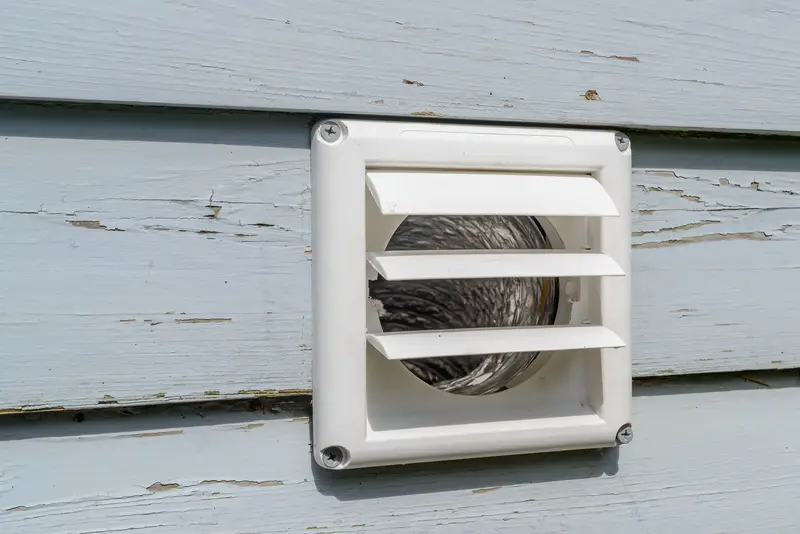
Other tells: more lint than usual piling up on the screen, or fuzz poking out of the outdoor vent flap. Speaking of that outdoor flap, go look at it. Birds love to build nests inside dryer vents, and leaves, snow, and dust collect around the opening. When the outside exit gets blocked, all that hot air has nowhere to escape and it backs up into the system. A slow dryer is basically a dryer waving its arms at you.
Newer Homes Are Actually More at Risk
You’d think a shiny new build would be safer than grandma’s old house. Not with dryers. It used to be that the dryer lived in the basement, right next to an outside wall, with a short and simple vent run. Easy. Newer homes cram the laundry into bedrooms, bathrooms, kitchens, and hall closets, often nowhere near an exterior wall.
That means the vent has to travel a longer distance with more sharp turns and bends just to wind its way outside. Every bend is another spot where lint loves to collect, and the long run is harder to reach and clean. So that convenient upstairs laundry room you loved on the home tour? It’s quietly working against you. Older dryers make it worse too. Machines more than 10 years old carry a 45% higher risk of vent-related fires as the parts wear down.
The 35-Foot Rule Nobody Told You About
Here’s a code detail most homeowners have never heard. Your dryer vent run is supposed to max out at 35 feet from the dryer to where it exits outside. But that number shrinks fast when your vent has turns. You subtract 2.5 feet for every 45-degree bend and a full 5 feet for every 90-degree bend. Two hard corners and you’ve already burned 10 feet off your allowance.
One more thing that trips people up: never use sheet-metal screws to join vent pipe together. The screw shafts poke into the duct and snag lint, building a clog right at the connection. Shorter and straighter always wins. If your dryer is buried in a closet down the hall from the nearest wall, your vent is probably fighting an uphill battle every load.
What to Actually Do About It
Okay, so what’s the move? Keep cleaning the lint screen after every load, that part still matters. But get the whole vent line cleaned out at least once a year, and every six months if you’ve got a big family running loads constantly. If you swap that old plastic hose for rigid metal, you drop your fire odds by around 70% compared to foil.
For short vent runs you can DIY it. Unplug the dryer, pull the hose off the back, and vacuum out the duct and the wall opening. For longer or hard-to-reach runs, hire a pro. It usually runs about $75 to $125, and they’ve got brushes and hoses that reach all the way to the end. Two habits that cost nothing: don’t stuff junk behind the dryer, and never run it while you’re asleep or out of the house. A burning smell only helps if someone’s actually home to smell it. For less than the price of a nice dinner, you can knock out the mistake that’s burning down thousands of houses a year.

