

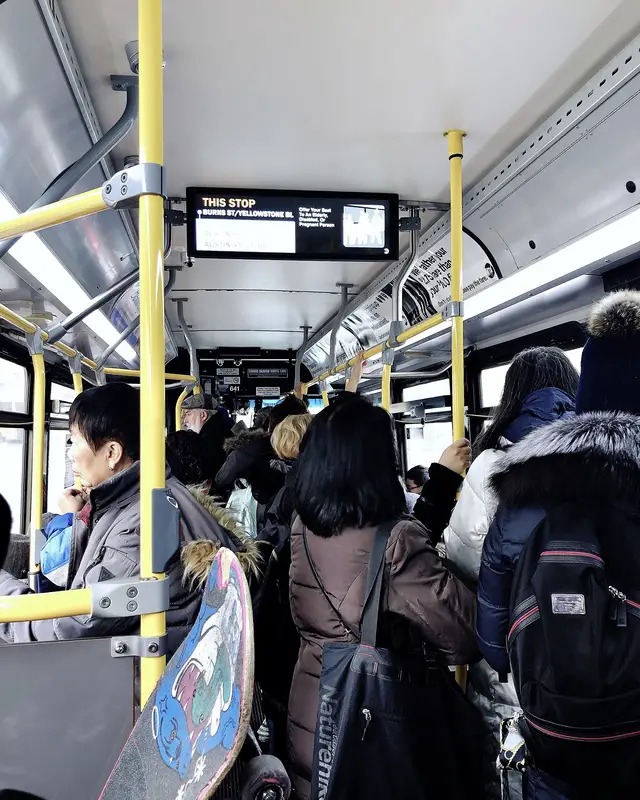
The doors fold open at rush hour, half the aisle is already standing, and the only clear stretch of empty seating on the whole bus is the bench across the very back. Five seats, nobody bidding against you, a clean view down the aisle. Take it and you will spend the rest of the ride regretting it. The back row is the worst seat on a crowded bus, and it is not close.
Everything unpleasant about a bus concentrates behind the rear axle. The noise, the bounce, the sway, the stale air, and on a long-distance coach, a restroom door swinging a few feet from your knee. It is also the hardest place in the vehicle to get out of when forty people are standing between you and the exit.
1. The Back Row (Worst)
Sit at the rear and every input the road gives the bus arrives at you magnified. The CDC’s advice for motion sickness is to sit in the front of a bus, and the back is where you feel why: the movement is amplified there, so an ordinary pothole lands like a real event. Engine noise sits right behind you, airflow is poor, and on coaches the restroom is usually in the same corner.
The numbers on how much a bus actually moves come from the University of Technology Sydney, where researchers put a six-axis accelerometer and gyroscope logger on a passenger seat in 30 city buses running routes across the Sydney CBD. Average seat acceleration during operation came out at about 0.12 times the force of gravity, with peaks reaching up to 0.44 times gravity. In the published Scientific Reports paper, 20% of peak acceleration cycles ran above 0.20 g longitudinally, 0.18 g laterally and 0.27 g vertically.
The thing you actually notice is not the average. It is the jolt. “Jerk is what you feel when the bus brakes or accelerates. It’s the rate of change in acceleration, and if it’s done very quickly, you may feel it like a jolt where your body is pushed forward or backward in your seat,” said Anna Lidfors Lindqvist, a lecturer at the UTS School of Mechanical and Mechatronic Engineering and a co-author of the study. Research suggests jerk may be a better measure of discomfort than acceleration alone.
2. The Side-Facing Seat by the Door
City transit buses line the front section with longitudinal benches, the ones where you face across the aisle instead of forward. They fill last for a reason. Facing sideways while the vehicle moves forward means your eyes never see the stop coming, so every brake and every turn arrives unannounced. That mismatch between what you see and what you feel is the classic recipe for a queasy ride.
The position is also the one thieves like best. Seats immediately by the door are the prime target for grab-and-go pickpockets who can snatch a backpack or a shopping bag and step off a half second before the doors close, according to travel writers who cover solo bus travel. Crowds make it easier, not harder: a packed aisle gives someone a reason to press against you. One travel blogger hit on the Barcelona Metro describes the same choreography on a train: a lurch, a stumble, an apology, and a man stepping off at the last second. Sitting further in does not make you untouchable, but it buys you time to react and people to react with you.
3. The Seat Next to the Restroom
On a coach, the seats flanking the restroom look like a convenience and function as a waiting room. They catch heavy foot traffic, the door noise, and the smell, and it all gets worse the longer the trip runs. Anyone who values a quiet ride should skip them, a point that charter operators make in their own seating advice. On a full bus, the line that forms outside the door forms directly over your armrest.
Safety advice for solo travelers flags the restroom seats for a second reason: constant traffic past your row means constant strangers pausing at your shoulder. If you are trying to sleep through a long leg, this is the one row where you are guaranteed not to.
4. The Middle Seat in a Three-Across Row
Wider coaches and some airport shuttles run three seats across, and the center one is the least comfortable seat in the vehicle. You are wedged between two strangers with no wall to lean on and no aisle to escape into, which means no shade control, no stretching, and no leaving without asking permission from someone who is asleep.
It is occasionally the cheapest seat on the manifest. That is the entire case for it. For a solo traveler who wants any personal space at all, the discount does not come close to covering what you give up.
5. The Emergency Exit Row
Extra legroom is real here, and it is a trap on a long ride. Exit rows frequently do not recline, and drafts come through the door seals, which turns a cold overnight run into a long one. If you boarded planning to sleep, you have picked the row that makes sleeping hardest.
On a crowded bus there is a second cost. The exit row is where standing riders congregate because the floor space is bigger, so the legroom you paid attention to ends up occupied by other people’s shins and rolling bags.
6. Directly Over a Wheel Arch
The raised platform seats over the wheels are a compromise most riders make without noticing. They sit in the calmer middle of the bus, which is good, but they transmit road thump more directly than the rows just ahead or behind them, and the wheel housing steals the footwell, so tall riders end up sitting with their knees at an angle for the whole trip.
They are not a disaster. They are simply worse than the identical-looking seats one row forward, which is the sort of detail worth knowing when you are choosing fast in a crowded aisle.
7. The Window Seat in the Middle Section
Now the list turns useful. A window seat mid-coach gives you a wall to lean on, control of the shade, a view, and fewer interruptions than anything on the aisle. Sleepers and scenery people should take it every time. Bring a layer in winter, because the wall gets cold, and accept that you will have to ask someone to move when your stop comes.
The middle section earns its place on ride quality. Seats between the front and rear axles are the most settled part of the bus outside the front rows, which is why riders who get queasy are steered toward the front or the middle rather than anywhere behind them.
8. The Aisle Seat Between the Axles
For a packed weekday commute, this is the practical winner. You can stand, stretch, reach the overhead rack and get to the doors without negotiating with a seatmate. One coach operator’s safety guidance points to the same zone, the middle portion of the bus on the aisle, as the spot with the best combination of stability and company around you. It is also the seat that is never isolated, since the rows around you fill first.
The trade is noise and contact. Aisle seats catch bumps from passing passengers and every conversation in the vehicle. One rule of the aisle seat is worth stating plainly, and a Bay Area transit riders’ guide does: taking the aisle and leaving the window empty on a full bus is claiming space you are not owed, and it forces every other rider to interrupt you to sit down. Same principle with a bag on the neighboring seat. Bags go between your feet or under the seat, and if you cannot sit without spreading across two seats, stand.
9. The Aisle Seat in the Front Rows (Best)
Front-section seating wins on every measure that matters on a crowded bus. The ride is smoothest there, with the least sway and the least motion to absorb, and the legroom is usually better than anything behind it. You are within speaking distance of the driver, which is the fastest way to deal with a problem, whether that is a stop you need or a passenger who will not leave you alone.
Make it the aisle. An aisle seat toward the front lets you see what is happening around you, keeps you from being boxed in by whoever sits down next to you, and lets you move to another seat at any point without asking anyone’s permission. On a double-decker, stay on the ground floor for the same reason. And keep clear of the door itself, where the grab-and-run risk sits.
One exception, and it is the only one. If motion sickness is your issue rather than crowds, take a forward-facing window seat in the front rows instead, watch the road ahead, and keep your phone in your pocket. Looking down at a screen on a moving bus undoes every advantage the good seat just gave you. Either way, book early if the service assigns seats, because the front rows go first and the back bench is the one still available at departure. There is a reason for that.

