

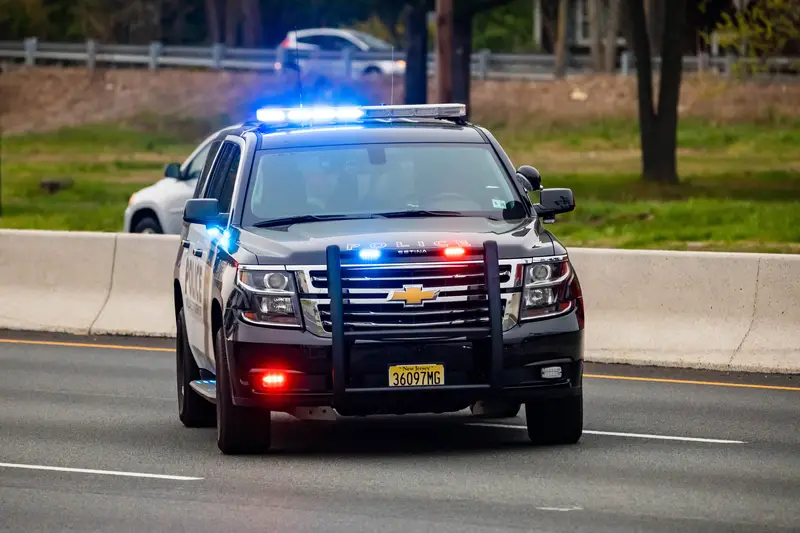
Blue lights fill your mirror on the interstate and your brain does the math in about half a second. The right lane is packed. The left shoulder is wide open, a few feet of asphalt against the median, and you are already sitting in the fast lane. Every instinct says swing left and get it over with.
That is the one stop police tell drivers never to make. Not the middle of the road, not the turn lane, not a dark side street. The left shoulder, snug against the median, is the spot that parks you and the officer between two streams of traffic with cars ripping past on both sides. Departments repeat this one more consistently than almost anything else they say about traffic stops, and they say it even when there is a median sitting right there looking like a safe place to hide.
The Left Side Puts Cars On Both Sides Of You
Sergeant Jeff Burke with the Douglas County Sheriff’s Office Traffic Unit in Colorado put it flatly when asked where drivers should stop. “Drivers should pull as far to the right as possible and come to a complete stop. Drivers should not pull to the left or stop in the middle of the roadway,” he said. Sergeant Kevin McCann with the Castle Rock Police Department said the same thing about interstates, adding that the safest option is usually the next off ramp, and that drivers should never pull off to the left of an interstate.
The geometry is the whole problem. The right shoulder normally has room to keep going, often flat grass past the pavement that lets you get real distance from moving cars. The left side has almost none, and barriers may block you from getting off the pavement at all. A concrete wall down the median is not protection when the danger is behind you.
There Is No Law Telling You Where To Stop
Both Colorado sergeants said there is no specific statute covering where a driver is supposed to stop once the lights come on. Burke said the closest thing is the rule you already follow when an emergency vehicle comes up behind you: where possible clear the farthest left-hand lane lawfully available to through traffic, get parallel and as close as possible to the right-hand edge or curb of the roadway, clear of any intersection, and stay there until the emergency vehicle has passed.
Sheriff’s office guidance elsewhere reads the same way. Drivers are told to look for the nearest place to get as far out of the lane of traffic as possible, generally the right side or wherever the shoulder is wider than usual, unless an officer directs otherwise. The uniform advice is right shoulder or off-road parking. The median never makes the list.
He Drove To A Shopping Center And Went To Jail
Driving on to find somewhere better can go badly wrong. In the summer of 2018, a Livermore, California police officer tried to stop Lavanz Crosby Jr. on the shoulder near a freeway onramp while Crosby was driving his girlfriend’s new car. Crosby decided the overpass was unsafe and parked in a shopping center less than a mile away. “As soon as I looked up, the officer had his gun pointed at me and yelling, telling me to keep my hands up. I was trying to keep myself under control because I didn’t want to get shot,” Crosby later recounted.
Crosby was arrested and taken to jail. No charges were ever filed. Police records show the officer had a change of heart after the arrest and called the District Attorney’s Office to ask prosecutors not to charge Crosby with evading an officer. In his report, the officer wrote that Crosby honestly thought he was doing the right thing by trying to find a safe place to park. The reason for the stop in the first place: the officer suspected the newly purchased car was stolen. It was not.
Burke pushed back on the idea that a driver gets to keep rolling until they personally feel comfortable. Once an officer has turned on the lights, he said, the officer has already judged that location safe or has seen an immediate reason to get that car stopped right there. Driving a reasonable distance may be acceptable. Driving as far as you feel like driving is not.
The Shoulder Is Where Officers Get Hit
An average year sees 566 people killed and more than 14,000 injured while dealing with a disabled vehicle at the roadside, according to Insurance Institute for Highway Safety estimates. California collision data reviewed in 2019 showed 2,708 crashes involving 2,757 parked law enforcement motorcycles and cars since 2013, covering officers helping stranded drivers, watching for speeders and working stops. Agencies do not directly track how many crashes happen during traffic stops.
CHP Officer Ross Lee was writing a ticket on Interstate 280 near Cupertino when a rubbernecking driver veered off the road into his car. “I cut my forehead. It knocked me onto this raised embankment,” he said. “It threw me back on the shoulder 10 feet. It was very scary, happened very fast.” Lee said just about every officer he knows has been in a crash during a stop or knows someone who has. He still feels comfortable stopping drivers on the shoulder rather than exiting the freeway.
CHP Chief of Enforcement and Planning Jim Epperson still deals with the aftermath of a 1999 stop. “I heard the brakes coming and another truck, who after a while admitted to not paying attention, hit my truck about 80 miles an hour,” he said. He suffered a skull fracture plus neck and back problems and missed nine months of work. His agency conducted roughly 2 million stops a year as of 2019, and his advice for drivers is short: when you see the red light, start moving right, and if he needs something different, he will tell you.
The shoulder is brutal for civilians too. Pedestrians killed on interstates make up as much as 12 percent of all pedestrian deaths but only 1.1 to 1.5 percent of traffic deaths overall, according to the AAA Foundation for Traffic Safety. The National Law Enforcement Officers Memorial Fund counted 10 officers struck and killed outside their patrol cars in 2023 and 15 in 2022, roughly one a month.
Your Hazard Lights Are A Conversation
Flip your flashers on the moment you see lights or hear a siren. It tells the drivers around you that you are the one slowing down, and it tells the officer behind you that you have seen him. Very few drivers do this, and it is free.
McCann said that on a road with no shoulder or no safe place to pull off, hazard lights plus continued driving to a parking lot or side street is the right move. Remember that the patrol car is parking behind you, so the space you pick needs to hold two vehicles, not one. Burke added a caution that surprises people: pulling into a nearby lot sometimes creates more of an obstruction and ends up less safe than simply stopping on the side of the road.
A Flat Tire Is Not A Reason To Stop
Blow a tire on the freeway and the first instinct is to stop immediately, even on the median, because you can hear the money leaving your wallet. Keep driving to the nearest exit. The worst you usually do is wreck a wheel or rim, which runs somewhere between $75 and $400 depending on the car, and more if a bent alloy has to be replaced outright.
If you do have to stop on the shoulder, do not stand next to your car. Get passengers out and away, and if there is a guardrail, climb over it and wait on the far side. Night makes all of it worse, because tired drivers see lights ahead and read them as a car in the right lane rather than something parked and still.
The Unmarked Car Exception
With a marked patrol car, roll your window down right away. With an unmarked car, the advice flips: wait until the officer gets out and you can see credentials before you lower the glass. If you are not sure the person behind you is law enforcement at all, both Colorado sergeants said to call 911 and give the dispatcher your license plate or the make and model of your vehicle plus your location. Dispatch can confirm whether a real stop is happening.
Small Moves That Keep The Stop Short
Once you are parked, shift into park and kill the ignition. Nothing you do should look like you are thinking about leaving. Police guidance on stop etiquette points out that officers notice brake lights still glowing, which means the car is still in gear and still capable of moving.
Leave your license and registration alone until you are asked. McCann’s department recommends hands on the steering wheel while you wait for the officer to make contact, and turning on your dome light if it is dark out. Officers cannot read movement inside a dim car until they are at the window, and digging through a glove box is exactly the movement they cannot read. It may also take the officer a minute or two to get out, because he is probably running your plate or telling dispatch where he is. Stay put.
Stopping on the left also opens the encounter by putting the officer on the traffic side of your car, which is the exact position every department quoted here tells you to keep him out of. The right shoulder has a practical bonus too: that side of traffic is usually the slower side, so merging back in afterward is easier.
The 2006 Law Almost Nobody Understands
Gov. Arnold Schwarzenegger signed California’s move over law in 2006, and from January 2007 it required drivers on freeways to move over or slow down for emergency workers on the side of the road, traffic stops included. Lawmakers made it permanent in 2009 and extended it to all highways in 2020. Epperson said that law is supposed to create a safety buffer around a stop. Driving school owner Randy Zimmer is not convinced it does much, arguing that if you interviewed ten people on the street about the move over and slow down law, they would not have a clear understanding of it. CHP’s own report to the legislature said there was no absolute way to measure the law’s effect, but that it appeared to have reduced collisions and injuries involving stopped emergency vehicles and tow trucks.
So the next time you pass someone pulled over, get out of the lane next to them or drop your speed hard if you cannot move. And when the lights are for you, the answer is boring and consistent across every department that publishes it: flashers on, right shoulder, as far right as the pavement lets you go, or the next exit if there is no shoulder at all. The median is not a hiding place. It is the worst seat on the highway.

