

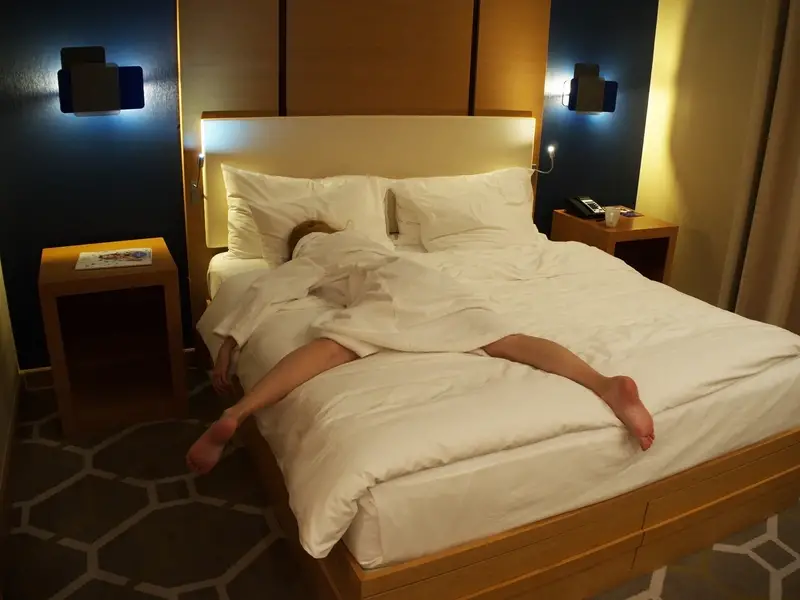
Nobody really picks a sleeping side. You brush your teeth, flop down facing whichever way the door is, and that decision holds for the next seven hours. More than 60% of adults sleep on their side, making it the most common position in the country, with back sleeping in second place. Most people never give it a thought. Sleep specialists do, and for one group of sleepers they keep pointing at the same side and shaking their heads. It is the right side, and the problem is heartburn.
The Right Side Is The Heartburn Side
People with GERD who sleep on their right side have more heartburn episodes than they do on their left, and those episodes last longer. A 2022 study found that left-side sleeping was linked to shorter acid exposure and faster clearing of the esophagus compared with the right side.
The reason is plumbing, not magic. Lying on your left keeps the esophagus positioned slightly higher than the stomach, so food keeps moving down the digestive tract instead of sloshing back up. Roll to the right and you flip that arrangement. Raising the head of the bed a few inches, or using a foam wedge so your head sits higher than your chest, is the other standard suggestion. It does not fix reflux, but it takes the edge off the symptoms.
Now The Left Side Gets Its Own Asterisk
Back in 1997, researchers noticed something odd: side sleeping changed the electrical activity of the heart as measured on an electrocardiogram, and the effect was more obvious when people lay on their left. A 2018 study using an imaging method called vectorcardiography found the same thing, and showed why. On the left side, the heart actually shifts and turns. On the right side, almost nothing changed, because the thin layer of tissue between the lungs, the mediastinum, holds the heart in place.
Before anyone panics about their favorite side, the researchers noted that left-side sleeping did not change how the heart functions electrically. It changed what the equipment recorded. The phenomenon is likely down to the testing apparatus, not a heart slipping into an off rhythm.
People With Heart Failure Keep Rolling Right
Plenty of people with heart failure find they get short of breath lying on their left side and do not on their right, so they drift right on their own. A 2018 study of patients with a heart muscle disease called consecutive dilated cardiomyopathy found the majority preferred sleeping on the right.
There has long been a theory that right-side sleeping compresses the vena cava, the vein that feeds into the right side of the heart. At this point there is no evidence that sleeping on your right raises the risk of developing heart failure, and it appears to be fine. One more detail almost nobody knows: most implantable cardioverter defibrillators are placed on the left side of the chest, and people who have one often find the opposite side more comfortable to sleep on.
The Side Your Brain Seems To Like
While you sleep, cerebrospinal fluid washes through the brain and carries off waste that piles up during the day, including beta amyloid, the substance found in the brains of people with Alzheimer’s disease. Research from the University of Rochester Medical Center found this cleaning system works best when people sleep on their side, especially the right side.
Maiken Nedergaard, a professor of neuroscience and neurology at URMC and a coauthor of that work, explained the mechanism in plain terms: “The pumping of blood initiates pulsations of the blood vessel walls that drive cerebrospinal fluid into the brain.” That process runs more efficiently when you are lying on your side rather than flat. So the side that aggravates heartburn may be the one your brain prefers. Nobody said this was tidy.
You Are Probably Not The Sleeper You Think You Are
Ask around and everyone will tell you confidently that they are a side sleeper or a back sleeper. The overnight data says otherwise. “I’ve interpreted thousands of sleep studies, and rarely do you see someone sleeping in the same position all night long,” says Dr. John Winkelman, a professor of psychiatry in the Division of Sleep Medicine at Harvard Medical School.
The reason is built into how sleep works. We move through roughly 90-minute cycles, and the switch between stages is often punctuated by a change in position. You may fall asleep on your left with the best intentions and spend half the night somewhere else entirely.
Flat On Your Back Is The One That Gets Called Out
If you snore, the position doing the damage is not a side at all. Winkelman tells people with obstructive sleep apnea to stay off their backs, and his description is hard to forget: “All the soft tissue in the back of the throat falls back like a cork. Gravity is not our friend here.” Side sleeping keeps the airway more open because the tongue and soft tissue do not collapse into the throat.
Sleep apnea is estimated to affect 30 million Americans, and only six million of them have been formally diagnosed, according to the American Medical Association. Rachel Marie E. Salas, M.D., assistant medical director of the Johns Hopkins Center for Sleep and Wellness in Baltimore, puts the gap a similar way: “Eighty percent of people that meet the diagnostic criteria for apnea are not diagnosed.”
There is even a version called positional obstructive sleep apnea, where the pauses in breathing happen in one position only, usually on the back. The gadgets built to stop back sleeping run from wearable electronic devices to the low-tech classic: a shirt with a pocket sewn into the back to hold a tennis ball.
The Signs People Miss Entirely
Loud snoring, gasping and choking are the famous signals. The quieter ones blend into ordinary life: morning headaches, dry mouth, irritability or low mood, acid reflux, and getting up to use the bathroom repeatedly overnight. Every one of those could be a dozen other things, which is exactly the problem. Winkelman’s advice is to look for combinations, especially loud snoring paired with any of the above, with daytime sleepiness, with new or stubborn high blood pressure, or with a partner reporting that you stop breathing at night.
Stomach Sleeping Is The One Nobody Defends
Roughly 80 percent of people in the United States have dealt with back pain at some point, and the position most likely to make a morning miserable is face down. Sleeping on your stomach forces you to turn your head to breathe and flattens the natural curve of the spine, which stresses the back and neck. It is the worst of the three for your spine, and it is not recommended for most people.
“Sleeping on your back in the neutral position is the gold standard,” says Shaleen Vira, assistant professor of orthopedic surgery and neurosurgery and director of spine surgery research at UT Southwestern Medical Center in Dallas. Neutral means keeping the spine’s natural curves, helped along by a pillow roll or rolled towel under the knees. Your head pillow matters more than people assume. Too big and the neck leans forward into strain; too small, or none at all, and the neck hyperextends. Side sleeping with a pillow between the knees is the next best setup.
Your Pillow Is Folding Your Face In One Direction
Side sleepers wake with creases, and the ones in their twenties watch those creases vanish over coffee. Later on, they stop vanishing. These are sleep lines, and they are mechanically different from expression lines. Expression lines come from muscles moving, smiling and squinting over decades. Sleep lines come from pressure, tension and the skin being pushed and held in a fold for hours, which is why they often run vertically or diagonally while expression lines tend to run across the face or fan out from the eyes.
Skin specialists can frequently guess which side a person sleeps on just by looking, because that side tends to show deeper lines, a flatter cheek or a slightly different eye shape. A cotton pillowcase makes it worse by gripping the skin. If this bothers you, the fixes are cheap and boring: a smoother pillowcase to cut friction, or a pillow with a cut-out that suspends the cheek over open space.
The Pregnancy Rule Is Less Settled Than You Heard
Left side, always, is the advice most expectant parents get, and there is logic behind it. The liver sits on the right side of the abdomen, so lying left keeps the uterus off it, and left-side sleeping increases blood flow to the fetus and the kidneys. The American College of Obstetricians and Gynecologists advises against back sleeping during the second and third trimesters, because the weight of the fetus presses on the spine and major blood vessels.
A 2019 review of studies, though, found no difference in outcomes for pregnant people or their babies between sleeping on the left and the right. Occasional right-side sleeping is fine. And if you wake up on your back, it is not an emergency. You probably woke up because it is uncomfortable. Roll over and go back to sleep.
So Which Side Should You Actually Pick
For most people, right versus left makes no real difference, and both keep the spine in decent shape if the mattress and pillow are doing their jobs. The warning only sharpens when you have a specific reason to care. Burning chest at 2 a.m. points you left. Breathlessness on your left side with a known heart condition points you right. Snoring points you off your back entirely, and a face that is creasing unevenly points at your pillowcase.
Winkelman’s own conclusion, after all those sleep studies, is that this has to be individualized, and that your body tells you what works. Which, honestly, is the most useful thing in any of this. The person tossing all night to obey a rule they read on their phone is losing more than the side ever cost them.

