

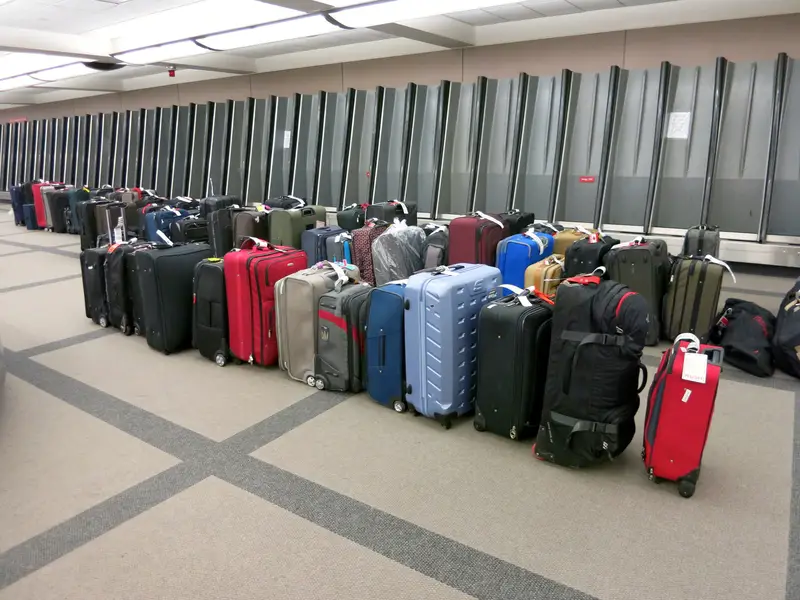
United Airlines is the carrier most likely to lose your suitcase, and the gap between it and everybody else is not small. Counting United and its United Express regional partners, the airline mishandled 0.72 bags for every 100 checked in 2025, the worst rate of any major network flying in the United States.
That comes from Department of Transportation data. The DOT counts a bag as mishandled if it gets lost, delayed, damaged, or pilfered, so that number covers every way your stuff can go sideways.
The industry average sat at 0.52 bags per 100. United came in at 0.72. American Airlines was next at 0.66. Flying United, statistically, you are about 40 percent more likely to have a bag problem than the average traveler.
In real numbers, that worked out to more than 550,000 bags on United and United Express that showed up late, went missing, or arrived beat up in 2025.
American Loses More Bags Than Anyone, Just at a Better Rate
Rate is one thing. Raw count is another. American Airlines put more bags on planes than any carrier in the country in 2025, over 110 million of them, and mishandled more than 720,000. That is the highest total of any U.S. airline.
Stretch the window out and it looks worse. Across 2024 and 2025 combined, American racked up about 1.6 million lost or damaged bags. United crossed a million in the same stretch.
American also had the highest cancellation rate among reporting networks in 2025 at 2.36 percent, and its on-time rate was only 73.5 percent. When flights get canceled and rebooked, bags and passengers stop traveling together. That is one big reason the bags pile up.
The Airline That Barely Loses Anything Is One You’ve Probably Skipped
Allegiant Air, the no-frills carrier out of Las Vegas, had the best baggage record in the country in 2025. It lost or damaged about 0.13 bags for every 100 it handled. Nobody else came close.
The reason is almost funny. Allegiant charges you for everything, including carry-ons, so passengers pack as light as humanly possible. Fewer bags in the system means fewer bags to lose. Its average add-on fee runs about $27.60, some of the steepest in the business.
Allegiant also flies point to point instead of routing everyone through big hubs. Your bag gets loaded once and unloaded once. There is no middle stop where it can get sorted onto the wrong plane.
Southwest Handles a Mountain of Bags and Still Barely Drops Them
This one is a genuine shocker. Southwest moves more checked bags than almost anyone, a legacy of the years when every passenger got two free. Two free bags now come only with the top fare bundle or the top elite tier. The airline handled roughly 32 million more checked bags than United and 7 million more than Delta in 2025. More bags should mean more problems.
It doesn’t. Southwest posted one of the lowest mishandling rates of any U.S. carrier, despite ranking near the top in sheer volume. JetBlue did the same, finishing among the very best for lost bags while carrying a huge passenger load.
The takeaway is blunt. Volume does not decide how often an airline loses your stuff. Operations do. Some carriers just run tighter ships than others.
Why the Giant Airlines Struggle
United and American are not losing bags because their workers are careless. They lose bags because of how they are built. Both run enormous hub-and-spoke systems, funneling passengers through mega-airports like Chicago O’Hare and Dallas/Fort Worth.
Every connection is a chance for something to go wrong. Your bag has to come off one plane, cross the airport, and get loaded onto another, often in under an hour. Ground crews are racing the clock. Miss that window and your bag catches a later flight without you.
Transfer bags are the single biggest cause of delayed luggage, about 39 percent of cases worldwide last year. Add in staffing gaps, packed terminals, and bad weather that jams up the automated sorting machines, and the misroutes multiply. United’s basic economy fare, which allows a personal item but no free carry-on, also pushes more people to check bags they would rather keep with them.
The Worst Months to Fly If You’re Checking a Bag
Timing matters more than most people think. January is the worst month for baggage, with 0.70 percent of bags lost or damaged, the highest of any month. July is right behind at 0.68 percent, and December comes in third at 0.61 percent.
Winter storms and holiday crowds are the culprits. Snow shuts down runways, delays cascade across the network, and the sorting systems fall behind.
Want the smoothest stretch? Fall travel, and October specifically, sees the lowest rates of mishandled luggage all year. Fewer crowds, calmer weather, cleaner handling.
A $29 Gadget Cuts Your Odds of a Truly Lost Bag by 90 Percent
The best defense against a lost bag costs less than dinner. Where a passenger shares an AirTag’s location with the airline through SITA’s WorldTracer system, the air-transport tech company says the number of truly lost bags falls by 90 percent. Close to 30 airlines have plugged into it so far.
Airlines using it also report cutting delayed-bag recovery time by 26 percent. Since a software update in December 2024, you can generate a link in Apple’s Find My app and send it to the airline, whose staff sign in to watch your bag move on a map and go grab it.
An AirTag runs $29 for one or $99 for a four-pack. Android users can grab a compatible Bluetooth tracker instead. The TSA and FAA allow them in checked bags because the tiny battery inside falls within the rules for the cargo hold. One traveler described watching their bag get unloaded from the plane in real time.
Getting Your Bag Back Can Take Months
Losing the bag is only half the headache. Getting the airline to make it right can drag on. United advertises the fastest claim resolution at about one month, and Delta averages roughly a month and a half. JetBlue and Alaska both take around three months to close a claim.
Delta is worth watching too. It ranked second for on-time flights in 2025, behind Hawaiian, but its baggage numbers have been sliding, from 0.44 mishandled bags per 100 to 0.46 across the two most recent twelve-month windows. And when an airline replaces a damaged bag, it often just hands you a choice from a set list of luggage, which may not match what you lost.
How to Cover Yourself Before You Check In
Keep the stuff you cannot replace out of the checked bag. Medication, jewelry, cash, your passport, and pricey electronics belong in your carry-on where you control them.
Strip off every old tag and barcode sticker before you drop your bag. A leftover sticker from your last trip can send your suitcase to the wrong city on its own. And don’t cut it close to the drop-off cutoff, which can be 45 to 90 minutes before takeoff.
Your credit card may already have your back. The American Express Platinum covers up to $2,000 for lost checked luggage and $3,000 for carry-on, capped at $3,000 per person in total, and the Capital One Venture X offers up to $3,000 per trip on top of whatever the airline pays, as long as you paid for the ticket with the card.
Alaska Airlines makes a promise almost nobody else does. Since 2010, if your checked bag doesn’t hit the carousel within 20 minutes of your flight landing, Alaska hands you a discount code or bonus loyalty miles. Worldwide, SITA says mishandling rates dropped 23 percent in 2025, the best result outside the pandemic years. That still leaves United at the back of the class.

