

You probably have a canister of salt sitting on your kitchen counter right now, and you’ve never thought twice about it. It seasons your eggs. It goes on your fries. Maybe you toss some into pasta water when you remember. But here’s the thing: people around the world have been scattering salt in the corners of their homes for thousands of years, and the reasons go way beyond cooking. Some of it sounds like old superstition. Some of it actually has a practical logic that makes you stop and think. Either way, it costs about two bucks to try, and the results might catch you off guard.
It’s One of the Oldest Rituals on the Planet
This isn’t some TikTok trend that popped up last week. The practice of placing salt in corners traces back over 6,000 years to Vastu Shastra, an ancient Indian system of architecture and spatial design that actually predates feng shui. The Romans did it too. They believed salt could drive away negativity, and the old custom of throwing salt over your left shoulder to prevent bad luck? That comes straight from Roman tradition.
Japanese sumo wrestlers still throw salt into the ring before every match. It’s not for traction or grip. They do it to purify the space and remove bad spirits before they compete. Catholic priests have historically used salt during exorcisms. Whether you buy into the spiritual side or not, the sheer number of unrelated cultures that independently landed on the same practice is, at minimum, pretty interesting.
The Feng Shui Angle Is More Specific Than You’d Think
In feng shui, salt isn’t just tossed around randomly. There’s a whole system behind it. Practitioners believe that stagnant “chi” (energy) collects in the corners of rooms the same way dust bunnies do. Corners are dead zones where air doesn’t circulate well, and in feng shui theory, energy behaves the same way.
One feng shui method recommends putting a pinch of salt in all four corners of your house specifically to “mop up fiscal fiasco energy.” Yes, that’s the actual phrase. The idea is that you clean out or replace the salt every week until things feel better. Another approach: stream a pinch of salt along your doorstep to attract good chi and abundance into the home. There’s even a recommendation to put a pinch of sea salt in your wallet and replace it weekly. The logic is that salt draws energy to it, and wallet energy is money energy. Replace it weekly, and it also forces you to clean out your wallet, which, honestly, most of us need to do anyway.
One Person Tried It for 10 Days Straight
A writer who had been feeling stuck and restless at home decided to run a 10-day experiment after researching the history of salt in spiritual practices. They carefully sprinkled salt in each corner of their home on Day 1, expecting nothing.
By Day 2, they reported a slight lightness in the air. A sense of calm that settled over them when entering each room. By Days 3 and 4, things got weirder. Misplaced objects turned up in unexpected places. Minor household problems resolved themselves without anyone intervening. Their mood shifted noticeably. They started tackling tasks they’d been procrastinating on for weeks.
By Days 5 and 6, they noticed a clear improvement in their sleep. Falling asleep came easier. Waking up felt refreshing instead of groggy. Their dreams became vivid and memorable, with themes of clarity and resolution. The living room felt more inviting. The kitchen felt more alive. The bedroom felt calm.
Now, is that the salt? Is it placebo? Is it just the psychological effect of doing something intentional in your space? Hard to say. But the person who did it called the experience genuinely transformative and said the final act of sweeping up the salt on Day 10 felt like clearing away the past and starting fresh.
Salt Actually Does Repel Certain Pests
Here’s where things shift from spiritual to practical. Salt works as a real, functional insect deterrent against specific pests. When salt contacts an insect’s body, it draws out moisture through osmosis. That’s not folklore. That’s chemistry.
It’s particularly effective against ants. Sprinkling salt along their trails or around the perimeter of your home disrupts the pheromone signals they use to navigate. Ants rely heavily on these scent trails to find food and communicate with the colony. Salt scrambles the signal, and they go looking for another route. You can also dissolve salt in water and spray it directly on ant nests or around entry points.
Slugs and snails are extremely sensitive to salt. Contact with salt draws water out of their bodies and dehydrates them. Spiders are also deterred by salt. One pest control company recommends mixing a salt and water solution and spraying it wherever you suspect spider nests. So when your grandmother told you to put salt in the corners to keep bugs away, she wasn’t making it up. She just didn’t explain the science behind it.
It Pulls Moisture Out of the Air
Salt is hygroscopic. That means it naturally absorbs moisture from the surrounding air. If you’ve ever left a salt shaker out on a humid day and watched it clump up, you’ve seen this in action. Scattering salt in the corners of damp rooms, like basements, bathrooms, or laundry rooms, helps reduce the humidity in those spaces.
High humidity creates conditions where mold and mildew thrive. Salt’s moisture-absorbing property creates a drier environment that’s less hospitable to mold growth. For damp areas, you can scatter a thin layer of salt in the corners and replace it regularly. It’s not going to replace a dehumidifier in a seriously wet basement, but for mild dampness in a bathroom corner or a slightly musty closet, it actually does something measurable.
It Kills Odors in Carpets and Corners
This one is straightforward and genuinely useful. Salt absorbs odors. If you sprinkle salt on a carpet or rug, let it sit for a few hours, and then vacuum it up, it pulls out smells that have settled into the fibers. Mix the salt with baking soda and the effect gets even stronger. If you’ve got a room that just smells “off” and you can’t pinpoint why, putting small bowls of salt in the corners works as a passive odor absorber. It’s the same principle as putting an open box of baking soda in your fridge, just applied to a room.
What Kind of Salt Should You Use?
If you’re going the spiritual or energy-cleansing route, the general consensus is: skip the regular table salt. One practitioner specifically recommends against industrially processed salt because it doesn’t feel natural enough for the ritual. Sea salt is the go-to recommendation because it’s affordable, easy to find at any grocery store, and has larger, irregular crystals. Rock salt works just as well and costs even less.
Himalayan pink salt is another popular option, especially if you want those trendy salt lamps. But for basic room cleansing with bowls in the corners, cheap rock salt does the job just fine. Save the fancy pink stuff for cooking or a lamp that gives off a warm glow. Both sea salt and rock salt have larger crystal structures compared to fine table salt, and the bigger surface area is thought to be better at absorbing whatever’s floating around in your space.
How to Actually Do It Right
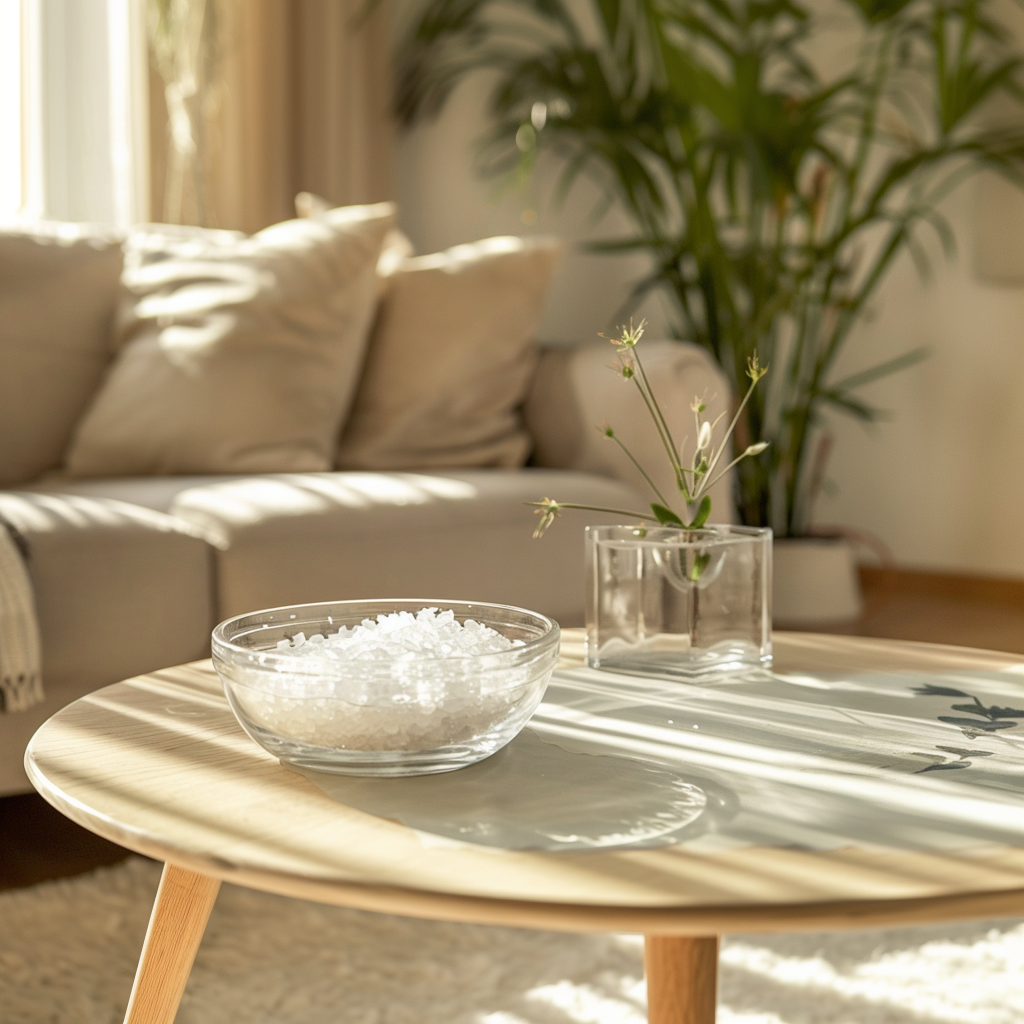
The process takes about two or three minutes per room. Grab some inexpensive rock salt or sea salt. Fill small bowls about halfway and place one in each corner of rooms that feel particularly tense or heavy. A bedroom after a rough week. A living room after a family argument. A home office where you just can’t focus.
Leave the bowls for 24 hours to a few days, depending on whose tradition you’re following. Then dispose of the salt properly. Dump it down the toilet or rinse it away under running water. Don’t toss it in the regular trash and definitely don’t dump it back in the salt container. The whole point is that the salt has absorbed whatever was in the room, and you want it gone.
Some people do a whole-house salt clearing once a month as regular maintenance. Others only pull out the salt when something feels off. You can also add salt to your mop water for a floor cleanse that takes zero extra time on top of your normal cleaning routine.
One more tip from the spiritual side: avoid porous bowls like untreated wood. Salt will eat into the material over several days. Glass, ceramic, or even a small plastic dish works better.
The Lemon and Salt Trick
Here’s a bonus trick that circulates in folk tradition: take half a fresh lemon, pile a handful of coarse salt on top of it, and place it in the living room behind the door. The combination is supposed to absorb bad energy. The tell? If the lemon and salt turn black within a week, the tradition says that’s proof there was negativity in the space. Throw the whole thing away outside the house (bury it if you can) and replace it with a fresh one.
Does it actually detect negative energy? Probably not in any scientific sense. But a lemon and salt turning black is just oxidation and moisture absorption doing their thing, and it does function as a crude indicator of air quality and humidity levels in a space. So even the most skeptical person might find that detail mildly interesting.
Is Any of This Real?
The pest control part? Yes, documented. The moisture absorption? Yes, basic chemistry. The odor removal? Absolutely works. The energy cleansing and spiritual protection? That depends entirely on what you believe. But here’s what’s hard to argue with: setting an intention, doing something deliberate in your space, and paying attention to how your rooms feel is not nothing. Even if the salt itself is just sitting there being salt, the act of placing it with purpose forces you to slow down, look at your home differently, and decide what kind of space you want to live in. That alone is worth the two dollars.

