

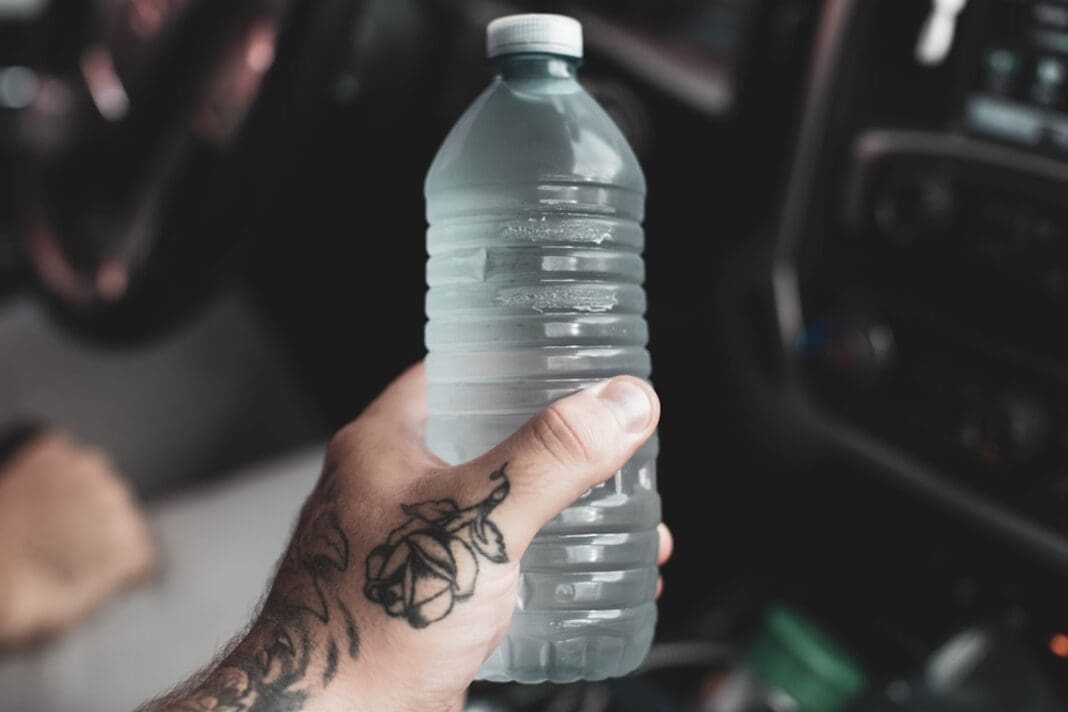
A clear plastic water bottle sitting on your car seat in direct sun can burn your upholstery. Not warp it. Not fade the color. It can scorch holes straight through the seat. Firefighters have the burn marks to prove it, and the physics behind it is the same trick bored kids use to torch ants with a magnifying glass on the sidewalk.
Most of us toss a bottle in the cupholder or on the passenger seat and never think twice. That bottle is a lens. Give it strong sunlight, a dark surface, and a little time, and it stops being a drink and starts being a firestarter.
The Idaho Guy Whose Truck Started Smoking
Dioni Amuchastegui was a battery technician for Idaho Power, working outside in 100-degree heat in Boise back in July 2017. He climbed into his truck for an early lunch and noticed something out of the corner of his eye. Smoke. Light was bending through a plastic water bottle on the seat and had already started to catch the seat on fire.
When he told his coworkers, a bunch of them figured he was making it up. So with the company safety director watching, he recreated it on camera. The minute-long clip showed smoke rising within seconds of a bottle being placed in the sun, leaving two small burn holes in the leather. The video blew up online and got picked up by fire departments across the country, including the Midwest City Fire Department in Oklahoma, which decided to run its own test to see if it was real. It was.
How a Bottle of Water Turns Into a Lens
The science is almost annoyingly simple. Sunlight hits the curved wall of a clear bottle, slows down as it passes through the water, and bends toward a single point on the other side. Instead of the sun’s energy spreading across your whole seat, it gets crammed into one tiny dot. That dot gets hot fast.
Michael Doutre, then a chemist at the Getty Conservation Institute studying plastic, put numbers to it. After sunlight passes through a car window, it can hit a seat with about 600 watts per square meter of energy, roughly the output of a small electric space heater, spread across a whole square metre rather than a point. Focus all of that into one pinpoint with a curved bottle and you have a problem. “We think of this as a cheap water bottle,” Doutre said, “but we’re unintentionally creating an optically almost-perfect shape for a lens.”
When firefighters recreated the effect, they burned clean through a dark sheet of paper. David Richardson, a spokesman for the Midwest City Fire Department, said a concentrated beam can exceed 400 degrees Fahrenheit on a dark surface within seconds, and that vinyl generally starts to burn around 455. “It wouldn’t take very long to start a fire if conditions were right,” he said, “depends on how focused that beam of light is.”
Your Parked Car Is Already an Oven Before the Bottle Does Anything
The reason this works so well inside a car is that the cabin is already an oven. Most of the heating happens fast: in the standard study of the effect, four fifths of the temperature rise arrived in the first thirty minutes. Run into the store on a 90-degree day and your car can be past 120 by the time you get back.
It gets worse the longer you leave it. Cars parked in the sun gained an average of 43 degrees in an hour, and the rise was much the same whatever the starting temperature. A mild 72-degree day put the inside of the car at 117. A 95-degree afternoon lands you near 138.
Then there are the surfaces themselves. A dark dashboard or seat, the meteorologist Jan Null reckons, often sits between 180 and over 200 degrees. That is a dry, baking, dark target just waiting for a concentrated beam of light to land on it. The seat is halfway to ignition before the bottle even does its thing.
The Bottle Does Not Have to Be Full
The experts who have looked at this describe a bottle full of clear liquid. But Jeffrey Baumgardner, a senior research scientist at Boston University’s Center for Space Physics, told investigators a bottle can act as a lens with or without some liquid inside. A half-drunk bottle rolling around your footwell is not automatically safe.
The bottle does not even need to be perfectly shaped. It just needs the right curve, the right water level, and direct sun long enough to cook one spot past what the fabric can take. A stray napkin on the floor, a loose receipt, a plastic bag, any of it can become the thing that catches.
Color changes everything, though. A tinted or opaque bottle blocks and scatters the beam instead of focusing it, which knocks the risk way down. A metal or insulated flask does not act as a lens at all, so it never concentrates light onto a single point. If you are the type who leaves a bottle rolling around your car all summer, that is the swap worth making.
It Has Already Done Worse Than Car Seats
This is not a car-only party trick. A three-alarm fire in Stoneham, Massachusetts, in March 2021 did more than $700,000 of damage and injured two firefighters. It took investigators a year to trace it to the same effect. Investigators determined that the sun’s rays had focused through glass bottles left on a deck in direct sun for about five hours, concentrating onto paper and other combustible material until it caught fire.
Peter Ostroskey, then the Massachusetts state fire marshal, called it uncommon but definitely not unheard of. “We’ve seen several fires involving windows, mirrors and other glass surfaces,” he said. “This was the first one we can remember involving glass bottles, but there’s no question these surfaces can concentrate sunlight into a competent heat source under the right circumstances.”
The recipe, according to the people who study this, is specific. You need a smooth, round, transparent bottle holding clear liquid, sitting at just the right distance from both the light and whatever it is aimed at. Line those up and you have built a firestarter by accident. It is rare because all those conditions have to click at once. Rare is not never.
Cold Weather Does Not Save You
People assume this is a Texas and Arizona thing. It is not really about the outside temperature. It is about direct sunlight. Anytime strong sun hits a parked car, even in a cooler climate, the cabin can heat up enough for a focused beam to scorch fabric. As Richardson put it, the air temperature does not matter. The sunlight does.
What makes the whole thing sneaky is that the bottle gives zero warning. It does not glow, buzz, or crackle. It just sits there looking like the most boring object in your car while quietly aiming a hot dot at your seat. It feels too ordinary to be a threat, which is exactly why nobody moves it.
What to Actually Do About It
The fix costs nothing. Grab the bottle when you get out of the car, or at least toss it somewhere the sun cannot reach it, like under a seat or in the glovebox. Firefighters recommend keeping clear bottles out of direct sunlight, and the same warning applies to any clear container holding liquid, not just the disposable ones.
If you ever get in your car and smell something burning, or spot a small cigarette-sized scorch mark starting to form, the move is simple: shove the bottle out of the light to break the beam. That alone stops it. Open the doors, look for hotspots on the seats, carpet, or dash, and let some air in. Richardson put it plainly. “It’s not a crisis,” he said. “We don’t know of this happening or becoming a contributing factor of car fires in our district, but the potential does exist.”
Dioni Amuchastegui caught his seat in time and walked away with two little holes in the leather and a story his coworkers refused to believe. He was lucky he glanced over when he did. Next time you leave a bottle baking on the passenger seat, remember you have basically built a tiny sun-powered lighter and pointed it at your own upholstery. Takes two seconds to grab it. Take the two seconds.

