

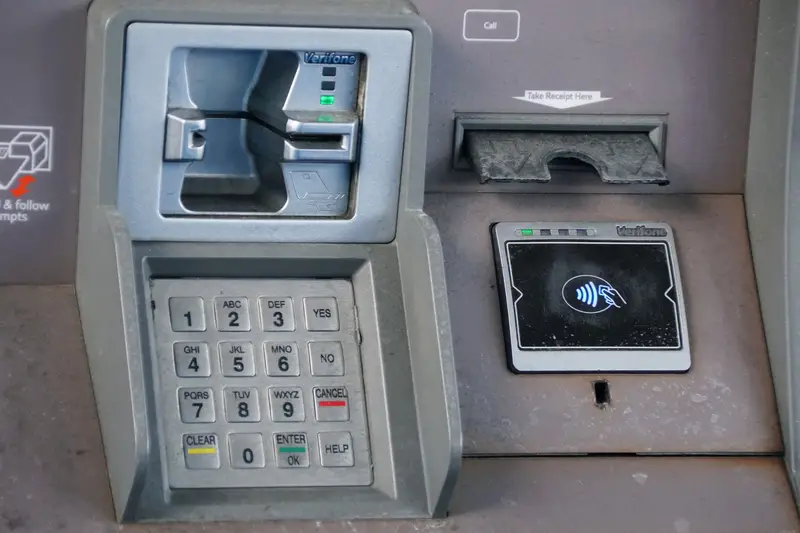
An 83-year-old man stood at an ATM on Colorado Boulevard at around 11:35 a.m. on Jan. 15. A man in a baseball cap stood close enough to read his fingers on the keypad. A $20 bill landed on the ground behind him. Somebody tapped his shoulder and pointed at it, so he turned around to pick it up.
He took his card out of the slot and walked off. By 1 p.m., two people were at a bank on North San Fernando Boulevard pulling money out of his account, according to the Los Angeles Police Department. The card in his pocket was not his card.
Police say the pair work in a coordinated manner. One watches the PIN go in. That same person drops the bill, taps the shoulder, and plays good Samaritan. While the victim is turned around, the second person steps up to the machine and, in the LAPD’s words, “removes the victim’s ATM card from the machine and replaces it with a counterfeit card that closely resembles the original.” The victim takes the fake, walks off, and has no reason to look at it again until the money is gone. The LAPD released photos of a bearded man in a baseball cap and a woman in a white jacket, and says the two are tied to a string of identity thefts.
Three People Arrested In California Over The Same Move
The Orange County Sheriff’s Department arrested three Romanian nationals on Jan. 6 in what it says was an ATM distraction theft operation running across several California counties. Romita Achitei, Paul Agafitei and George Asafiei face multiple felony charges, including grand theft, identity theft and forgery. Investigators have linked the three to thefts in Orange, San Bernardino, Los Angeles, San Francisco and Sacramento counties.
One case lays out the choreography. A 66-year-old man used an ATM at a bank in Villa Park on Nov. 18, 2025. One suspect allegedly watched him type his PIN. Money was dropped at his feet so he would bend down, and while he did, a second suspect swapped his card for a fake. Then the thieves used his card and PIN to shop and pull out cash. He figured out his card had been compromised the next day and reported it on Nov. 22. Surveillance video from the bank pointed investigators to a grey SUV.
At least a dozen victims have been hit, authorities said, and the sheriff’s department believes there are more. Its advice is blunt about strangers in a parking lot or near a card reader: do not allow any stranger within arm’s reach.
The ATM That Acts Broken On Purpose
Philadelphia police spent an April news conference on a different trick, one that never touches your card at all. A device gets slipped into the cash dispenser to jam the ATM’s roll door. You punch in your withdrawal, the machine counts out the money, and nothing comes out. It looks dead, or out of money. The bills are sitting right there behind the stuck door, waiting for the thief to come back, pop off the plate and pocket them.
Captain Robert McKeever, who commands the Major Crimes Unit, said that since March 15, 2026, police had found the device at nine different locations around the city. Over the weekend of March 28, 2026 alone, officers were called to five bank locations where the things were attached to ATMs. Most of it happens on Saturdays and Sundays, and that is not laziness. It is the plan.
“Because now the branch is closed, he won’t be disturbed. And also, when people go in there, if it doesn’t give them the money, the branch is closed and now they can’t take care of it until Monday,” McKeever said. Police also released surveillance images of two masked men and said the suspects may have left in a dark-colored SUV with a possible New Jersey registration. Anyone with information is asked to call 215-686-TIPS (8477).
It Is Called Cash Trapping, And It Costs Almost Nothing To Pull Off
Most ATM crime chases your card number. This one chases the actual twenties. That is why it is called cash trapping instead of skimming, and why it is spreading. There is no electronics skill involved, no cloning, no dark web resale. It is a piece of metal and a bracket, and it goes on machines with a roll-down dispenser door.
The reason it works has nothing to do with technology. It works because a broken ATM is boring. Nobody stands there arguing with a machine on a Sunday. They shrug, walk to the next one, and plan to call the bank later. Philadelphia police are asking people to do the opposite: watch the account balance, and check the machine before trusting it.
Two Wawa ATMs, Up To 100 Customers
A customer at the Wawa in Hilltown Township, Pennsylvania pulled his card out of the ATM on May 5, 2026 and noticed a small piece of a cloning device stuck to it. Employees checked the machine and found a camera attached to the front. They kept checking over the next several days. About a week later they found a second skimming device installed on another ATM in the same store.
By August, employees at Quakertown National Bank were telling investigators that cloned cards were being used to pull money out of victims’ accounts. Detective James Towhey of the Hilltown Township Police determined the suspects were driving rental cars down from New York and hitting 7-Eleven and CVS stores in three other Pennsylvania counties too. One has been identified as Grozea Daragiu, a Romanian national. The second has not been identified. Towhey said the men could have hit 50 to 100 customers at the Bucks County Wawa by itself.
His advice is the grab-and-wiggle test. “If it doesn’t look right, grab a hold of it. If you wiggle it or pull on it and it comes off, pieces aren’t supposed to come off ATMs once they’re installed,” he said.
The Skimmer Nobody Found Until A Technician Opened The Machine
Boston police officers from District D-14 in Allston/Brighton were called to the 7-Eleven at 241 Market Street in Brighton on Aug. 13, 2026 for a skimming device on the ATM inside. It was not spotted by a customer. It turned up when the machine was being serviced, which is the uncomfortable part. Devices planted inside the card reader slot are often impossible to see from the outside, and the pinhole cameras that record your PIN can have a lens the size of the tip of a ballpoint pen.
The department published the tells worth knowing: a card slot that feels tighter than usual, a panel made of a slightly different material than the rest of the machine, a small hole near the keypad or reader, missing store or manufacturer decals, broken lights, a raised PIN pad, loose parts, stickers stuck in odd places. At checkout counters, the version criminals use is a plastic overlay built to look exactly like the top of the terminal. Cards without chip technology, including EBT cards, are especially vulnerable. If a terminal at a register feels loose, tell the clerk and use a different one.
411 Devices Pulled Off Machines In One Year
The Secret Service ran 22 anti-skimming operations in cities around the country in 2025, including Los Angeles, Washington, D.C., Anchorage, Boston, Orlando, Charlotte, Buffalo, San Diego, New York City, San Antonio, Baltimore, Tampa, Atlanta, Savannah, Memphis, Miami and Pittsburgh. Agents and local partners visited more than 9,000 businesses, inspected nearly 60,000 point-of-sale terminals, gas pumps and ATMs, and removed 411 illegal skimming devices. The estimated loss prevented was more than $428.1 million. Skimming is estimated to cost American financial institutions and consumers more than $1 billion a year.
Store owners often have no idea. Secret Service financial analyst Vincent Porter described a Boston bakery owner who was so upset at the device found in his shop that he started crying, as much for his customers as for himself. And the thieves come back. “Within days, or even hours, of educating the store owners, scammers had come back to the store and installed more devices,” Porter said. This time the owners knew what to look for and spotted them right away.
There Are Usually Two Devices, Not One
Michael Peck, an assistant special agent in charge at the Secret Service, says the setup is usually a pair. “For an ATM, they’re going to put a small device inside of it. And usually, a device on the outside that is stealing not only our card information, but your PIN number that they can then use to access your cash,” Peck said. Gas pumps get the same treatment, one piece in the card slot and one on the face.
Before you put a card in anything, the agency says to look for loose parts, tape or glue residue, and to skip any pump that looks different from the others at the same station. Tourist areas get hit hard. Running a debit card as credit at the pump keeps your PIN out of play, and tap-to-pay keeps the card out of the slot entirely.
The Gas Station Machine That Is Not A Bank ATM
Adrian, Michigan police warned in August about a run of crypto ATM losses, with multiple victims in the city losing nearly $10,000. The callers pose as law enforcement and threaten arrest unless the person pays immediately, then steer them to a gas station machine and have them scan a QR code. Lane Montz, president and CEO of the Better Business Bureau of Northwest Ohio and Southeast Michigan, said the machines themselves are perfectly legal. The trick is getting you to feed one.
“Nobody that says you have to pay some sort of a debt by cryptocurrency… that is not valid. There’s no government agency that will take crypto as a payment,” Montz said. He added that the losses cannot be reversed: “Nobody, not even the government, can get it back.” Adrian police have put warning flyers above the machines around town.
The Thirty Seconds That Protect You
Tug on the card reader before you use it. McKeever put it plainly: if something does not look right on the machine, pull on it a little and see if it moves. Cover the keypad with your free hand every single time, even inside a bank lobby, because the person behind you may be reading your fingers rather than waiting his turn.
Do not turn around. Money on the ground behind you at an ATM is bait, and the people who use that bait are counting on your manners. Finish the transaction, take your card, and look at it before it goes back in your wallet. If the machine eats your withdrawal and gives you nothing, stay put and call the bank right then, because walking away is the entire point of the trap door.

