

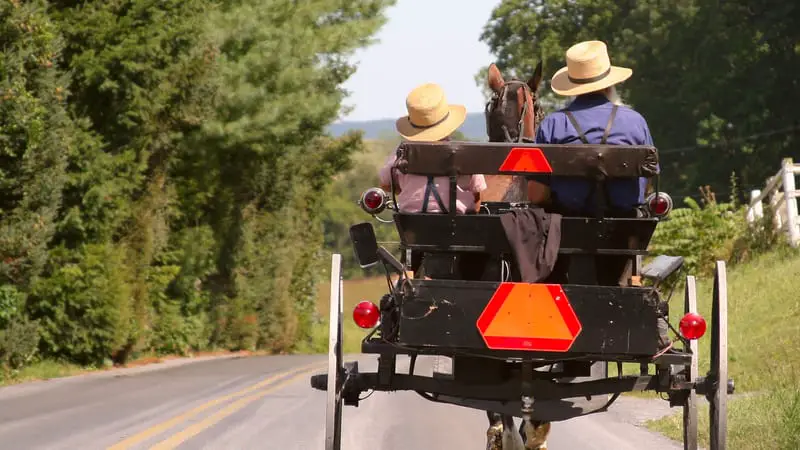
Out in the farm fields of Lancaster County, Pennsylvania, there are small wooden sheds with telephones inside. Several Amish families share each one, and that is where rides into town get booked, often days or weeks ahead of time. “It looks like an outhouse,” said Lee Allan Cisney, who was 56 when the Philadelphia Inquirer profiled his family in 2019 and makes his living driving Amish passengers around rural Pennsylvania.
His family has been doing it since 1975, when an Amish neighbor asked Carl Cisney for a ride to a welding shop. Carl was out of work. He did the favor, and once he got there, other Amish men told him he could turn it into a job.
They were right. The Amish do not own cars and do not drive them, but most of them will ride in one without a second thought, and their non-Amish neighbors have built an entire paying trade out of that gap. In Pennsylvania, the state issues a license for it.
The Rule Is About Owning, Not Riding
Amish churches object to two things: owning a car and operating one. Sitting in the passenger seat is a separate question entirely, and most communities permit it. That one distinction explains the whole arrangement.
A car in the driveway would mean a family could live anywhere, attend any church, shop in any city and leave whenever the mood struck. Buggy range keeps households clustered tight around their church district, and the closeness is the entire point. People who cannot drive themselves have to ask each other for help, and that asking is what holds the place together.
Then there is the status problem. Cars come in every size, color and price, and not everybody could afford the same one. A buggy is a buggy. Nobody’s is faster or flashier.
The rules behind all of this are called the Ordnung, the German word for order, discipline, rule or arrangement. Among the Amish it is largely unwritten. There is no central church government, so every local district is its own authority and the rules shift from one district to the next. Underneath it sits Gelassenheit, usually translated as yieldedness, letting be, or submission to the will of God.
In Lancaster County, one local guide notes, the line against ownership is drawn hard enough that Amish business owners are not permitted to lend a non-Amish employee money to buy a vehicle, either.
Pennsylvania Hands Out A License For This
Doing favors is fine. Carpooling is fine. Charging money to haul Amish passengers in Pennsylvania requires a permit from the state Public Utility Commission. Drivers like the Cisneys are licensed paratransit operators, cleared to “transport people whose personal convictions prevent them owning or operating motor vehicles,” said PUC spokesperson Nils Hagan-Frederiksen.
About 167 people held that specific license as of 2019, and 99 of them were in Lancaster County alone. Another 29 applications had come in during the previous 12 months. Plenty of drivers skip the paperwork, but the PUC patrols the area and hands out fines of up to $1,000 to individuals caught transporting Amish passengers without a permit.
When Carl started in 1975, he charged 25 cents a mile plus $2 for every hour of waiting time. By 2015 he was getting 90 cents a mile and $8 an hour, and in 2019 the family charged 80 cents to $1.30 a mile, Lee Allan Cisney said.
“It’s safe to say that for decades, there’s been demand for this type of transportation,” Hagan-Frederiksen said, calling it “an interesting carve-out that serves a need.”
Rides Get Booked From A Shed In A Field
No app, no five-minute pickup, no surge pricing. Trips are arranged days or weeks in advance over the landline phones in those shared shanties, and a driver’s calendar fills up the way a plumber’s does. On one afternoon in 2019 Cisney had to turn down an Amish caller because he already had a morning and afternoon run booked, including taking a young couple to pick out a wedding gift.
The vehicle is usually a 15-passenger van, and the ride is usually shared with other Amish families headed the same direction. One trip often covers several errands in a row: a doctor’s appointment, the bank, a big grocery run that would take all day by buggy.
All that friction is intentional. A trip you have to plan a day ahead and pay for by the mile does not become a habit.
A Horse Sets The Daily Limit
Buggies travel at roughly 5 to 10 miles per hour and have a range of 15 to 20 miles before the horse needs rest. That is the real boundary of Amish daily life, drawn by an animal.
Ben Kauffman, 68, who runs Kauffman’s Lancaster County Produce at Philadelphia’s Reading Terminal Market, said the most a horse can handle in a day is a 40-mile round trip. “All depends on the horse, of course,” he added. Kauffman makes the long morning run into the city by van, driven by a non-Amish employee, which needs no special permit because the driver is simply another worker. “I sleep on the way there, but I can’t sleep on the way home,” he said.
No Ducks, Boots In Bags, And One Baby
Carl Cisney, who was 78 in 2019, built up house rules over four decades behind the wheel. Passengers have asked to bring chickens and ducks inside the van. The answer has always been no. Amish men take their boots off and put them in bags, particularly after a barn raising.
In a 1978 snowstorm he picked up a passenger who was very pregnant and then, quite suddenly, was not. The baby girl born in his van was named Sarah, after his wife Sarah Jane, who came to help. Carl cannot stand the sight of blood. “I jumped out of the van and said, ‘I’ll see you later,'” he said.
Other runs were worse. He drove a man to the hospital after he shot a nail through his foot into a barn beam with an air hammer; co-workers cut the wood out and it arrived at the emergency room still attached to him. Another time Carl was handed two severed fingers on ice in a shoe box, the result of an accident at a pallet shop, and told to drive. He did not make it in time.
Gossip turned out to be the hardest part of the job. Every new customer wanted to know where the last one had been dropped off, so Carl posted a sign by the dashboard: “Don’t ask me where the last person went and I won’t tell the next person where you were going.”
Drivers pick things up over the years, even without learning Pennsylvania Dutch. If the Amish women in the back are talking fast, the Cisneys said, they are talking about the driver. Younger passengers want the radio on, country for the most part, with some Christian music mixed in.
Some Churches Refuse The Whole Arrangement
The Swartzentruber Amish, one of the most conservative groups, allow car travel only in an emergency. Visiting relatives in a distant settlement means a bus or a train. The rule reaches into their work, too: a Swartzentruber carpentry crew cannot take jobs outside horse-and-buggy range.
One Plain group went the opposite direction. The Lobelville community in Tennessee, usually classed as para-Amish rather than Old Order, has one or two members who can drive, and the community owns a van together. The thinking, as one writer on Amish life explains it, is that doing it themselves makes them less dependent on outsiders, not more.
Hiring A Driver Is Not Cheap
In small, conservative settlements, hiring a driver is still rare. In the big ones it can happen weekly or daily, and the mileage bills can offset much of what a family saves by never making a car payment or paying for insurance.
On the other side of the windshield, the work is real work. One full-time Pennsylvania driver was putting roughly 80,000 miles a year on his vehicle in 2016 and charging $1 a mile. Waiting time is billed by the hour. A standing market run can mean a 4 a.m. alarm.
The job tends to attract retirees and people between jobs, Sarah Jane Cisney, then 75, said. Lee Allan took over the family business in 2018 after quitting a longtime job at a titanium foundry in Morgantown. Benny Perez, a former EMT in New York City who used to visit Lancaster County on vacation with his kids, now drives a Chevy van with “God be with you” written across the bug guard. “I’ve been haulin’ Amish for about three years now,” Perez told the Inquirer in 2019.
Bicycles Are Banned, Rollerblades Are Not
Most church districts in Lancaster County do not permit bicycles. Push scooters are common there, as they are in Allen County, Indiana. Rollerblades are widely accepted in Lancaster, mostly by kids and teenagers getting down the road. Midwestern communities ride bikes freely; Arthur, Illinois is flat enough to make it easy.
Trains are fair game, and some Amish spend three days aboard one on a long cross-country trip. Greyhound carries them between cities, and specialty coach lines such as Pioneer Trails run to Pinecraft, the Amish settlement in Florida that fills up as a winter vacation spot.
Airplanes are the firm no. Flying is seen as worldly and unnecessary, and nearly all churches forbid it except in emergencies such as a Life Flight helicopter. New Order Amish, a few percent of the population, do fly. The handful who travel to Europe go by ship, the same way their ancestors crossed in the 1700s. Some Amish in Lancaster County book deep-sea fishing charters.
Teenage boys often get a buggy of their own around 16, when they start going with the youth. Some young people get a driver’s license and a car for a stretch before joining the church, which is tolerated because they have not joined yet.
From the outside, hiring a neighbor to drive you looks like a loophole, a way to have the car without breaking the rule. It is closer to a toll. Every ride costs money, takes planning and depends on somebody else’s schedule, and those three frictions do exactly what the buggy does. The Amish are not trying to make the outside world unreachable. They are trying to make reaching it inconvenient enough that nobody does it by accident.

