

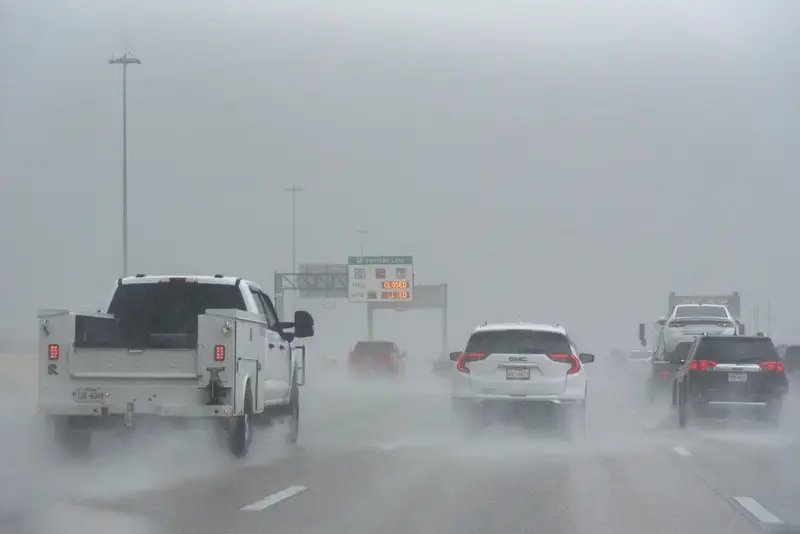
The wipers come on, traffic bunches up, and after twenty minutes of holding a steady 65 your right leg starts to ache. So you tap the cruise control. It feels responsible. You are not speeding, you are not creeping, you are locked in at a legal number and you can relax a little. That habit is the one police departments, sheriff’s offices and fire departments across the country keep begging drivers to break the second pavement gets wet.
The Button Cops Want You To Leave Alone
Cruise control has no idea it is raining. It holds a number, and holding a number is exactly the wrong instinct on a road that changes grip every few hundred feet. A weekly safety column from the Lincoln County Sheriff’s Office in Oregon puts it about as bluntly as a government agency can: if you start to hydroplane while cruise control is engaged, your car will actually speed up. The system is built to hold a speed, not to notice that your tires just let go of the road. So you can end up gaining speed while your tires are riding on water.
The San José Fire Department lists the same warning in its official rain guidance, along with the plain reason: cruise control can get in the way of your car slowing down while it is hydroplaning. AAA says the same thing in its wet-weather tips. Three different kinds of agencies, same instruction, and almost nobody follows it.
It takes shockingly little water to make this real. The Lincoln County column says one-twelfth of an inch of water on the road and a speed above 35 mph is all it takes to hydroplane. That is a puddle you would not notice in your shoes.
The Worst Part Of A Storm Is The Start
Most people assume the dangerous moment is the middle of a downpour, when the sky is dumping and you can barely see the lane. It is the opposite. Roads are at their slickest right as the rain starts, because weeks of oil, grease, brake dust and rubber sitting on the asphalt mix with the first water into something closer to a lubricant than a wet surface. The longer the dry spell before the storm, the greasier that film is.
That mix is more slippery than plain water, and it catches drivers at their least prepared, because almost nobody slows down or backs off the car ahead in the first thirty seconds of a sprinkle. Later in the storm, the rain has washed the oil off and the road is grippier than it was when the first drops hit.
There is a tell you can actually see. A rainbow sheen on wet pavement means oil or fluid is sitting on top of the water. Steer around it if you can, and ease through it if you cannot.
The scale of this is not small. The Federal Highway Administration estimates that 75 percent of weather-related vehicle crashes happen on wet pavement and 47 percent happen while it is actually raining. Nearly 5,700 people are killed and more than 544,700 are injured in wet-pavement crashes in a typical year. Snow and ice get the news coverage. Rain does the damage.
Hazard Lights Are Not Rain Lights
Flip on your four-ways in a downpour and you probably think you are being visible and considerate. AAA says to stop. Hazard lights traditionally mean one thing on American roads: this vehicle is disabled. Running them while you are still moving tells everyone behind you that you are stopped, which is a terrible thing to communicate on a crowded interstate in heavy rain. On a lot of cars they also tie up your turn signals, so nobody knows which way you are about to go.
Headlights are the correct answer, and they are not optional in a lot of places. In California, drivers are legally required to turn headlights on whenever rain or mist keeps the wipers running, under Vehicle Code 24400. Many other states have the same wipers-on, lights-on rule. Skip the high beams, though. In pouring rain they bounce off the water in the air and make things worse, not better.
If visibility drops to the point where you genuinely cannot see, AAA’s advice is to pull off the road. On surface streets, a parking lot beats the curb. On the interstate, AAA says to take an exit instead of stopping on the shoulder, because the driver behind you is squinting through the same curtain of water you are and the shoulder is where they will end up. Standing on the shoulder in a storm is one of the worst places to be on an American highway.
When The Car Starts To Slide, Your Foot Is The Problem
Every instinct says brake. Every instructor says do not. Santa Maria Police Department Traffic Officer Nicholas Barton told KSBY that the move when a car begins to hydroplane is to simply get off the gas.
“Just come off the gas. You’ll end up causing more loss of control if you end up just slamming on the brakes because the vehicle is now trying to gain traction with the roadway,” Barton said. “Just bring your vehicle down to a slow speed and then the tires will eventually gain traction again with the roadway.”
Steer straight while that happens, or gently in the direction you actually want to go. No jerking the wheel. The San José Fire Department’s guidance adds one exception worth knowing: if your car has anti-lock brakes, you can brake normally rather than pumping, which is advice that confuses a lot of drivers who learned to drive in the 1980s.
Barton also had a number for puddles that most people never think about. On a road where you would normally run 40, he said drivers should be down around 30 or 25 approaching a big puddle so they do not lose control.
You Can Get A Ticket Doing The Speed Limit
This one surprises people who have been driving for decades. Speed limit signs do not change when the weather does, but most states enforce what is called the basic speed law, which requires you to drive at a speed that is safe for current conditions. Translation: you can be cited for going too fast for conditions while sitting under the posted number, and if you spin out at 65 in a torrential storm, fault can land on you even though the sign said 65.
How much slower? A common rule of thumb, one the San José Fire Department uses, is to cut your speed by about a third when the road is wet. Seventy-five becomes something closer to 50. Sixty becomes 40. AAA says even brand-new tires can start losing some contact with the road at speeds as low as 35 mph, which should end the argument about whether your fresh set of all-seasons makes you immune.
Federal data shows how little most drivers actually back off. Freeway speeds drop just 3 to 17 percent in heavy rain. On main roads with traffic lights, the drop on wet pavement runs 10 to 25 percent. People are slowing down a little and feeling virtuous about it.
Four To Eight Seconds, Not Two
Barton’s recommended following distance on wet roads is four to eight seconds. Pick a sign or a shadow, watch the car ahead pass it, and start counting.
The reason that gap needs to double is that both halves of stopping get worse at once. The time it takes you to recognize a problem and the distance it takes to haul the car down both stretch out in the wet. You are reacting slower to a car that is harder to see while riding on tires with a third less grip.
Give semis an absurd amount of room. A loaded 18-wheeler can weigh 80,000 pounds and needs about 525 feet, almost two football fields, to stop from 65 mph in good conditions. Wet pavement makes that worse, and the spray coming off the trailer will blind you while you sit in it. Pass or hang back, but do not live alongside one in a storm.
The Puddle That Eats Your Car
There is a simple test for flooded pavement from the San José Fire Department: if water is covering the road markings, it is too deep to cross. Turn around and find another route. The National Weather Service says just 12 inches of rushing water can carry off most cars. That is about twice the height of a standard curb.
Standing water also hides what is underneath it, including washed-out pavement, open potholes and downed power lines. “Wet pavement can turn roads into a slip and slide in seconds,” said Adrienne Woodland, spokeswoman for AAA-The Auto Club Group, in a warning to Michigan drivers.
Then there is the part that hits your wallet. AAA says a flooded vehicle often means thousands of dollars in repairs, and that damage is not covered by a standard auto policy. It falls under comprehensive coverage, which you have to be carrying before the storm arrives. If your car does stall in rising water, do not try to restart it, because that is how you turn an engine problem into a dead engine. Get out and get to higher ground.
The Stuff Nobody Checks Until The Sky Opens
Wiper blades are rubber and rubber dies. AAA puts their useful life at six to twelve months, and says to replace them sooner if they streak, skip or blur your view instead of clearing the glass in one pass. Do not forget the rear one if you have it.
Tires matter more than anything else on this list. AAA recommends rotating them every 5,000 to 7,500 miles to keep wear even and cut hydroplaning risk, and checking pressure at least once a month, spare included. AAA says to replace tires once tread gets down to 4/32 of an inch, well above the 2/32 that many state laws allow. In AAA’s own testing, tires worn to 4/32 took about 87 more feet to stop on wet pavement than new ones.
One last habit worth adopting: water pools in the outer lanes, where the crown of the road sheds it. If the middle lane is open, take it. And when your windows fog, hit the air conditioning rather than wiping the glass with your sleeve, which just smears it and takes your hand off the wheel.
None of this requires buying anything. It requires leaving earlier, keeping your foot on the pedal instead of on the cruise control, and accepting that the number on the sign was written for a dry Tuesday.

