

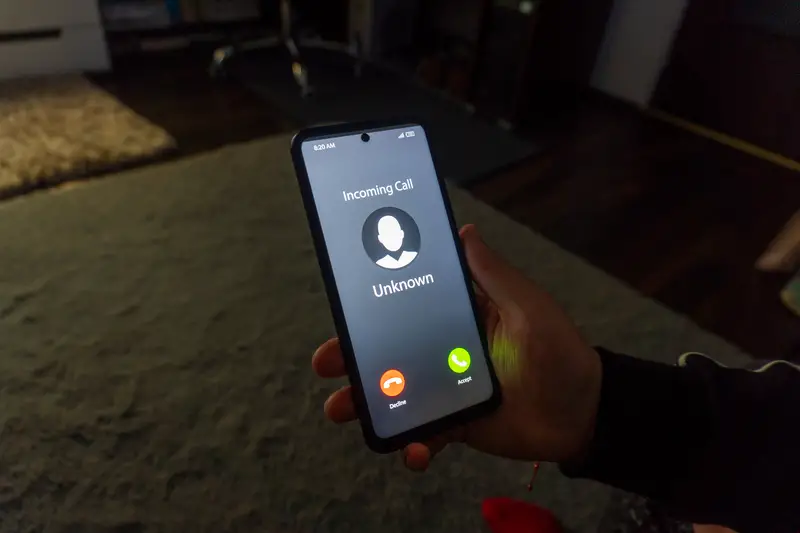
Your phone rings. You glance at the screen. The number looks normal, maybe even local. So you pick up. And just like that, you’ve walked into a trap that costs the average victim $3,690.
Here’s the thing most people don’t realize: that number on your caller ID? It means absolutely nothing. Scammers can make any number they want appear on your screen. They can look like your bank, your local police department, even the IRS. And the tricks they’re using in 2025 are more sophisticated than anything we’ve seen before. Let me walk you through exactly which numbers should make you hit that red button, and what happens if you don’t.
The 833 Area Code Is the Biggest Red Flag Right Now
If you’ve been getting calls from numbers starting with 833, you’re not alone, and you’re right to be suspicious. An analysis of FTC complaint data covering over 608,000 unique phone numbers found that the 833 area code leads the entire country in complaints, with 19,520 complaints generated by just 892 numbers. That’s an absurd concentration of bad actors.
And it’s not just 833. All seven of the most complained about area codes are toll-free prefixes. You know those 800, 888, 877, 866 numbers that companies use for customer service? Scammers love them because toll-free numbers are portable, meaning they can be routed to literally any location on Earth. A call displaying an 833 number could be originating from a basement in another country. The area code tells you the number type, not where the caller is sitting.
On average, toll-free numbers generate nearly twice as many complaints per number (16.9) compared to local numbers (8.8). So when one of these pops up on your phone and you don’t recognize it, let it go to voicemail. Every single time.
The Caribbean Numbers That Look American But Aren’t
This one catches a lot of people off guard. There’s a whole category of scam called the “One Ring” scam (or “Wangiri,” which is Japanese for “one ring and cut”). Your phone rings once, maybe twice, then stops. You see the missed call. You think, “Huh, someone tried to reach me.” You call back. And suddenly you’re racking up charges on a premium-rate international number that can cost up to $50 per minute.
The genius of this scam is that the numbers look completely American. Several Caribbean nations are part of the North American Numbering Plan, which means their phone numbers follow the exact same format as U.S. numbers: country code 1, plus a three-digit area code, plus seven digits. Your phone can’t tell the difference, and neither can you just by glancing at the screen.
The FTC has specifically linked the following area codes to one-ring scam activity: 268 (Antigua and Barbuda), 284 (British Virgin Islands), 473 (Grenada), 664 (Montserrat), 649 (Turks and Caicos), 767 (Dominica), 809, 829, and 849 (Dominican Republic), and 876 (Jamaica). There’s also been a new wave tied to country code 222, which belongs to Mauritania in West Africa.
Write those down. Stick them on a Post-it next to your phone. If you see any of those area codes and you don’t know someone in the Caribbean, do not call back. You aren’t missing anything important. You’re dodging a bill.
The “Press 1 to Stop” Trick That Gets Everyone
You answer a call and hear a robotic voice: “Press 1 to be removed from our calling list.” Sounds helpful, right? You just want the calls to stop. So you press the button. Congratulations, you just confirmed to a scammer that your number belongs to a real, living human who actually answers the phone. According to the FCC, scammers use this exact trick to build lists of active numbers, which they then sell to other scammers or hit with even more targeted attacks.
The same goes for answering “yes” or “no” to any question. Some scammers will open with something like, “Can you hear me?” Your natural response is to say yes. But there are reports of these recordings being used later for fraudulent authorizations. The safest move when you get a suspicious call is to say nothing and hang up. Don’t press any buttons. Don’t confirm your name. Don’t engage at all.
4.5 Billion Robocalls in a Single Month
If it feels like you’re getting more junk calls than ever, the data backs you up. In February 2025 alone, U.S. consumers received approximately 4.5 billion robocalls. That’s not a yearly total. That’s one month. Spam robocalls increased by 20% in a single year, and they’ve now passed the average levels seen in 2019, before Congress passed the TRACED Act, which was supposed to fix the problem.
The money lost to phone scams jumped 16% from the first half of 2024 to the first half of 2025. And the Do Not Call Registry? It now has a record 258 million registered phone numbers, which tells you both that people are desperate for relief and that the registry alone isn’t solving the problem. Illegal callers, especially ones operating from overseas, simply don’t care if your number is on a list.
Here’s a number that made my jaw drop: a single voice service provider called Lumen transmitted 886.2 million SSA and IRS impersonation calls. One company. Nearly a billion fake government calls flowing through its network.
That “Local” Number Probably Isn’t Local
Scammers figured out years ago that people are way more likely to answer a call that looks like it’s coming from their own area code. This technique is called “neighbor spoofing,” and it remains one of the most effective tricks in the book. The number on your screen might share your first six digits. It looks like someone down the street is calling. But the person behind it could be anywhere in the world.
There’s one particularly nasty example. Area code 934, an overlay for Long Island, New York, has only 30 high-complaint numbers, but those numbers average 26.7 complaints each. That’s the highest per-number rate of any local code in the country. It suggests a small but extremely active operation using a real New York area code to build trust with victims.
The same data found area code 315 (Syracuse, New York) generating 2,798 complaints from just 123 numbers. Again, a concentrated operation using a familiar, regional code to seem credible. So even if a call looks local, that doesn’t mean it is.
International Codes That Should Immediately Raise Suspicion
Beyond the Caribbean area codes, there are international country codes that pop up over and over in scam reports. Country code +7 (Russia and Kazakhstan) is commonly used for phishing and fake customer support calls. Country code +91 (India) is frequently associated with tech support, online banking, and IRS impersonation schemes. And country code +232 (Sierra Leone) has been flagged repeatedly in connection with one-ring callback scams.
More than 21% of Americans fell victim to a scam call in 2023, and that percentage has only grown since. If a number pops up with an unfamiliar country code, or if you see a “+” before a number you don’t recognize, that’s a strong signal to let it ring out. No legitimate American business or government agency is going to call you from an international line and demand personal information.
What the Phone Companies Are (and Aren’t) Doing About It
The government mandated something called STIR/SHAKEN, a system designed to verify that the number showing up on your caller ID is actually where the call is coming from. Sounds great in theory. In practice? Of the 9,242 phone companies that filed with the FCC as of September 2025, only 44% have completely installed it. That number actually dropped from 47% the year before. We’re going backwards.
In August 2025, the FCC did take a major step by essentially shutting down 1,203 phone companies for non-compliance, forbidding other carriers from transmitting any calls through their lines. That’s a big deal. But with billions of calls pouring in every month, enforcement is always playing catch-up.
Your carrier does offer some tools worth turning on. AT&T has Call Protect, which automatically blocks fraud calls and warns about suspected spam. Verizon’s Call Filter identifies spam and lets you report numbers. T-Mobile offers Scam Shield, which includes a proxy number feature that can keep your real number hidden. These aren’t perfect, but they’re better than nothing.
The Simple Rule That Protects You
If someone calls claiming to be from your bank, the government, or any company, hang up and call the number on their official website or your account statement. That one habit alone defeats the majority of phone scams in circulation right now. Legitimate organizations will never pressure you to act immediately, demand payment via gift cards, or ask you to confirm your Social Security number over the phone.
Also, just Google the number. It takes five seconds. If a number has been used in scams, there’s a very good chance other people have already reported it online. Free tools like Truecaller can flag known spam numbers before you even pick up.
The 258 million Americans who’ve registered on the Do Not Call list had the right idea, but that list can only stop callers who follow the law. The ones who don’t follow the law are the exact ones you need to worry about. Your best defense isn’t a government registry. It’s the red button on your phone, and the willingness to use it on any call that doesn’t feel right.

