

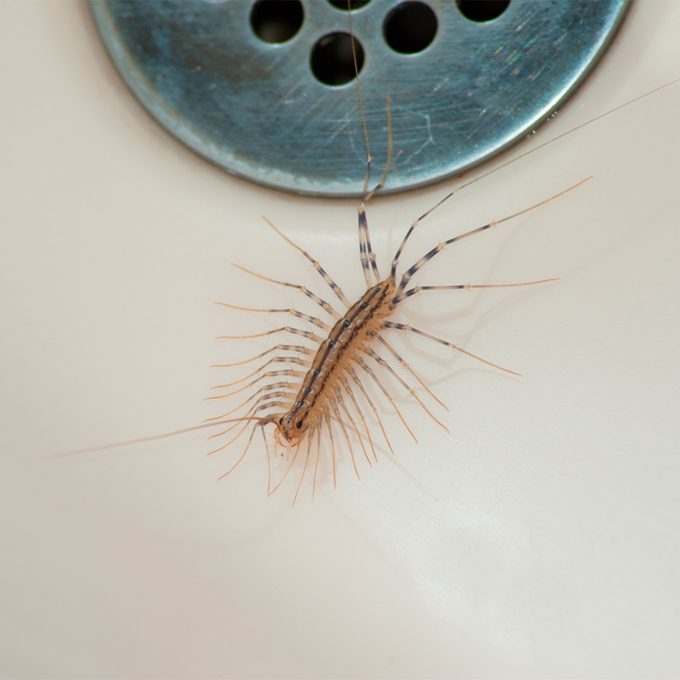
You’re brushing your teeth at 11 p.m. and something darts across the bathroom floor so fast it barely registers. You look down and see it: a flat, yellowish, many-legged creature that looks like it crawled straight out of a nightmare. Every instinct in your body says grab a shoe and end this thing immediately.
I get it. I’ve been there. But here’s the thing: that bug is almost certainly a house centipede, and killing it is one of the worst things you can do for your home. That creepy little speed demon is actually doing you a massive favor, and once you understand what it’s up to, you might even feel a little grateful. Maybe. Let’s not get carried away.
What Exactly Is That Thing?
The house centipede, officially known as Scutigera coleoptrata, is the most common centipede species found in American homes. It’s usually about one to one and a half inches long in body length, but those wild, banded legs make it look much bigger, sometimes appearing three to four inches from tip to tip. Adults have 15 pairs of legs, and the rear pair on adult females can be nearly twice the length of the body itself. That’s a design choice that actually serves a purpose: prey can’t easily tell which end is the front and which is the back.
The body is a dirty yellow color with three dark longitudinal stripes running from head to tail. The legs are banded light and dark, giving the whole creature a look that most people would describe as “absolutely not welcome in my house.” Fair enough. But appearances can be deceiving.
Here’s a fun fact that makes them even creepier: house centipedes aren’t even from here. They’re native to the Mediterranean region and were accidentally introduced to the southern United States. The first recorded sighting was in Pennsylvania in 1849. Since then, they’ve spread throughout the entire country and, frankly, the entire world.
They’re Faster Than You Think
If you’ve ever tried to catch a house centipede, you already know this. These things can move at about sixteen inches per second. That’s more than a foot per second for something the size of your pinky finger. Some sources put it at 1.3 feet per second. Either way, they are shockingly fast, and good luck smashing one before it vanishes behind your toilet.
That speed isn’t just for running away from your flip-flop, either. House centipedes are active hunters. They don’t sit around in webs waiting for dinner to show up. They sprint after their prey, pounce on it, and wrap it up in all those long legs like a net. Researchers at the University of Georgia have described their hunting technique as “lassoing,” where they literally jump on a bug and ensnare it with their legs before delivering a venomous bite.
Yes, they’re venomous. They have a pair of modified front legs called forcipules that act as fangs, injecting venom to paralyze prey. But before you panic, their jaws aren’t strong enough to easily pierce human skin. In the rare case one does bite a person (usually only when handled roughly), it feels like a mild bee sting. They almost always run from humans instead.
Your Free, 24/7 Exterminator
Here’s where it gets interesting, and where the argument for keeping them alive becomes genuinely convincing. House centipedes eat the bugs you actually hate. We’re talking cockroaches, silverfish, carpet beetle larvae, spiders, flies, ants, moths, crickets, termites, and even bed bugs. That’s basically a greatest hits list of household pests.
A single house centipede can consume dozens of unwanted insects each week. They hunt primarily at night when most other bugs are active, which means they’re working the night shift while you sleep. They don’t build nests or webs. They don’t eat your food. They don’t chew on your furniture or your clothes. They don’t transmit diseases. They don’t damage anything in your house. They just hunt.
Think about that for a second. Professional pest control services can cost hundreds of dollars per visit to deal with cockroach or termite infestations. House centipedes do the same job for free. Unlike chemical pest control methods, they specifically target live, moving prey rather than contaminating surfaces or leaving residues. They’re like having a tiny, terrifying security guard patrolling your baseboards around the clock.
They’re Trying to Tell You Something
This is the part most people miss. Seeing a house centipede in your bathroom isn’t just about that one bug. It’s a signal. Michael J. Skvarla, an assistant research professor of arthropod identification at Penn State University, has explained that while a single centipede might not mean much, seeing many of them usually indicates an underlying pest problem. The centipedes are there because they have something to eat.
Pest control professionals have inspected hundreds of homes where customers called about centipedes. In most cases, they found active cockroach populations hiding under bathroom sinks or silverfish infestations in storage areas. The centipedes were the symptom, not the problem. Killing the centipede is like smashing the smoke detector because the beeping annoys you. The fire is still burning somewhere.
If you’re seeing centipedes in your bathroom specifically, there’s a reason for that too. These creatures need moisture to survive. They lack the waxy, moisture-preserving cuticle that most insects have, so they dry out quickly. That’s why they gravitate toward damp spaces like basements, bathrooms, and areas under sinks. A dripping showerhead or slow drain creates the perfect environment, not just for centipedes, but for the drain flies and roaches they’re hunting.
The Life Cycle Is Wilder Than You’d Expect
House centipedes don’t just pop into existence fully formed with all 15 pairs of legs. Newly hatched larvae start with just four pairs. Over the course of five larval molts, they gradually gain more: 5 pairs, then 7, then 9, 11, and 13. After that, they’re considered adolescents with 15 pairs, and they’ll molt four more times before reaching full adulthood. That’s a lot of costume changes.
The word “centipede” literally means “100 legs,” but house centipedes never actually have 100 legs. With 15 pairs, they max out at 30. Other centipede species can range anywhere from 15 to 177 pairs, but the house variety keeps it relatively modest. Females prefer soil for laying eggs, and they can produce between 60 and 150 eggs at a time according to some estimates. So yes, for every one you see, there could be many more elsewhere. But since they’re nocturnal and tend to avoid humans, most of them stay out of sight.
They also have surprisingly long lifespans compared to most household arthropods. Established individuals can keep providing their pest control services for years, not weeks or months. That’s a long time to have a free exterminator on staff.
If You Really Can’t Stand Them, Do This Instead
Look, I understand. Knowing they’re helpful doesn’t always override the pure visceral reaction of seeing one sprint across your bathroom wall at midnight. If you absolutely cannot coexist with house centipedes, please don’t just stomp on them. Relocate them outside where they’ll continue eating pests in your yard. The cup and paper method works: drop a cup or jar over the centipede, slide a piece of paper underneath, and carry it out the door. They’re fast, but it can be done with some persistence.
But the real move is to make your bathroom less appealing to them in the first place. And honestly, the steps are the same ones that will also reduce the bugs they’re hunting. Run your bathroom fan for at least five minutes after every shower to reduce moisture. Fix any leaky faucets or slow drains. Check under your bathroom sink for water stains or dampness on the cabinet floor, because even minor leaks create conditions where roaches and silverfish love to hang out.
Seal cracks and crevices in your foundation, around doors and windows, and along baseboards. Use a dehumidifier in your basement if it tends to stay damp. Clean your drains regularly to remove the biofilm where drain flies breed (those flies are centipede food). Keep crawl spaces clean and well ventilated.
Pesticides Don’t Really Work on Them Anyway
Here’s one more reason not to bother trying to kill them: pesticides are largely ineffective against house centipedes. Because of those crazy long legs, they hold their bodies high off the ground when they move. That means they have very limited contact with pesticide-treated surfaces. You’d be spraying chemicals around your bathroom for almost no practical result.
The smarter approach, as any decent exterminator will tell you, is to eliminate the food source. If there’s nothing to eat, centipedes leave on their own. Set out a few sticky traps around your home to figure out what other bugs might be present. You might be surprised at what you find. That centipede scurrying across your tile floor was trying to handle the problem for you.
The Verdict: Let the Weird Little Guys Live
I’m not going to pretend house centipedes are cute. They’re not. They look like something that escaped from a sci-fi movie, and their speed is genuinely startling. But they don’t bite (almost ever), they don’t wreck your stuff, they don’t spread disease, and they actively hunt the bugs you actually want gone. Cockroaches, silverfish, termites, bed bugs, spiders, flies, moths, carpet beetles. That’s one heck of a resume.
Next time you see one in your bathroom at 2 a.m., take a breath. Let it go about its business. It’s on your side, even if it doesn’t look like it. And if you’re seeing a lot of them? Don’t blame the centipede. Start looking at what else might be living in your walls. Because that’s the real problem, and your house centipede was trying to warn you.

