

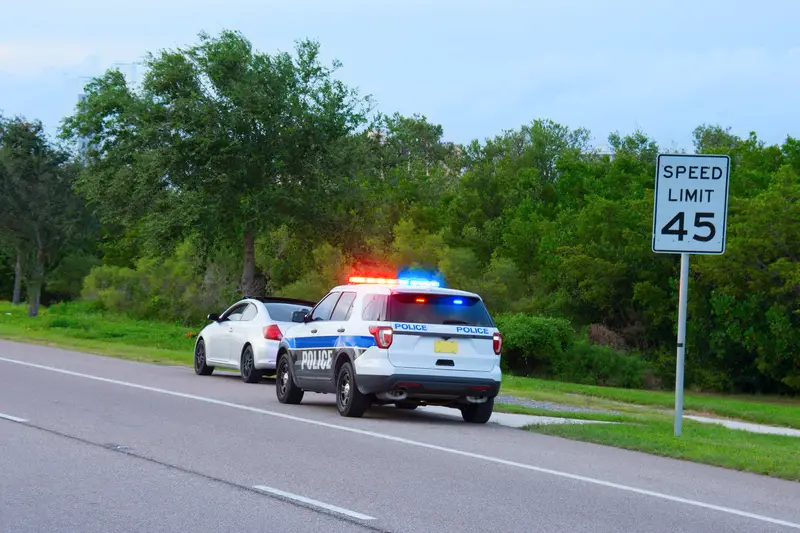
Sitting in the far left lane when you are not passing anyone can get you a ticket, and in some states it does not matter one bit that you are doing the speed limit.
Connecticut is the latest state to tighten the rule. Its law lets police ticket drivers who linger in the left lane without actively passing another car. The state’s own highway safety office lists the fine at $88. The strengthened provisions take effect on October 1, 2026, and the state ran a “Pass Left, Drive Right” ad push in late 2025 to give people a warning.
The left lane is a passing lane. Legally, that is the whole story. There is no such thing as “the fast lane,” no matter what your uncle told you when he taught you to drive. Speed alone does not earn you a spot out there.
Doing the Speed Limit Is Not a Defense
What trips people up is that in a bunch of states the rule targets your lane choice, not your speed. You can be cruising five over the limit and still get pulled over for blocking the left lane.
These are called passing-only states, and the list includes Massachusetts, New Jersey and Missouri, plus Maine on limited-access highways posted at 65 or above. In those places, going exactly the posted limit gives you no cover at all. Montana and Washington look like they belong on that list and do not: both statutes carve out any driver already moving faster than the traffic around them.
Washington State Trooper Kyle Yarbrough put the enforcement view plainly to KIRO Newsradio back in 2018. “It’s law enforcement’s job to police people’s speeding,” he said, “not someone in the left lane.” Translation: get over, even if you feel like you are already flying.
Florida, Texas and Georgia all have versions of this. Florida’s rule bites when a faster car comes up behind you rather than when you simply fail to pass. Georgia flat out bans driving in the left lane when it slows other cars, and there the violation carries three points, which stack toward a suspended license and pricier premiums.
The Fine Swings Wildly Depending on the State
Same exact move, radically different price. Camping in the left lane in Mississippi can be as little as $5. Do it in Wyoming and a first conviction runs up to $200. The gap between the cheapest and the most expensive slowpoke ticket in America is roughly fortyfold.
Louisiana updated its law in 2025 with a $150 fine for first offenders, and a third offense within 12 months can carry jail time. Massachusetts goes up to $100. New York can reach $150 on a first offense, before the state surcharge.
Beyond the money, this habit is a genuine road rage trigger. Slow drivers in the left lane sit near the top of every survey of what makes American drivers angry, and the reason is mechanical rather than moral. Everyone behind starts weaving around the slow car to get past, and a lane full of weaving cars is a lane full of near misses.
Your Hazard Lights Can Get You Stopped
Flicking on your four-ways in a downpour feels like the responsible thing to do. In a number of states it is against the law while your car is moving.
The reasoning is that flashing hazards on a moving vehicle confuse other drivers and disable your turn signals, so nobody can tell which way you plan to go. Illinois names it a specific traffic violation, which gives an officer clear authority to stop you. Florida used to be on that list and is not any more: since 2021 the state has allowed hazards on roads posted at 55 or above when visibility is extremely low.
The truly maddening part is how the rules flip across state lines. A driver crossing the country in one afternoon could find the habit banned outright in Illinois, prohibited in Missouri except as a turn signal, and expressly allowed for bad weather in Indiana and Ohio. How much it costs flips too. Florida treats it as a nonmoving violation while Ohio makes it a minor misdemeanor.
Police Are Watching From Places You Never Think to Look
Phone use behind the wheel is now a primary offense in most states, meaning an officer can pull you over for holding your phone and nothing else. Not weaving, not speeding. In Pennsylvania even the phone in your hand at a red light counts. Florida and Ohio both write in an exemption for a stopped car, so the same gesture is legal there.
New York troopers use unmarked CITE vehicles that blend into traffic and sit up high enough to look down into your car. During an April 2025 campaign, New York State Police wrote 22,867 tickets in a single week, including 4,607 just for distracted driving. The elevated view exists specifically to catch people who drop the phone into their lap the second they spot a cruiser.
Pennsylvania takes it a step further. Under Paul Miller’s Law, distracted drivers face $50 fines plus court costs, and the year-long grace period of warnings ended in June 2026. State troopers also ride inside big construction vehicles in Turnpike work zones as part of “Operation Orange Squeeze,” radioing descriptions to patrol cars waiting down the road. Hiding the phone below the wheel does not work when someone is looking straight down into the cab.
South Carolina’s Hands-Free Act took effect in September 2025 and citations began in February 2026. Its language is strict: you may not “hold or support, with any part of the body, a mobile electronic device.” Louisiana started issuing penalties on January 1, 2026, though outside school and construction zones handling a phone there is a secondary offense, so an officer needs another reason to stop you first.
Cameras That Ticket You With No Officer in Sight
Automated enforcement has moved way past the old red-light camera at your local intersection. Pennsylvania and Maryland run work-zone speed cameras that clock you and mail a civil violation with no officer standing there. Florida’s version covers school zones only, Michigan has authorized cameras but not switched them on, and Ohio still requires an officer at the roadside.
Pennsylvania starts with a warning, then charges $75, then $150 for anyone caught 11 mph or more over in an active work zone. Maryland runs from $60 to $500 at 12 over. The camera does not care that you were keeping up with everyone else, and it stops writing warnings after the first one.
The fine is rarely the whole cost either. A distracted driving conviction follows you to the insurance renewal, which is where a $50 ticket quietly turns into a bigger number.
The Merge Everyone Fights Over Is Actually the Law
You know the driver who rides an ending lane all the way to the cone and then squeezes in, and everyone silently hates them? That driver is right. It is called the zipper merge, and a Minnesota Department of Transportation study found it can cut the length of the backup by as much as 40%.
Illinois went as far as putting it in the statute book, though not in the way people repeat. Public Act 101-0174 tells the Secretary of State to teach the zipper merge in the Rules of the Road, and that is all it does. There is no duty to let anyone in and no penalty for refusing. The late merger is following the state’s own advice, not the law.
Tailgating is the other habit that gets underrated. Rear-end collisions make up about 29% of all crashes nationwide, according to the National Highway Traffic Safety Administration. The car-length rule most people were taught has been retired. Driver handbooks now teach a three-second gap, counted from the moment the car ahead passes a fixed object, and four seconds in bad weather.
And watch for the expanded “move over” rules. Since January 2026 California has required you to slow down or change lanes for any stopped vehicle showing hazard lights or another warning device, not just cop cars and ambulances. So the same hazard lights that can get you ticketed while moving can also force the traffic around you to give a wide berth once you are safely stopped on the shoulder. Cars are strange that way.
Most of this comes down to one idea police keep repeating. The left lane is for passing, your phone belongs in the glove box, and the flow of traffic is a shared thing, not a personal one. Cheap advice compared to a $200 ticket in Wyoming.

