

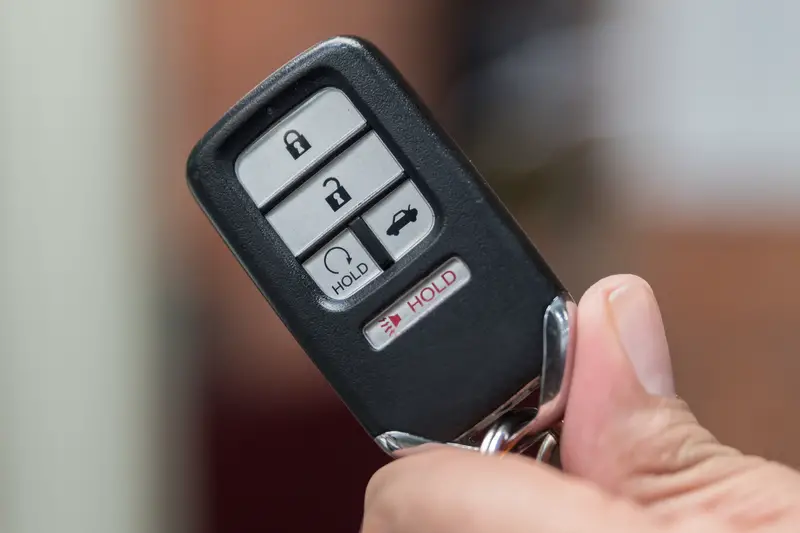
Your keys are probably sitting in a bowl by the front door right now, or still in the coat you hung up. That is where almost everyone leaves them. Move them twenty feet tonight, onto the nightstand, and you change what you are able to do at 2 a.m. when the dog starts growling at something in the driveway. The panic button on your fob sets off your car’s horn and lights from inside the house, and on most vehicles it runs for anywhere from about 30 seconds to a few minutes before shutting itself off.
The button you have only ever pressed by accident
Most modern vehicles include a panic function that triggers the horn and flashing lights, and the noise carries down the block. The point of a car alarm was never to stop a theft on its own. It exists to make a lot of people look in one direction at once, which is the single thing an intruder is least interested in. A horn going off in the driveway also tells whoever is at your back door something they did not know a second earlier: somebody in this house is awake.
Range is the part nobody checks. Key fobs run on weak, short range radio, and drywall, brick and distance all eat into the signal. Whether yours reaches the driveway from the bedroom depends entirely on your layout and where the car sits. A fob with a dead coin battery transmits nothing at all.
Not every fob has the feature. Some do not include a panic button, and some owners have never located it. Press yours in the driveway on a Saturday afternoon, in daylight, when a blaring horn is an annoyance rather than a 911 call from a confused neighbor.
The neighbors are the actual alarm system
Rich Kinsey, a retired Ann Arbor police detective sergeant who wrote about crime and safety for AnnArbor.com, has said the idea has merit, with one condition attached that most people skip. “The key components of this panic button alarm system are your neighbors,” he wrote. If you plan to use the fob this way, tell the people around you first, explain why, and ask them to call police if they ever hear your horn going and going.
Nobody nearby to hear it changes the math completely. In that case, Kinsey wrote, you are depending on the horn alone to scare someone off, and you would be better served by an alarm system, a dog, or a firearm kept for home defense. A car honking at an empty cul-de-sac is just noise.
He also flipped the advice around for the rest of us. If you are the neighbor, and a car alarm down the street will not stop, call police. Officers will find the vehicle, run the plate, or knock on the door if the car is in a driveway or garage. The horn that woke you up at 3 a.m. might be somebody asking for help in the only way they can.
Fact-checkers graded this one mixture of true and false
The chain email version of this tip has been bouncing around inboxes since at least July 2006, and when it was graded that August, it came back as a mixture of true and false information. The mechanics check out. The premise, that people come running when a car alarm goes off, does not. Decades of false alarms have taught everyone within earshot to ignore them.
How sensitive are these things? One person writing to Miss Manners about the nuisance described watching a stray cat set an alarm off by walking eight feet away from the car. Wind does it. A pigeon landing on a side mirror does it. A purse brushing a fender does it.
That training runs deep enough to be dangerous. After a Montreal family was tied up and robbed in their home in 2003, a neighbor described hearing the alarm and assuming it was a car. The neighbor admitted to being desensitized to alarms and decided to close the window because the noise was a bother. A home alarm got mistaken for a car alarm and ignored.
There is a cheaper move that works on the same psychology. Flipping on a light inside the house tells an intruder someone is home and awake, which is the whole thing a burglar is trying to avoid. It costs nothing, wakes nobody, and does not make the street hate you.
It worked in Albuquerque, and the details are hard to read
In 2000, an assailant accosted 23-year-old Tanya Cass in the parking lot of a child-care center in Albuquerque. She hit the panic button, and the alarm apparently drove the attacker away. She had already been stabbed nine times.
Keep that case in the right frame. A panic button can end an attack. It is not a force field, and the noise works on an attacker’s nerve, not on physics. That is also the argument for carrying your keys in your hand across a parking lot instead of digging for them at the car door, which is the one place and moment where the fob is guaranteed to be in range.
Burglars are not mostly coming at night
The nightstand framing of this tip gets the clock wrong. Burglars want an empty house, and the middle of a workday is when houses are empty. The calendar matters too: household burglary runs about 11 percent lower in winter than in summer, according to the Justice Department’s victimization survey.
The scale is still enormous. The FBI estimated 779,542 burglaries in 2024, down 8.6 percent from 2023, which works out to roughly 2,100 a day, or one every 40 seconds.
Entry points are boring and predictable. In one widely cited industry survey, 81 percent of break-ins came through the first floor: 34 percent through the front door, 23 percent through a ground-floor window, 22 percent through the back door, 9 percent through the garage and 4 percent through the basement. Only 2 percent involved the second floor.
The chin trick, which sounds made up
Hold the fob against the underside of your chin and press the button, and the signal can reach somewhat farther than it would otherwise, by a few car lengths in one engineering simulation. The explanation offered for the chin trick is that your head is mostly water, water conducts, and your skull ends up acting as an antenna for a very weak transmitter.
It costs nothing to try in a parking garage when you cannot remember which level you parked on. It is worth trying from the far corner of the house, too, if the fob will not reach the driveway from your bedroom.
Practice it in the dark, including turning it off
Kinsey’s advice was to run short trials: confirm the signal reaches the car from your bed, then confirm you can work the fob with no light, and confirm you can shut the alarm off when it goes off by accident at 4 a.m. He also said to call 911 the moment you trip the panic button, so officers are already rolling while the horn is still sounding.
Dialing is a skill too, and it degrades. Pull the battery or unplug the phone and practice the motion in the dark and without your glasses, because under intense stress, as Kinsey put it, fine motor skills become impaired. The same logic underpins the standard police advice not to go investigate a noise yourself. Stay in a room with a locked door, call for help, and make the noise from where you are rather than walking down a dark hallway toward whatever it was.
The use nobody mentions until it happens
Break-ins are not the only reason to keep the fob within reach. Hand an older parent the car keys before they go out to the yard, and if they fall where nobody can hear them, they can set off the horn and somebody inside the house will know within seconds. It is a free signal that needs no subscription, no installation and no cell service, and it is already on the ring next to the house key.
What actually keeps somebody out
About 60 percent of convicted burglars in a UNC Charlotte survey said an alarm would send them to another target, and most opportunistic intruders are picking the easiest house on the street rather than targeting yours specifically. Deadbolts, outdoor lighting, cameras and a monitored system do the heavy work. So do the unglamorous things: cut the shrubs back from under the windows, chain down the patio furniture, put up a security decal even if there is no system behind it, get a dog, lock the sliding door, and never leave a spare house key in the car.
My verdict on the keys: do it. It costs nothing, it takes one night to build the habit, and a fob on the nightstand is strictly better than a fob in a bowl downstairs. Just be honest about what you are holding. It is a noisemaker with a long reach, not a security system, and the neighbors only come to the window if you have already told them what the honking means.
Test it this weekend. Press the button, see if it reaches, then press it again and time how long it takes you to make it stop. That second number is the one that will matter at 2 a.m.

