

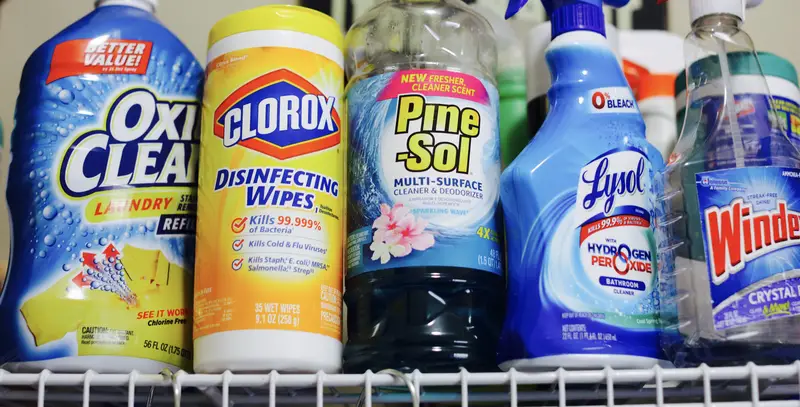
Somewhere under your kitchen sink right now, there’s a good chance two cleaning products are sitting side by side that could, under the wrong circumstances, create a gas potent enough to send you to the emergency room. And no, this isn’t some far-fetched scenario. According to the American Association of Poison Control Centers, accidental exposures to chlorine gas from mixing bleach and acid happened 2,284 times in a single year. That’s just one category of bad combinations. The real number of incidents involving mixed cleaners is much higher.
The two products you should never store together? Bleach and ammonia. Most people know you shouldn’t mix them, at least vaguely. But storing them next to each other is a risk most of us never think about. And the reasons go way deeper than “it smells bad.”
What Actually Happens When Bleach Meets Ammonia
Here’s the chemistry in plain English. Bleach contains sodium hypochlorite. Ammonia is, well, ammonia. When these two chemicals come into contact, they react to produce chloramine gas. Chloramine is nasty stuff. It attacks the lining of your lungs and respiratory tract, and at high concentrations, it can kill.
But it gets worse. If there’s a lot of ammonia relative to the bleach, the reaction can also produce liquid hydrazine. If you’ve heard of hydrazine, it’s probably in the context of rocket fuel. It’s that kind of chemical. Hydrazine is not only extremely irritating to breathe, it’s also potentially explosive if it gets heated or agitated. The reaction itself generates heat, which means the mixture can actually boil and spray hot liquid. So we’re not just talking about bad fumes. We’re talking about a boiling, spraying, potentially explosive chemical cocktail forming under your sink because a bottle tipped over.
Why Storing Them Together Is the Real Problem
Most of the safety advice out there focuses on “don’t mix these products.” And sure, nobody is deliberately pouring bleach into a bucket of ammonia cleaner. The real danger is accidental contact. A cap that wasn’t screwed on tight. A bottle that falls sideways in a cabinet. Residue dripping down the outside of a container onto the bottle next to it.
According to storage safety guidelines, even small drips or residue on the exterior of bottles can trigger a reaction if incompatible products are touching each other. Think about it. How many times have you shoved a drippy bottle of cleaner back under the sink without wiping it down? That sticky ring at the bottom of the bottle isn’t just gross. It’s a potential chemical reaction waiting for its dance partner.
This is why the advice isn’t just “don’t mix.” It’s “don’t store them anywhere near each other.” Separate shelves. Separate cabinets. Separate bins if you can manage it. And always keep them in their original labeled containers so nobody gets confused about what’s what.
You Probably Have Ammonia in Products You Don’t Realize
Here’s where it gets tricky. When people think “ammonia,” they picture a bottle of straight ammonia cleaner. But ammonia hides in a surprising number of common household products. The classic Windex formula contains ammonia (ammonium hydroxide, specifically). That’s the ingredient that makes it so good at cleaning glass without streaks. There are ammonia-free versions of Windex now, but the original blue bottle that most people grab? That’s got ammonia in it.
Some all-purpose cleaners contain ammonia. Certain oven cleaners do too. And as the ammonia market continues to grow (it hit roughly $85.5 billion globally in 2025), with some states banning PFAS chemicals in cleaning products by January 2026, there’s a chance even more products will shift to ammonia-based formulations in the future. Maine and Minnesota are already leading that charge. So the number of ammonia-containing products in your cabinet might actually increase over time.
The point is, you can’t just eyeball it. You have to read the ingredient labels. If one product contains sodium hypochlorite and another contains ammonium hydroxide or ammonia, they need to live in different zip codes under your sink.
The Cat Litter Situation Nobody Talks About
This one catches people off guard constantly. Cat urine contains ammonia. So does human urine, in smaller amounts. If you clean a litter box with bleach, you are mixing bleach and ammonia. Same thing applies to cleaning up pet accidents on carpet, scrubbing a diaper pail, or wiping down the area around a toilet. If there’s any urine residue and you hit it with bleach, you’re creating chloramine gas right there in your bathroom.
Plenty of people have learned this the hard way. You smell something sharp, your eyes start watering, and your throat feels like it’s closing up. That’s chloramine doing its thing. The gas is actually less soluble in water than regular chlorine gas, which means it penetrates deeper into your lungs before reacting with the moisture in your airways. That’s a particularly bad trait for something you might accidentally breathe in a tiny, poorly ventilated bathroom.
Bleach Is Basically the Mean Girl of Cleaning Products
Ammonia isn’t the only thing bleach fights with. Bleach is reactive with a truly absurd number of common household chemicals. Mix bleach with vinegar? You get chlorine gas. Mix it with rubbing alcohol? Chloroform. Yes, the stuff from old detective movies. Mix it with drain cleaner? More chlorine gas. Lemon juice? Same thing, because lemon juice is acidic.
The Washington State Department of Health specifically warns that bleach reacts with ammonia, drain cleaners, acids, oven cleaners, hydrogen peroxide, and even some insecticides. Pool chemicals, which frequently contain calcium hypochlorite or sodium hypochlorite, shouldn’t be mixed with anything either. Bleach doesn’t play well with others. Period.
About 40% of reported injuries from cleaning products involve household bleach. That’s a staggering number when you think about how many different cleaning products exist. Almost half of all cleaning injuries come from this one ingredient.
The “Rainbow Pour” TikTok Trend Making Things Worse
Because of course the internet found a way to make this more dangerous. There’s a social media trend called the “Rainbow Pour” where people dump multiple different colored cleaners into a toilet bowl to create a rainbow effect for video content. It looks pretty. It’s also spectacularly reckless. The trend has been linked to a rise in respiratory issues in 2025 and 2026, because people are literally pouring bleach products, ammonia products, acidic products, and who knows what else into the same small space and leaning over to film it.
Your bathroom is typically one of the smallest, most poorly ventilated rooms in your house. It is the absolute worst place to be creating chemical reactions for content.
Other Pairs That Need to Stay Separated
Bleach and ammonia are the biggest offenders, but they’re not the only dangerous storage combination. Acid-based products (like toilet bowl cleaners and vinegar) should never be stored alongside alkaline products (like drain cleaners and oven cleaners). These sit at opposite ends of the pH scale. If they mix, the reaction generates heat rapidly and can cause containers to burst, spraying caustic liquid everywhere.
Hydrogen peroxide and vinegar is another bad pairing. Together they form peracetic acid, which is corrosive and produces irritating fumes. The Alabama Department of Public Health notes that mixing these two can even cause spontaneous combustion under certain conditions. That’s not a typo. Spontaneous combustion. From two products you can buy at any grocery store.
The Delayed Reaction That Makes This Extra Scary
One of the most unsettling things about chloramine exposure is that some of the worst effects don’t show up immediately. Pulmonary oedema, a condition where fluid fills your lungs, can take several hours to become apparent after exposure. Chloramine gas is sneaky because it’s less soluble in water than chlorine. It slips past your upper airways and gets deep into the tiny air sacs in your lungs before it starts reacting. You might feel okay initially and then get dramatically worse hours later.
This is why medical professionals recommend observation for up to 48 hours after significant exposure. You can’t just “walk it off.” And the gas itself can linger in a poorly ventilated room for hours. Don’t walk back into a room where cleaners were accidentally mixed thinking the danger has passed because the initial smell faded.
Simple Rules That Actually Work
The good news is that preventing this is straightforward. Keep bleach products and ammonia products in completely separate locations. Not separate shelves in the same cabinet. Separate cabinets. Use a plastic bin or caddy for each group so even if something leaks, it stays contained and away from incompatible chemicals.
Never transfer cleaning products to unlabeled containers. It seems obvious, but plenty of people pour leftover cleaner into a random spray bottle and forget what it is. That’s how accidental mixing happens three months later when someone grabs it assuming it’s something else.
Read labels. If something contains sodium hypochlorite, it’s a bleach product. If something contains ammonium hydroxide, it’s an ammonia product. Those two groups don’t get to be neighbors.
And honestly? The biggest takeaway is this: bleach should never be mixed with anything. Not ammonia, not vinegar, not rubbing alcohol, not drain cleaner, not Lysol, not lemon juice. Bleach works great on its own with water. It doesn’t need a sidekick. Every time someone tries to supercharge bleach by adding something else, the chemistry goes sideways fast. If you take nothing else from this, take that. Bleach flies solo. Always.

