

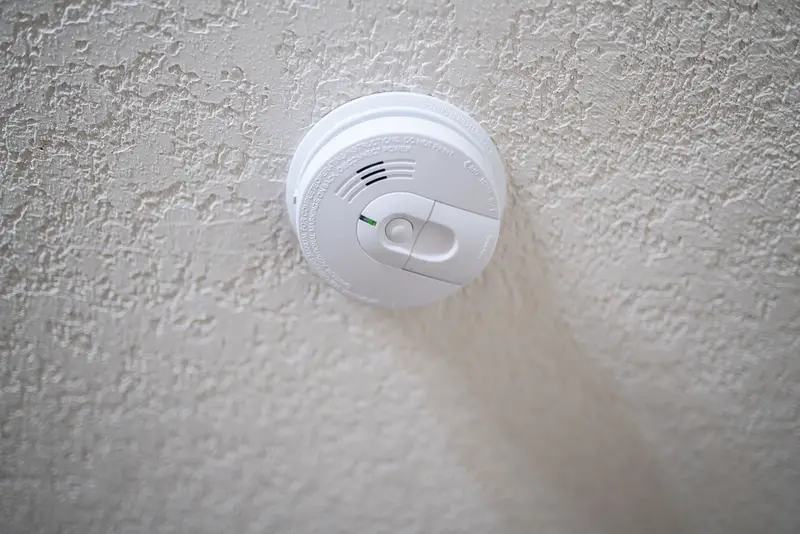
Here’s something that should bother you: there’s a decent chance the smoke detector on your ceiling right now is useless. Not “kind of working” or “probably fine.” Useless. As in, it might not go off if your house catches fire tonight. And the worst part? You’d never know it just by looking at it.
Most of us install smoke detectors and then forget they exist for years. Maybe decades. We hear the occasional chirp, swap out a battery, and go right back to ignoring them. But smoke detectors aren’t like light bulbs. They don’t just stop working one day with a dramatic pop. They fade. Slowly. Silently. And by the time you actually need one to save your life, it might already be too far gone to do its job.
The 10-Year Rule Nobody Talks About
Every smoke detector has an expiration date. Not a suggestion, not a recommendation. An actual hard limit. The NFPA mandates that all smoke alarms must be replaced within 10 years from their date of manufacture. Not the date you bought it at Home Depot. Not the date you stuck it on the ceiling. The date it rolled off the factory line.
That distinction matters more than you think. Say you grabbed a smoke detector from a clearance bin at the hardware store. It might have been sitting on a shelf or in a warehouse for two or three years before you ever opened the box. You install it, feel responsible, and mentally check “home safety” off your list. But that detector was already aging before you brought it home. If it was manufactured nine years ago and you installed it yesterday, you’ve got about one year before it needs to go in the trash.
To find out how old yours actually is, pop it off the ceiling and flip it over. There should be a manufacture date printed or stamped on the back. If there isn’t one, or if you can’t read it anymore, that’s a pretty strong sign it’s time for a replacement.
Passing the Test Button Means Almost Nothing
This is the one that really gets people. You press the little test button on your smoke detector, it lets out that ear-splitting beep, and you think, “Great, it works.” But that test only confirms the electronics are functional. It does not tell you whether the sensor inside can actually detect smoke.
Think of it this way: the test button is like checking that your car’s horn works. The horn honking doesn’t mean the brakes are good. Inside every smoke detector is a sensor that degrades over time. Dust, humidity, airborne grease from cooking, even tiny insects can get into the sensing chamber and mess with its accuracy. The electronic circuitry might be perfectly fine while the sensor itself is basically blind.
An aging detector might still beep when you push the button but take way too long to react to actual smoke. In a real fire, those extra seconds or minutes can be the difference between getting out and not getting out. You may have less than two minutes to escape once a fire starts. A sluggish sensor eats into that window fast.
Some Detectors Fail Completely Silent
A lot of people assume their smoke detector will warn them when it’s dying. You know the chirp. That annoying single beep every 30 to 60 seconds that drives you crazy at 3 a.m. That chirp usually means one of two things: the battery is low, or the unit has reached its end of life. But here’s the thing. Not all detectors chirp when they’re done. Some just fail silently.
No warning. No annoying beep. Nothing. They just stop working and sit there on your ceiling looking exactly the same as they did when they were brand new. If you’re relying on that chirp as your cue to replace the unit, you might be living with a dead detector and never know it.
That’s why the monthly test and the 10-year replacement schedule exist. You cannot count on the detector to tell you it’s done.
The Yellowing Plastic Is a Red Flag
Take a look at your smoke detector right now. Is it white? Or has it turned kind of yellowish, maybe even light brown? That yellowing isn’t just cosmetic. According to fire safety experts, the discoloration of the plastic housing on older detectors happens because of UV light exposure and bromine in the plastic over time. It’s a visible indicator that the device is old.
If your smoke detector has that vintage computer beige color going on, it’s almost certainly past its prime. Don’t wait for the chirp or the test button to fail. The yellowing is the detector waving a flag at you.
Hardwired Doesn’t Mean Immortal
A lot of homeowners with hardwired smoke detectors assume they’re set for life. The thinking goes: it’s wired into the house’s electrical system, so it’ll work forever, right? Wrong. The power source doesn’t affect sensor lifespan. Whether your detector runs on a 9-volt battery or is connected to your home’s wiring, the sensor inside still degrades at the same rate.
Hardwired detectors also have backup batteries that need to be replaced at least once a year. And after 10 years, the entire unit needs to go, just like a battery-powered one. The only real advantage of hardwired systems is that they’re usually interconnected, meaning when one alarm sounds, they all sound. That’s genuinely important. But it doesn’t change the 10-year clock.
One more thing about hardwired units: replacing them involves working with your home’s electrical wiring and making sure the interconnection still functions properly. If you’re not comfortable with that kind of work, call a licensed electrician. A bad installation can leave you thinking every unit is connected when half of them aren’t.
You Probably Have the Wrong Type of Detector
Did you know there are two completely different technologies inside smoke detectors? And they detect different kinds of fires? Most people have no idea. Ionization detectors react quickly to fast, flaming fires. Photoelectric detectors are better at catching slow, smoldering fires, the kind that can quietly fill a room with dangerous gases while you sleep.
In fire tests conducted by the National Institute of Standards and Technology, ionization alarms triggered in about 81 seconds during a flaming polyurethane foam fire. Photoelectric alarms took roughly 133 seconds for the same fire. That’s almost a full minute of difference. But flip the scenario to a smoldering fire, and the results shift. Response times for smoldering fires were 10 to 25 times slower than for flaming fires regardless of detector type. Both types struggle with smoldering fires, but photoelectric detectors generally have a slight edge.
The U.S. Fire Administration recommends that every home have both ionization and photoelectric alarms, or dual-sensor alarms that combine both technologies in one unit. If you only have one type, you’re only covered for one kind of fire. Dual-sensor alarms cost two to three times more than single-sensor units, but they cover both bases.
Where You Put Them Matters More Than You Think
Sticking a smoke detector on the hallway ceiling and calling it a day is not going to cut it. Current guidelines say you need alarms inside every bedroom, outside each sleeping area, and on every level of your home including the basement. That’s a lot more detectors than most people have.
Placement mistakes are also common. Keep smoke detectors at least 10 feet from cooking appliances, or you’ll get constant false alarms that eventually lead you to rip the battery out in frustration. Don’t install them within 36 inches of a bathroom door that has a shower or tub behind it, because the steam will set them off. Avoid putting them near windows or HVAC vents, where airflow can push smoke away from the sensor.
If you have ionization detectors near the kitchen, that’s probably why you’re getting nuisance alarms every time you make toast. Swap those for photoelectric or smart detectors designed to reduce false triggers in cooking areas.
The Scary Statistic That Should Get You Off the Couch
Nearly three out of five home fire deaths happen in homes that either have no smoke alarms or have alarms that aren’t working. Let that sink in. More than half of the people who die in house fires didn’t have functioning smoke detection. A properly working smoke detector can double your chances of surviving a fire.
And remember, a smoke alarm with a dead battery is the same as having no smoke alarm at all. So is one that’s 15 years old with a degraded sensor. So is one you disconnected because it kept going off when you were cooking dinner.
What You Should Actually Do Right Now
Stop reading this and go look at your smoke detectors. Seriously. Pull each one down and check the manufacture date on the back. If it’s older than 10 years, order a replacement today. If you can’t find a date, replace it anyway.
Test every unit monthly by pressing and holding the test button for three to five seconds. If it doesn’t produce a loud sound, something is wrong. Replace the batteries in every battery-powered or backup-battery unit at least once a year. A lot of people use Daylight Saving Time as their reminder, which is as good a system as any.
Clean your detectors every six months with a vacuum or compressed air to clear out dust. Never use water or cleaning chemicals. And if you have interconnected alarms, test them together. Don’t assume that because one works, they all do. Walk through the house and verify each one.
If you’ve survived a fire or your alarms were exposed to heavy smoke, replace them immediately, even if they seem fine afterward. And if you’re on a tight budget, check with your local fire department. Many will install battery-operated smoke alarms in homes at no cost.
This is one of those things where five minutes of effort now could matter more than almost anything else you do today. Your smoke detector is either going to work when you need it or it isn’t. And you don’t get a second chance to find out which one it is.

