

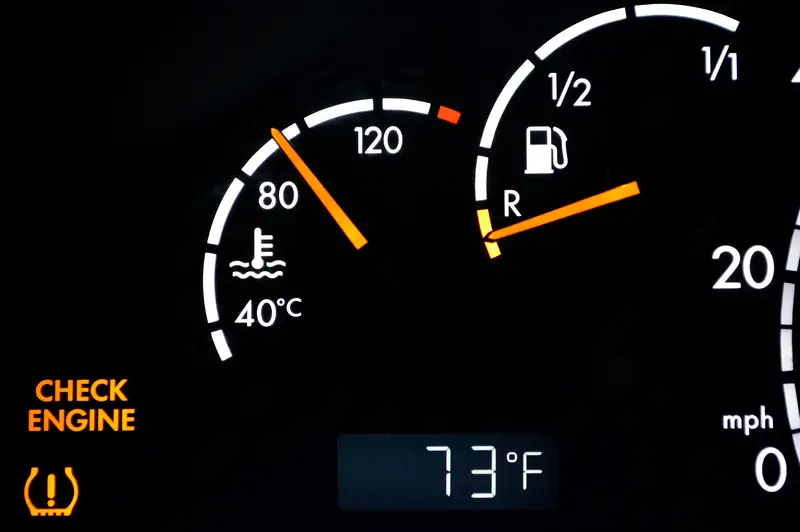
You know that little glowing gas pump symbol that lights up on your dashboard? Be honest. Most of us treat it like a polite suggestion. A gentle “hey, maybe think about getting gas at some point” nudge that we ignore for another 40 miles because the exit with the cheap station is just up ahead. I did this for years. Turns out that habit is quietly chewing through a part that can cost more than a thousand dollars to replace, and the fix is shockingly simple. Keep your tank above the quarter mark. Here is why that line on your gauge matters way more than anyone ever told you.
The Real Reason Mechanics Say Never Go Below a Quarter
For decades people thought the quarter-tank rule was just an old wives’ tale your grandpa repeated. It is not. The actual reason comes down to a single part most drivers do not even know exists. Modern fuel pumps sit inside the gas tank, and the gasoline around them keeps them cool and lubricated while they run. When you let the fuel level drop way down, that pump loses its built-in cooling bath. It overheats, it works harder, and it starts aging faster than it should. The quarter mark is not a random number. It is roughly the point where the pump stays safely covered while you drive around, sloshing and braking and turning. Above that line, the pump is happy. Below it, you are slowly cooking an expensive component for no good reason.
Your Gas Light Is Already Too Late
Here is the part that surprised me most. By the time that little light dings, you are already in the danger zone. That warning means your tank has hit “reserve,” which is only about 10 to 15 percent of your total capacity. So if you have been telling yourself the light is your cue to start hunting for gas, you have had it backwards. The light is not the starting whistle. It is more like the two-minute warning. A lot of people play a little game where they calculate how many miles they can squeeze out after the light comes on. Bad idea. The smart move is to fill up at a quarter tank, before the light ever turns on. Treat the light as an emergency, not a countdown timer you are trying to beat.
There’s a Pump Hiding Inside Your Gas Tank
Let me back up, because this blew my mind a little. The fuel pump in your car is not at the gas station. It is a small motor living inside your tank, surrounded by gas, pushing fuel up to your engine. Years ago, pumps were mounted outside the tank. They did not rely on gasoline to stay cool, and they were cheaper and easier to reach when something went wrong. Carmakers moved the pump inside the tank, which works great as long as the pump stays submerged. The catch is that when the fuel level falls below the pump, it starts sucking in air instead of gas. Air does not cool anything. So the pump heats up, and that heat is exactly what wears it out early or kills it completely. Every mile you drive on fumes is a mile that part runs hot.
The Junk Sitting at the Bottom of Your Tank
Your gas tank is not a perfectly clean container. Over time, tiny bits of sediment and gunk settle at the bottom. Think of it like the dregs in the bottom of a coffee pot. When your tank is mostly full, that debris stays put down low, far from the pump’s pickup. But when you run low, the pump is forced to draw from that bottom layer, slurping up the very stuff it is supposed to avoid. That junk can clog your fuel filter, which then slows the flow of gas to your engine. A clogged filter creates a chain reaction: rough idling, weak acceleration, stalling, and in bad cases, dirty particles that slip past and reach your fuel injectors. Replacing a plugged filter and dealing with the mess it causes costs a whole lot more than just keeping your tank topped off in the first place.
Idling Is Actually Safer Than Driving on Fumes
This one is genuinely counterintuitive. You would think a running car is a running car, but the way the fuel behaves changes everything. When you are sitting still and idling, the gas in your tank sits flat and level, so the pump stays covered longer. But the second you start driving, the fuel sloshes all over the place. Hit the brakes and it rushes forward. Take a turn and it slides to one side. Go up a hill and it pools at the back. Every time it sloshes away from the pump’s pickup, the pump gulps air and heats up. That is why driving on a low tank is harder on the pump than idling on one. If you are stuck driving low and you know you have stop-and-go traffic, steep hills, or a heavy load coming up, you want even more than a quarter tank, because those conditions throw the fuel around the most.
Winter Makes the Whole Thing Worse
If you live anywhere that gets cold, running low in winter adds a whole new headache. An empty space in your tank is just air, and air carries moisture. When the temperature swings, that moisture can condense into water inside the tank. A fuller tank leaves less room for that humid air to gather. Now here is the winter twist. If that water makes its way into your fuel lines and the temperature drops below freezing, it can turn to ice. Frozen lines mean your car will not start, and the freezing and thawing can actually damage the lines themselves as the water expands and contracts. So while everyone else is scraping their windshield and cursing the cold, the person who kept their tank near full is just driving away. A small thing, but on a 10-degree morning it is the difference between getting to work and calling for a tow.
Your Engine Can Start Knocking
Driving hard on a near-empty tank can mess with the engine itself, not just the pump. When you are cruising at highway speed and the pump cannot deliver enough fuel, your car’s computer may call for a richer fuel mix to protect the engine. If the pump cannot keep up, you can get engine knock, the same kind of problem you would see if you put regular gas in a car that needs premium. Knock is not something to shrug off, because over time it can do real damage to the engine. You might also feel the early warning signs first: sputtering or hesitation when you accelerate, a loss of power going uphill, or a hard time starting after the car has been sitting. Those are your car waving a little flag at you. The catalytic converter can take a beating too when the engine is starved and running rough.
What It Actually Costs When You Ignore This
Okay, so what is the damage if you wear out that pump? Brace yourself. A fuel pump replacement usually runs between $800 and $1,500 once you count parts and labor. About half of that is the pump itself. Factory parts can run from $200 to $1,000, and the labor stings because mechanics often have to drop the entire gas tank to reach the thing. That is 3 to 5 hours of work on a lot of trucks, SUVs, and sedans. Independent shops charge around $80 to $120 an hour, dealerships run $120 to $180 and up, and in big cities the rate can blow past $200 an hour. On something fancy like a 2024 Mercedes G-Wagon, the whole job lands around $1,400. Compare that to the cost of an extra few gallons of gas every week. It is not even close.
The Stupidly Simple Habit That Saves You
Here is the whole thing in one sentence: fill up when your gauge hits a quarter tank, and stop treating the warning light as your cue. That is it. You do not need to keep it pegged at full, and you do not need to obsess. You just need to break the habit of riding the bottom of the tank because you are too lazy to stop, or because you are chasing a station that is four cents cheaper. The reserve light is not a safety net you can lean on, even though your car gives you a buffer of maybe 30 to 50 miles after it comes on. That buffer is for emergencies, not for everyday driving. Set yourself a mental rule. Quarter tank, time to fill. Your fuel pump will last longer, your engine will run cleaner, and you will never get stranded on the shoulder watching traffic fly past. The cheapest car repair is the one you never have to make.

