

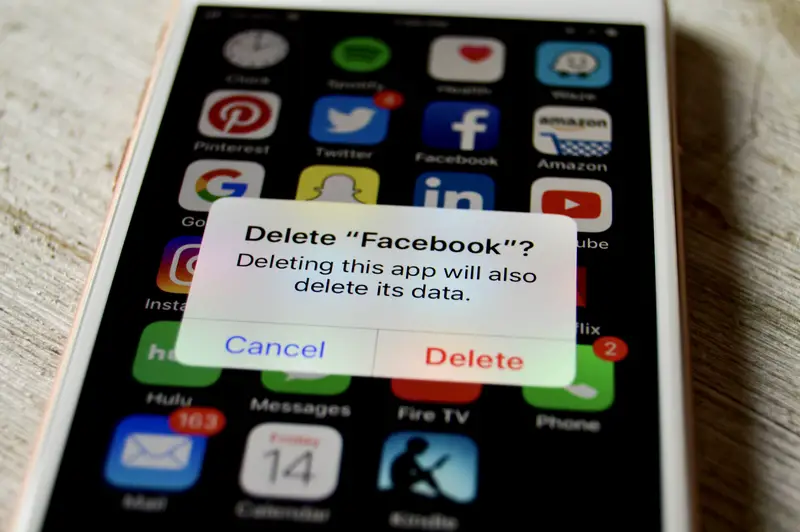
Let me just say it plainly: if Facebook is still on your phone in 2026, you’re giving away more of yourself than you probably realize. Not in some vague, hand-wavy “big tech is scary” way. In a very specific, documented, legally contested way. The company formerly known as Facebook (now Meta) has spent years quietly expanding what it collects, who it shares data with, and how deeply its AI tools reach into your private life. And it keeps getting worse.
Here’s what’s actually going on, and why this is the year to finally pull the plug.
Facebook Tracks You Even When You’re Not Using Facebook
Most people think Facebook tracks what you post, what you like, and who you’re friends with. That’s true, but it’s barely the beginning. In 2026, Facebook tracks your offline purchases, which apps you use, which websites you visit, what’s in your photos, and where you physically go throughout the day. All of this feeds Meta’s advertising machine, which now runs on AI models that predict your behavior and purchasing intent with scary accuracy.
And here’s the kicker: it doesn’t matter if you’ve never made a Facebook account. According to Meta’s own privacy policy, the company collects information from other users’ address books. So if your friend uploads their contacts, Meta has your phone number and name. The Facebook Pixel, a tracking cookie embedded in millions of third-party websites, follows non-users around the internet too. You don’t even have to play the game to lose.
Meta’s AI Is Now Inside Your Private Chats
This one is wild. As of early 2026, Meta’s AI tools are embedded directly into private conversations on Facebook, Instagram, and WhatsApp. A policy shift now allows Meta to use your interactions with its generative AI for personalized content and advertising. That means the things you type in what you thought were private messages can feed the ad machine.
Privacy advocates have pointed out that even “anonymized” data can be re-identified when cross-referenced with everything else Meta already knows about you. There’s no meaningful opt-out for most users. Complaints have already been filed with the Federal Trade Commission accusing Meta of burying these policy changes in fine print. Class-action lawsuits are expected.
Think about what you’ve said in DMs over the years. Now imagine an AI parsing all of it to sell you stuff. That’s the reality.
Your Settings Keep Resetting Without Telling You
Even people who are careful about privacy settings are getting burned. Meta’s 2026 updates have quietly shifted Facebook’s defaults toward deeper AI-driven tracking. New features scan your camera roll, categorize your photos, and nudge you into expanding your friend network. Most of this is switched on automatically.
Worse, app updates can quietly reset previous privacy choices. So that setting you turned off six months ago? It might be back on right now, and you’d never know unless you went digging through menus that Meta has intentionally buried. Federal regulators have warned that these practices expose users to identity theft, stalking, and reputational harm. Older posts that were once private can suddenly become public after a default change.
The whole system is designed so that doing nothing means giving Meta everything. You have to actively fight for your own privacy, over and over again, after every update.
A Meta Employee Downloaded 30,000 Private User Images
In 2026, it came to light that a Meta employee allegedly downloaded 30,000 private Facebook images from users without authorization. Meta says it discovered the breach over a year prior, fired the person, and referred the matter to UK law enforcement. The suspect is currently on police bail.
What’s disturbing isn’t just that it happened. It’s what it reveals about Meta’s internal security. Even with access controls, multi-factor authentication, and monitoring systems in place, a single determined insider was able to write their own tools and extract thousands of private photos. If that’s possible from inside Meta, what confidence should any of us have that our private images and messages are actually safe on the platform?
And remember: even after you request deletion of your account, Meta may retain your data for up to 180 days. Your most sensitive information might already be exposed before you ever hit “delete.”
The Cambridge Analytica Scandal Was Just the Beginning
You probably remember the name Cambridge Analytica, but the details are worth revisiting because they reveal how Facebook has always operated. In 2014, a third-party survey app created by a Cambridge University researcher harvested data from roughly 87 million Facebook users without their consent. The app didn’t just grab data from the people who used it. It pulled information from their entire friend networks, multiplying the data pool exponentially.
Cambridge Analytica used that data to assist the 2016 presidential campaigns of Ted Cruz and Donald Trump. The Federal Trade Commission fined Facebook $5 billion in 2019. Meta later agreed to a $725 million class-action settlement in 2022 and paid another $650 million under Illinois’s biometric privacy law in 2021.
Facebook engineers later admitted they didn’t even know where user data was stored. Let that sink in. The people who built the system couldn’t track where your information ended up. Even WhatsApp’s co-founder, whose company Meta owns, publicly called on people to delete Facebook after the scandal.
Meta Killed Its Own Study When the Results Looked Bad
Court documents released in November 2025 revealed that Meta shut down a 2019 internal study that was evaluating the mental well-being effects of Facebook and Instagram. The filing came out of the U.S. District Court for the Northern District of California, as part of a multi-party lawsuit brought by school districts, parents, and state attorneys general.
One Meta employee, according to court records, questioned whether Meta would look like “big tobacco companies that suppressed studies about cigarettes.” That comparison wasn’t made by an outside critic. It came from inside the building. Meta spokesman Andy Stone said the study was paused because it was flawed. Make of that what you will.
Meanwhile, a landmark study from MIT Sloan, Tel Aviv University, and Bocconi University established a causal link between Facebook access and increased depression and anxiety among college students. The researchers paired Facebook’s staggered rollout across 775 American colleges with 430,000 survey responses. The results were clear, and the negative effects grew stronger the longer students had access to the platform.
Meta Now Records Every Keystroke Its Own Employees Make
If you want to understand how Meta thinks about surveillance, look at how it treats its own workers. In April 2026, Reuters revealed that Meta quietly deployed monitoring software called the Model Capability Initiative (MCI) on U.S. employees’ work laptops. The software captures every keystroke, mouse movement, click, and takes periodic screenshots as employees work across hundreds of websites and apps.
There’s no opt-out for American employees. European employees are completely exempt because GDPR makes this kind of monitoring illegal without explicit consent. Meta laid off about 8,000 employees the same week the program rolled out. Multiple employees described MCI as “dystopian” to reporters.
CEO Mark Zuckerberg has committed up to $135 billion in AI spending for 2026, nearly double the previous year. The surveillance culture that Meta has applied to its 3 billion users for years (tracking what they like, who they message, where they go) has now been turned inward. If Meta treats its own people like this, what do you think it’s willing to do with your data?
Facial Recognition on Smart Glasses Is Coming Back
In 2021, Meta shut down its face-scanning tool and deleted more than a billion face templates after years of legal trouble. You’d think the lesson was learned. It wasn’t. In February 2026, the Electronic Frontier Foundation issued a major warning about Meta’s renewed plans to deploy facial recognition through its Ray-Ban smart glasses.
The feature would require collecting a faceprint from every person who steps into view of the camera on the glasses, including random bystanders who have never agreed to anything. Meta has already paid nearly $7 billion in related settlements over biometric data. And yet, here they go again. Dozens of state laws require consent before biometric data collection, but that hasn’t stopped the company from moving forward.
People Who Deleted Facebook Say Their Lives Got Better
A survey of over 1,000 people who deleted their Facebook accounts found that 53.1% of men said their relationship with their significant other improved afterward. Millennials were the most likely generation to delete the app, and privacy was the top reason they cited. After the Cambridge Analytica scandal, 3 in 4 Facebook users made some effort to change their presence on the site, and likes, posts, and shares dropped by almost 20%.
The biggest reason people stay? Staying connected to family and friends. That’s a real and valid concern. But it’s also the one thing Meta is banking on to keep you locked in. The platform is designed with infinite scrolling, unpredictable notifications, and variable reward schedules (like a slot machine) specifically to keep you coming back. The connection you get from Facebook comes at a cost that most people don’t fully see.
Facebook isn’t just an app on your phone. It’s a data collection machine that has been fined billions of dollars, caught suppressing its own research, breached from the inside, and is now embedding AI into your private conversations. At some point, the question stops being “should I delete it?” and starts being “why haven’t I already?”

