

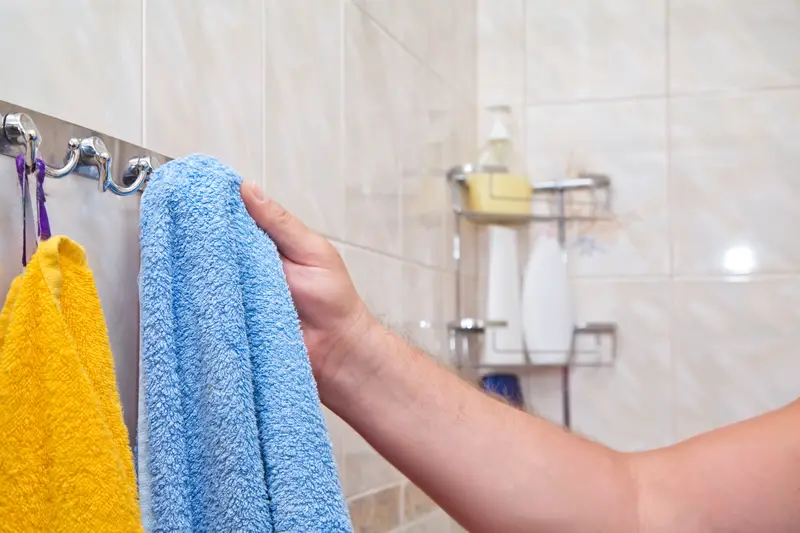
I used to think hanging a towel was the simplest thing in the world. You get out of the shower, you toss it somewhere, and you move on with your life. Turns out, I was wrong. Not just a little wrong. I was creating a situation in my bathroom that explains why my towels always smelled weird after two days, why they felt stiff and crunchy by midweek, and why I was burning through new towel sets every year. The way most Americans hang their wet towels is quietly ruining them, and almost nobody talks about it.
The Shower Curtain Rod Is the Worst Spot in Your Bathroom
Let’s start with the single biggest offender, because I guarantee a huge percentage of people reading this are guilty. Tossing your wet towel over the shower curtain rod after you dry off feels logical. It’s right there. It’s convenient. It keeps the towel off the floor. But it’s actually one of the worst places you can put a wet towel.
Here’s why. All the humidity from your shower rises toward the ceiling. That shower rod sits right in the thick of that steam cloud. So while the ends of your towel might feel dry to the touch a few hours later, the middle section, the part draped over the rod, stays damp. It’s basically sitting in a sauna. Laundry expert Ashley Kidder has described this setup as “basically a mildew party,” and she’s not exaggerating. The problem isn’t the rod itself. It’s the constant steam and the complete lack of airflow up there, especially if you close the shower curtain afterward and trap all that moisture in.
You think your towel is dry. You grab it the next morning, rub it on your face, and wonder why it smells a little off. That’s because it never actually dried. The dampness in the center created the perfect conditions for that distinctive musty funk that seems impossible to wash out.
Folding Your Towel Before Hanging It Is a Rookie Mistake
This one surprised me because I’ve done it my entire adult life. You fold the towel neatly in thirds, drape it over the bar, and feel like a responsible person with a tidy bathroom. Looks great. Instagram would approve. But you’re trapping moisture inside those folds where air can’t reach it.
Textile care expert Frej Lewenhaupt has explained that the key to preventing mildew and odor is to hang towels fully spread out so moisture can evaporate evenly and quickly. When you fold a wet towel, the inner layers stay damp for hours longer than the outer layers. Those hidden damp sections become breeding grounds for bacteria and mildew. Over time, this weakens the cotton fibers too, which is why you start noticing thin spots and holes developing in specific areas of the towel.
The fix is simple but requires a small mental shift. Spread the entire towel across the full length of the bar. Don’t fold it. Don’t let the sides touch each other. It won’t look as neat, but it will cut drying time roughly in half. A towel that dries within four to six hours stays fresh. A towel that stays damp for 12 hours does not.
Behind the Bathroom Door Is Another Problem Zone
Lots of people have those over-the-door hooks, and they seem like a great space-saving solution. But think about what happens when you close that bathroom door. Your towel is now hanging in a dead air zone with zero ventilation. No window access, no fan, no airflow whatsoever. It’s basically sealed in a warm, humid box.
Cleaning expert Gerardo Mellado and others have pointed out that behind the door is one of the worst spots for towel drying because the air just sits there. The towel stays damp for much longer than it would even on the shower rod, which at least has some ambient air movement. And here’s the thing people don’t consider: if your towel is near the toilet, every flush sends microscopic water droplets into the air that settle on nearby surfaces. Your already damp towel absorbs those particles like a sponge.
If you absolutely must use behind-the-door hooks, at least keep the door open after you shower. Running the exhaust fan for 30 minutes helps too. But ideally, you want your towel somewhere with real air circulation.
Hooks Versus Bars: One Is Clearly Better
I know hooks are popular. They’re cheap, easy to install, and you can stick a bunch of them on one wall. But hooks have real downsides that most people never think about.
When you hang a wet towel on a single hook, the fabric bunches together. All that weight concentrates on one small point, which stretches and damages the towel over time. You’ll notice pilling, thinning, and eventually holes forming right where the towel meets the hook. Meanwhile, the bunched-up fabric creates moisture pockets throughout the towel. None of it dries evenly. In humid climates like Florida or the Gulf Coast, a towel on a hook might never fully dry between uses.
Towel bars distribute the weight more evenly and give the fabric room to spread out. If you do stick with hooks, experts recommend spacing them at least 12 inches apart so each towel hangs without touching another. Give the towel a good shake before hanging it and try to drape it as open and loose as possible. If you have multiple people in the household, piling towels on the same hook is, as one expert put it, “a fast track to that ugh smell.”
Your Bathroom Might Just Be a Bad Place to Dry Towels
Here’s something that doesn’t get discussed enough. Some bathrooms are simply terrible environments for drying anything. If your bathroom has no window and no exhaust fan, you’re fighting an uphill battle no matter where you hang the towel. The humidity from your shower has nowhere to go. It just hangs in the air, and your towel absorbs moisture from the room even while it’s supposedly drying.
In these situations, the smartest move is to take your wet towel out of the bathroom entirely. Hang it in a bedroom, a hallway, or near any area with decent air movement. I know it sounds weird to have a damp towel hanging in your hallway, but it will dry faster there than in a steamy bathroom with the door closed.
If moving it out of the bathroom isn’t realistic, run your exhaust fan for at least 30 minutes after your shower. Crack the window if you have one. Anything you can do to move that humid air out of the room will help your towels dry faster.
Don’t Toss Wet Towels in the Hamper Either
This is one that I was absolutely guilty of. Shower, dry off, toss the towel in the laundry basket. Out of sight, out of mind. But a wet towel sitting in a closed hamper is one of the fastest ways to create a smell that will make you gag when you finally open the lid on laundry day.
Damp towels crammed into a basket or closed hamper trap all that moisture with nowhere to escape. Within hours, bacteria are multiplying rapidly. By the time you get around to washing them two or three days later, the smell has set into the fibers so deeply that a normal wash cycle barely makes a dent. If you must put a used towel in a hamper before it’s fully dry, use a ventilated basket that allows some airflow. But the better move is to hang it up to dry first, then put it in the hamper once it’s no longer damp.
A Few Washing Mistakes That Make Everything Worse
Even if you nail the hanging part, your washing routine might be sabotaging your towels. Most people use way too much detergent, which leaves a soapy film on the fibers that actually makes towels less absorbent over time. That stiff, scratchy feeling? It’s often detergent buildup, not worn-out cotton.
Fabric softener is another sneaky problem. It coats towel fibers with a waxy residue that reduces absorbency and makes the towels look dull. Skip it entirely. If you want softer towels, toss in a couple of wool dryer balls instead. They naturally soften the fabric and create air pockets that speed up drying time.
Wash towels in hot water (around 140 degrees Fahrenheit) to kill bacteria effectively. If you want to bleach them, use a non-chlorine, oxygen-based bleach. Regular chlorine bleach is too aggressive and will break down cotton fibers over time. And here’s a tip: add white vinegar to the rinse cycle occasionally. It kills bacteria, prevents static, and doesn’t leave any residue behind. Your towels will come out softer and more absorbent than they have in months.
How Often Should You Actually Wash Towels?
Most people use the same bath towel for a week or more before washing it. That’s too long. The general recommendation from laundry experts is every three to four uses, assuming you’re hanging it properly and letting it dry completely between showers. If your towel isn’t drying fully (because of the mistakes above), you should wash it even more often.
Washcloths are a different story entirely. They get soaked with dead skin cells, soap, and oils every single use, and because they’re small and thick, they take longer to dry than bath towels. Wash them after every use. Seriously, every time. Toss them in the hamper or directly in the wash. Don’t hang a wet washcloth on a hook and expect to use it tomorrow. It won’t be in good shape.
One last thing: assign individual towels to each family member. Color-coding works great for this. When multiple people share towels or when different towels get piled together on the same hook or bar, you’re creating a cross-contamination situation that no amount of fancy detergent can fix. Give every person their own towel, their own hanging spot, and enough space so nothing touches. Your towels will last longer, smell better, and actually do their job.

