

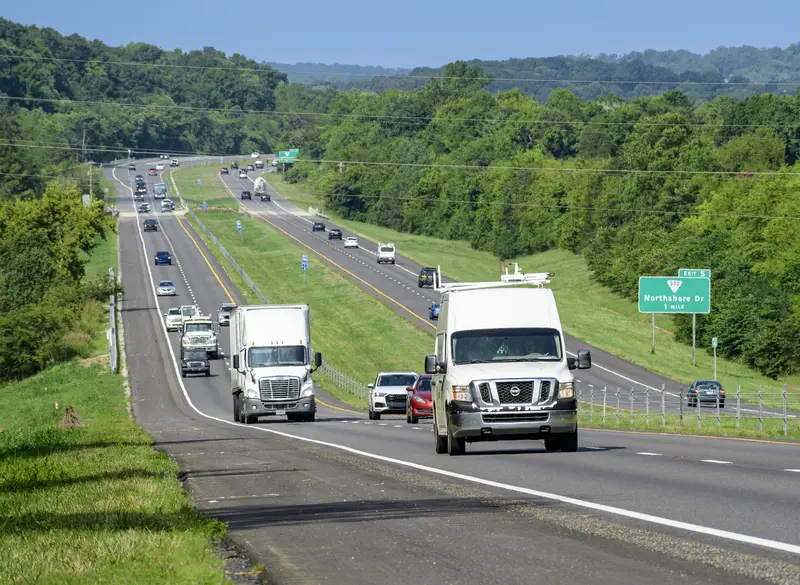
You are doing 70 in a 70. The pickup behind you is close enough to read your bumper sticker, flashing his high beams, and you are not budging, because you are already at the posted limit and he can wait. Feels righteous. It is also, in most of the country, the part of this standoff that is against the law. In roughly 30 states, sitting in the far left lane when you are not actively passing somebody is a citable moving violation, and the number on your speedometer does not save you.
The left lane was never yours to keep
Traffic codes call it a keep-right statute, and the idea behind it is simple: on a multi-lane highway, the far left lane is a passing lane, not a travel lane. You use it to get around a slower car, then you move back over. Sustained cruising over there, with no overtaking happening, is the violation. There is no federal law on this at all, which is exactly why the rules change the second you cross a state line.
Fines for left lane camping start at $50 in Tennessee and vary by state. Enforcement picked up in the mid-2010s: Georgia passed its slowpoke law in 2014, Tennessee followed in 2016, and the Washington State Patrol ran dedicated left lane patrols, pointing to left lane blocking as a factor in crashes and road rage.
Speed is not the defense drivers think it is. You can be doing 80 in a 70 and still get written up if you are parked in the left lane with faster traffic stacking up behind you and no car in front of you to pass. The statute is about lane position relative to the flow of traffic, not about your speed relative to the sign.
Even in the states without a dedicated keep-right law, there is a second trapdoor. Impeding or obstructing traffic is its own offense in nearly every state. Rolling along at 55 in a left lane where everyone else is moving at 70 qualifies, no keep-right statute required.
Legitimate reasons to be over there are recognized almost everywhere: you are actively passing, you are setting up for a left exit or left turn within a reasonable distance, traffic is heavy enough that changing lanes is unsafe, or an officer has told you to stay put. Outside of that, the rule is blunt. Not passing? Move right. And states keep tightening these rules rather than loosening them. Connecticut’s new left lane law took effect October 1, 2026, with an $88 fine.
Hazard lights in a downpour can get you a ticket
Heavy rain hits, half the highway flips on the four-way flashers, and everyone feels responsible. In roughly half the states, that move is illegal or restricted while the car is moving, including Illinois, Massachusetts and Louisiana. Hazard lights were built for a disabled vehicle sitting still, and a blinking car in low visibility reads to the driver behind you as a stopped car, which is a terrible thing to misjudge at 50 mph in standing water.
There is a mechanical problem too. Hazards use the same bulbs as your turn signals. With them on, you cannot signal a lane change or a turn to anybody. You have traded your ability to communicate for a light show. Texas, New Jersey, Michigan, Georgia and Alabama are among the states where it is allowed, and Florida now permits it in extreme low visibility on roads posted at 55 mph or higher.
Two things that are illegal in all 50 states
The rolling stop, the California stop, the slow creep through a quiet intersection at 6 a.m. with nobody around. Illegal in every single state, no exceptions, no regional variation. The law wants the wheels to stop turning behind the line. Police watch for it hardest in residential areas and near schools, which is precisely where drivers feel safest cutting the corner.
The other universal one is the turn signal. Skipping it on a turn or a lane change is a violation in all 50 states. What varies is how far in advance you are required to flick the lever, and that distance is set state by state.
Coasting downhill in neutral belongs in the same bucket of habits that feel clever and are not. It is banned in a number of states, California and Colorado among them, because you lose engine braking and some of your control. It also saves nothing. A modern engine uses almost no fuel when you coast in gear.
Your mirror and your windshield
The air freshener, the parking pass, the graduation tassel from 2009. Minnesota, California and Pennsylvania are among the states that prohibit anything dangling where it blocks your view through the windshield, and the stop is usually the opening act for a longer conversation with the officer.
The same logic covers the GPS suction-cupped to the glass. Minnesota allows one only near the bottom of the windshield, and the dashboard is the safer spot anywhere.
Holding your phone at a red light now counts
Pennsylvania used to let you hold a phone for anything other than texting. Paul Miller’s Law ended that. Signed in June 2024 and in force since June 2025, it is named for Paul Miller, killed in 2010 in a crash caused by a tractor-trailer driver who reached for a phone. Starting in June 2026, you can be cited for simply holding a phone while operating the vehicle, even if you are stopped or sitting in traffic. The fine is $50 plus court costs and fees. Thirty-three states now have similar legislation.
South Carolina’s Hands-Free Driving Act, in force since September 2025, is written tightly enough to close the usual loopholes. Drivers cannot hold or support a phone with any part of their body, which rules out wedging it between your knees. First offense is $100; a second within three years costs $200 and two points on your record.
Louisiana’s version, the Touch Law, arrived in August 2025 with penalties starting January 1, 2026. The Louisiana Highway Safety Commission counted 178 people killed in the state in 2023 in crashes involving inattention or distraction. Navigation and calls are still fine through hands-free systems and voice commands. Touching the phone is not.
The pattern across these states matters more than any single fine. Each one ran a grace period where drivers got warnings instead of tickets, and those warning periods have ended. The habit did not change. The consequence did.
Warming up the car and leaving it there
Cold morning, keys in the ignition, engine running, you back inside for coffee. Texas and Ohio are among the states that will fine you for leaving a vehicle running and unattended, though Ohio exempts a car that is locked or parked at home. Remote start keeps you legal. Keys in the ignition does not.
Related, and more expensive: clearing a porthole in your windshield and calling it done. New Jersey, Connecticut and Pennsylvania have snow removal laws requiring you to clear the whole vehicle, roof included, before you pull out. A sheet of ice coming off your roof at highway speed is somebody else’s windshield, and in those states it is your fine and your liability.
Driving tired can bring a homicide charge in New Jersey
Most people file drowsy driving under bad idea rather than crime. New Jersey’s Maggie’s Law was passed after Maggie McDonnell, 20, was killed in 1997 by a driver who had been awake for 30 hours. Under it, a driver who kills someone after more than 24 hours without sleep can be charged with vehicular homicide.
Distraction carries that same weight elsewhere. In Pennsylvania, causing a death while texting or holding a phone can bring a homicide by vehicle conviction, with up to five more years added for the phone violation.
Flashing your brights to warn about a speed trap
This one has no clean answer, which is the surprising part. Some states treat the headlight flash as protected speech. Others call it obstructing justice or interfering with law enforcement. New Jersey and North Dakota may allow it. Florida has ticketed drivers for doing it. Same gesture, opposite outcomes, depending on which side of a state line you are flashing on.
The stereo, the earbuds and the funeral procession
No federal law caps how loud your music can be. Many states handle it with a distance test instead: if your stereo is clearly audible from 25 feet away, you can be fined as a nuisance. Wearing earbuds or headphones in both ears is banned in California, Virginia and Louisiana, on the theory that you need to hear the siren and the horn.
Funeral processions have the right of way in at least 15 states, meaning the cars behind the lead vehicle do not have to stop for red lights. Cutting into one or riding its tail is the violation. Move-over laws, requiring you to shift a lane away from emergency vehicles stopped on the shoulder, are on the books in all 50 states.
The speed camera does the math for you now
Maryland scrapped its flat camera fine in October 2025 and replaced it with a sliding scale. Twelve to 15 mph over costs $40. Sixteen to 19 is $70. Twenty to 29 is $120. Thirty to 39 jumps to $230, and more than 40 over the limit is $425. Camera tickets do not put points on your license, which is the one piece of mercy in the system.
California, meanwhile, is working through the biggest set of changes to its Vehicle Code in years, with some provisions saving drivers money and others carrying steep penalties aimed at reckless driving.
One famous rule that was never real
Driving barefoot. Everybody’s uncle has a story about it. No U.S. state explicitly bans it. The catch is that if you crash or get stopped and bare feet are judged a contributing factor, you can be cited for careless driving, which is the same way flip-flops get people in trouble when a sandal slides under the brake pedal.
If you change one habit after reading this, make it the left lane. It costs you nothing, it is the violation with the widest reach, and it is the one you are probably committing on purpose.

