

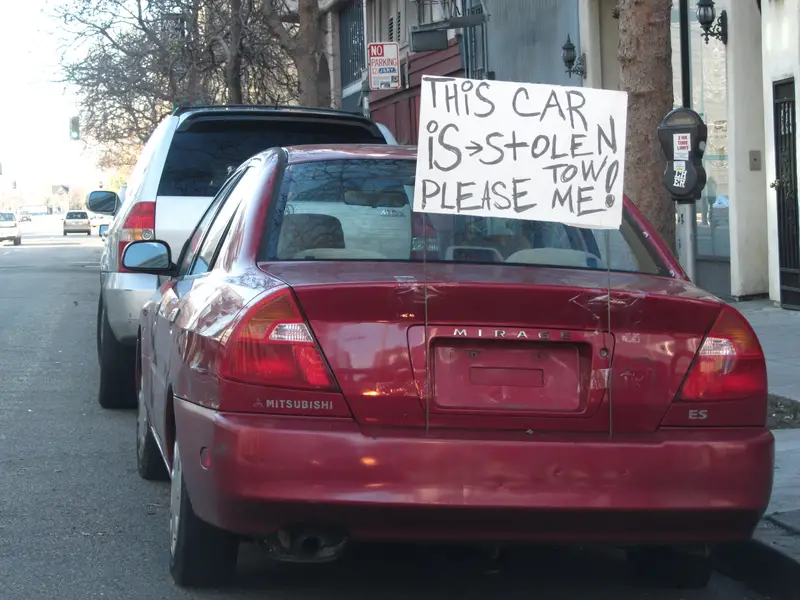
Car theft in America is at a level drivers have not seen in years. Roughly 659,880 vehicles were reported stolen in 2025, down 35% from the 2023 peak of 1,020,729, and the national rate now sits at 193 thefts per 100,000 people. That still works out to one vehicle gone every 48 seconds. What the national average hides is how unevenly the risk is spread: across a ranking of 281 U.S. cities built from FBI National Incident-Based Reporting System counts and Census population estimates, the gap between the top and the bottom is 56 times. At the top, by a distance nobody else is close to, sits Oakland, California, at 1,459 stolen vehicles per 100,000 residents.
Here is how the worst cities in the country to leave a car parked compare with the places where vehicles basically stay put.
Oakland, California
Oakland does not just lead the country on vehicle theft, it laps the field. The 281-city ranking puts its rate at 1,459 per 100,000 residents. A separate analysis of the FBI’s newly released 2025 city-level data found 6,431 stolen vehicles in Oakland, a rate of 1,448 per 100,000 and the highest of any large American city, 22% above the second-place city. A vehicle disappears there roughly every 1.4 hours.
The part that should worry owners more than the rate is the recovery of consequences. Oakland reported exactly one clearance against those thousands of vehicle thefts in 2025, a clearance rate of 0.02%. Steal a car in Oakland and the statistical odds of anyone being arrested for it round to zero.
Crime in the city is genuinely falling. Oakland’s property crime rate dropped 27% in a single year and 41% from its 2023 peak, and officials have been making the case that their investments are working. Swearing in James P. Beere as permanent police chief on July 29, 2026, Mayor Barbara Lee said his appointment marked “an important step as we continue building a safer Oakland where every resident feels secure and every neighborhood has the opportunity to thrive.” Oakland stayed at the top of the property-crime table anyway, because the other high-rate cities fell at a similar pace. Vehicle theft in Oakland is still up 26% since 2010, over a stretch when California’s rate fell 23%.
St. Louis, Missouri
St. Louis comes in second at 1,172 thefts per 100,000 residents, which in a city that size means a vehicle is taken about every 2.7 hours. Missouri shows up twice near the top of the national picture: the FBI’s 2025 agency-level figures put Kansas City in the number two slot nationally, with Oakland’s rate 22% higher. Whichever dataset you prefer, the state is overrepresented at the bad end of the list, and St. Louis is the headline case. Nothing about the gap between first and second is comforting either; 1,172 per 100,000 is roughly six times the national rate on its own.
Minneapolis, Minnesota
Minneapolis posts 1,141 thefts per 100,000 residents, third-highest in the country, and it loses a vehicle roughly every 1.8 hours. That frequency puts it behind only Philadelphia and Oakland among the cities singled out in the ranking, despite Minneapolis being considerably smaller than most of the metros that generate bigger raw totals. Minnesota does not have the state-level profile of Nevada or Maryland, which makes the concentration in one city more striking. If you live there and park outside, your exposure has nothing to do with the state average.
Dayton, Ohio
Dayton is the clearest example of why per-capita numbers matter more than headlines about big-city crime. Its rate is 1,118 per 100,000, fourth in the nation, yet a vehicle goes missing only about every 5.7 hours, because there are far fewer vehicles and people to begin with. Raw totals in Dayton will never make a national news story. For an individual owner, the rate is what determines the odds, and on that measure Dayton is in the same conversation as Oakland and St. Louis. Ohio places two cities in the worst ten.
Philadelphia, Pennsylvania
No American city loses vehicles as often as Philadelphia does. One disappears approximately every 33 minutes, the highest frequency anywhere in the study, on a rate of 1,015 thefts per 100,000 residents. Scale is doing some of that work, but the trend is the real problem. Pennsylvania’s theft rate is up 106% since 2019, the second-steepest increase in the country behind Washington, D.C., at 110%. D.C. also carries the highest rate of any state or district at 696 per 100,000. The mid-Atlantic corridor is where theft has climbed hardest while the national numbers were falling, and Philadelphia is the center of it.
Detroit, Michigan
Detroit records 961 thefts per 100,000 residents, sixth nationally. It is also a useful place to talk about what thieves actually take, because vehicle type changes your risk as much as your ZIP code does. On a Highway Loss Data Institute theft index cited in the ranking, where the average passenger vehicle scores 100, pickup trucks come in at 205 and SUVs at 58. Pickups face roughly double the fleet average and about 3.5 times the exposure of an SUV.
The Chevrolet Silverado 1500 has been a fixture on the national most-stolen list for three straight years: fourth in 2023 with 23,721 thefts, third in 2024 with 21,666, and fourth again in 2025 with 16,764. The Ford F-150 ranked seventh nationally in 2025 with 10,102 thefts. Muscle cars are worse per vehicle on the road. The two-door Camaro runs about 13 times the fleet average, and the Camaro ZL1 39 times. Sixth-generation Camaros from 2016 onward are stolen at more than 10 times the rate of 2010 to 2015 models, a jump that tracks with the move to push-button ignition.
Memphis, Tennessee
Memphis ranks ninth at 896 thefts per 100,000 residents. Pueblo, Colorado at 924 and Cleveland, Ohio at 919 sit just above it, and Milwaukee, Wisconsin closes out the worst ten at 859. Everything in that group is more than four times the national rate.
One factory decision explains a large share of the theft surge these cities absorbed. Immobilizers were standard on only 26% of 2015 model-year Hyundai and Kia models, compared with 96% of vehicles from other manufacturers. An immobilizer stops the engine from starting without the correct electronic signal. Without one, a thief has a far shorter path to driving off, and the resulting wave hit exactly the kind of mid-size cities on this list hardest.
McAllen, Texas
At the opposite end, McAllen reports 30 thefts per 100,000 residents, third-lowest among the 281 cities measured. Texas is unusually well represented down here, with Allen at 37, Frisco at 52 and McKinney at 58 also in the ten lowest. One caveat belongs with those numbers: low reported rates in some Texas, Florida and California cities may be influenced by incomplete NIBRS reporting, so a handful of these figures may understate reality. Even allowing for that, the Dallas-area suburbs and the Rio Grande Valley are not places where vehicles vanish.
Worcester, Massachusetts
Worcester records 27 thefts per 100,000 residents, second-lowest in the country and the only Northeast city anywhere in the bottom ten. That is worth pausing on, because the Northeast is where theft rates have risen fastest: New York’s rate is up 94% since 2019 and Maryland’s 70%. Worcester is a real working city of substantial size, not a gated subdivision, and it still posts a rate about 54 times lower than Oakland’s. Geography inside a region matters as much as the region itself.
Meridian, Idaho
Meridian has the lowest rate of all 281 cities measured, 26 thefts per 100,000 residents. Oakland’s rate is more than 56 times higher. This is not a fluke of one city’s reporting, either: Idaho’s statewide rate of 53 per 100,000 is among the lowest in the nation, behind only Vermont at 49 and level with New Hampshire at 53. The rest of the bottom ten, Worcester, McAllen, Allen, Naperville, Fishers, Thousand Oaks, Frisco, Irvine and McKinney, all sit under 60 per 100,000.
The honest verdict is that where you park is the single biggest variable, and it dwarfs everything else. California alone accounted for 136,988 stolen vehicles, around 21% of the national total, and the Los Angeles metro area logged 53,911 thefts in 2025, about 8% of every stolen vehicle in the country. Nobody is moving to Meridian over a theft statistic. What travels is the rest of it: a pickup or a performance car raises your odds regardless of address, and the basics still work. A steering wheel lock is a visible deterrent that costs a thief time, a tracking system improves your chances of getting the vehicle back, and a garage or a well-lit spot removes the opportunity in the first place. In Oakland, where one stolen vehicle in roughly 6,400 produced a clearance, those are not optional extras.

