

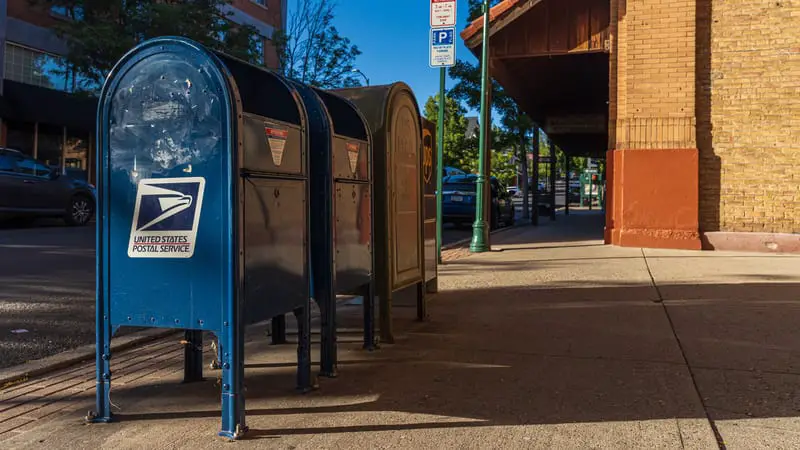
Just before 12:40 in the morning on Nov. 23, 2026, on a street of small businesses in Westfield, Massachusetts, a sensor hidden inside a mailbox went off. Police had planted sensors in the boxes during an investigation that had stretched across eight weeks. Shortly before 1 a.m., officers stopped three people. They were not after packages. Surveillance video shows two people walking down the street, and one of them going up to the mailboxes and rifling through them. The junk mail got left behind. What these crews want, almost everywhere in the country, is a paper check.
The Junk Mail Stays, The Checks Go
Businesses on Mainline Drive in Westfield say the thefts had been going on every weekend for nearly three months before anyone was stopped. Jason Moran, president of Morduct, first assumed it was kids messing around. Then company bank accounts started getting hacked, and so did accounts at other businesses on the street.
“They were looking for strictly checks and they would open the mailbox, actually sort through it, leave the junk mail, and actually take anything with bank information,” Moran said.
One business on the street lost a check worth $25,000, and whoever took it used a fake name trying to cash it. It got so bad the companies asked the post office to stop delivering to the street on Saturdays. Moran bought a mailbox with a lock on it, and that did not solve it either, because locked boxes down the road were being broken into too. The post office started hand delivering instead, at least for the time being.
The three people caught that night are considered suspects, and as of Nov. 23, 2026, were not being held on any charges. Police are still working out whether they are connected to the earlier thefts.
A Glue Trap On The End Of A Belt
The tool of choice for emptying a blue collection box is not a crowbar. In Suffolk County, New York, prosecutors say three men used a sticky glue trap attached to the end of a belt, lowered through the slot, to pull envelopes back out. Fishing, they call it.
Suffolk County District Attorney Raymond A. Tierney announced the arrests of Nicholas Delvillar, 32, of the Bronx, Franklin Mercedes, 27, of the Bronx, and Jhosua Peralta, 24, of Queens on grand larceny charges. On June 3, 2026, the three allegedly drove out from the Bronx and worked collection boxes in Melville, Huntington Station, East Northport, Commack, Smithtown, St. James, Nesconset, Hauppauge, Centereach, Holbrook, Bohemia, Farmingville, Brentwood, Medford, Patchogue, Blue Point, Bayport, Sayville, West Sayville and Oakdale. One day. Twenty towns.
Search warrants at their homes turned up more than 6,750 stolen checks worth $4.8 million, a loaded 9mm firearm and cash, according to the district attorney’s July 7, 2026, announcement. All three were placed on supervised release with GPS monitoring while the case proceeds, and all three are presumed innocent. Tierney’s advice to residents was blunt: use the letter slots inside your local post office.
The Keys That Open A Whole Zip Code
There is a shortcut that beats fishing. Mail carriers carry arrow lock keys, universal master keys that can open nearly every blue collection box, cluster mailbox and apartment panel in a ZIP code. Carriers are supposed to sign them out each morning, keep them chained to the uniform, and sign them back in at the end of the shift. When one goes missing, it is a skeleton key to an entire neighborhood’s outgoing mail.
Michael Edwards, 31, of Bridgeport, Connecticut, was sentenced to eight years in federal prison after pleading guilty in a $55 million check fraud conspiracy that ran on stolen postal keys, including keys that opened collection boxes in some of Manhattan’s wealthiest neighborhoods. He was ordered to forfeit nearly $19 million.
Sometimes the key never has to be stolen, because the carrier is in on it. Federal prosecutors have accused three Houston-area postal workers of selling checks they pulled from the mail to a man who then listed them for sale online. Tryston Tremaine Vaughn allegedly recruited carriers Catherine Clauzelle Kilpatrick, Drakkor Jamar Alexander and Malcom Tiree Joubert, in an operation the indictment says ran from 2022 to 2024 and involved nearly $24 million in checks. One single check was reportedly worth $1.5 million. A fifth defendant, Alyssa Nadine Bryant, is accused of buying the checks. Arrest warrants went out for all five on Aug. 20, 2026, and the most serious bank fraud counts carry up to 30 years.
How A $118 Check Becomes $4,118
A stolen check is only worth stealing because of one quirk of ballpoint pens: the ink sits on top of the paper instead of soaking into the fibers. A solvent lifts the writing straight off. Thieves use acetone, bleach, whatever strips ink without destroying the sheet, and they go after the payee and the amount. The one thing they leave alone is your signature, because a real signature is what gets the doctored check through.
San Francisco resident Kyung Cha Moon had three checks taken from the mail. A $118 payment came back altered to $4,118. Thieves also grabbed property tax payments, swapped her name for theirs, and deposited them into a credit union account. Her son, Mitchell Mun, said the forgery was obvious the second the family saw the check images: “This is altered. This is fraud. This is forgery.”
South Bay resident Bob Dilfer watched a $100 check of his get rewritten as $6,000, caught only because a bank manager flagged it. He mailed a check to the IRS and found out eight months later the agency never got it. A postal clerk later told him three men had taken an entire bin of mail off a post office loading dock and driven off with it.
Nearly 50 Napa homeowners had property tax checks stolen and deposited into accounts spread across multiple states. The FBI arrested an Arizona man in connection with that scheme, which involved roughly $1.5 million. Most of those victims got their money back.
Stolen Checks Have A Price List
Nobody is washing checks one at a time in a basement anymore. The stolen paper gets resold, in bulk, in group chats. The Houston indictment names a Telegram channel called “slipsandchips” where checks were allegedly advertised. Telegram channels broadcast to large audiences, which is the whole point.
The checks sell for a fraction of their face value. Buyers do the rest, sometimes with solvent and a pen, sometimes with Photoshop and check design software, printing a clean counterfeit off the original instead of bothering to alter it. That version has its own nickname: check cooking.
Financial-crime analytics firm Nasdaq Verafin estimates U.S. check fraud losses reached $33.6 billion in 2025, most of the world’s total. Paper checks, the payment method most Americans assume is already dead, are still a gold mine for criminals.
The Numbers Behind All Of This
The Postal Inspection Service took in more than 800,000 mail theft complaints across fiscal years 2023 through 2025. Complaints dipped in FY2024, then climbed again in FY2025 in every Postal Inspection Service division except Seattle.
Reports of high-volume mail theft from mail receptacles, blue collection boxes included, rose 139% between 2019 and 2023, according to the Postal Inspection Service. The FBI and the Postal Inspection Service issued a joint alert noting that suspicious activity reports tied to check fraud nearly doubled between 2021 and 2023, and Nasdaq Verafin estimated check fraud losses across the Americas at $21 billion in 2023 alone.
The Postal Service has been swapping out hardware in response. More than 23,000 high-security collection boxes have been installed, and more than 47,000 electronic locks have gone in in place of arrow locks, with tens of thousands more planned. Project Safe Delivery, the joint effort launched in May 2023, had produced 4,257 mail theft arrests and 591 robbery arrests through September 30, 2026.
Scale is the problem. In 2025, USPS moved an average of more than 250,000 pieces of mail every minute and delivers to roughly 157.8 million residential addresses.
Three Investigators For An Entire State
Orange, Virginia, a town northeast of Charlottesville, has more than 50 open mail fraud cases. Deputy Police Chief Michael Utz has assigned one of his investigators to do nothing but check fraud. Victims usually have no idea anything happened until money leaves the account, or until a stranger calls to ask whether the check they just received is real.
Congressman Eugene Vindman of Woodbridge has introduced legislation to crack down on check fraud, mail theft and postal employee misconduct, and he put the staffing math plainly: “Only three U.S. Postal Service Office of Inspector General special agents cover the entire Commonwealth of Virginia, so you can extrapolate,” he said. The core of the bill is more investigators for the Office of Inspector General.
Sheriff’s offices are not waiting. In June 2026, the Nemaha County Sheriff’s Office in Nebraska warned that criminals were stealing checks from mailboxes, collection boxes and even business mailrooms. They want ordinary payments, the utility check, the credit card payment, the stuff nobody thinks twice about mailing.
The Pen You Use Matters More Than The Mailbox
Gel ink binds into the paper fibers instead of resting on the surface, which makes it much harder to strip with the solvents thieves reach for. A black indelible gel pen is the single cheapest thing standing between your signature and someone else’s bank account.
Postal inspectors’ advice is to use the letter slots inside your local post office. If you must use a blue box, drop your mail close to the posted pickup time and never after the last collection of the day. The overnight window, between the last pickup of the day and the first one the next morning, is when a box sits full and unwatched.
Timing matters on the back end too. Banks typically give customers only 30 to 60 days to report check fraud, ABC7 reports, which is a short clock for anyone who pays bills by mail and skims their statement once a month. Free USPS Informed Delivery emails a daily photo preview of what is coming, so a check someone mails you that shows up in the preview and never lands in the box flags itself in hours instead of weeks. For checks you send, watch your bank’s cleared check images.
If a check does get taken, the Postal Inspection Service takes reports at 1-877-876-2455, and those reports are how multi-state rings get connected to each other. The crews fishing boxes at one in the morning are counting on nobody bothering.

