

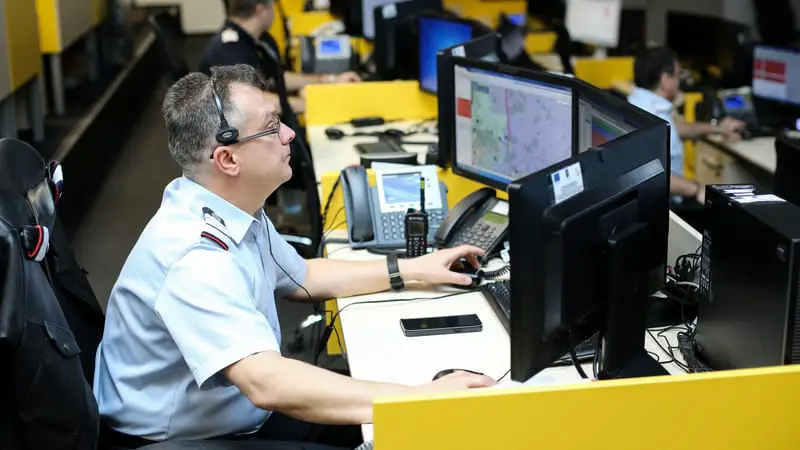
Most of us have rehearsed the call in our heads without meaning to. Something awful happens, you dial three numbers, and the first thing out of your mouth is what went wrong. That instinct is backwards, and the people who answer those calls have been trying to correct it for years. In a lot of centers around the country, the greeting is not even “what’s your emergency.” It is some version of “911, what is the address of your emergency?” The address comes first for a blunt reason: it is the only thing you can say that still does its job after the call falls apart. Where you are, then your phone number, then what happened. In that order, every time.
Location Is The Only Thing That Survives A Dropped Call
If the line cuts out thirty seconds in and the dispatcher has your street, an ambulance is already rolling. If it cuts out and all they have is a description of someone bleeding, they have a voice and nothing else.
Emergency educators at UPMC spell out a line short enough to say in one breath: “I need an ambulance. I’m at the corner of Grant Street and Fifth Avenue in downtown Pittsburgh. I’m calling from a cell phone and the number is 412-555-5555.” Three facts, no story. The callback number is the second-most valuable thing you can hand over, because it is the backup plan if the signal drops or your thumb hits the screen wrong.
Inside a building, “the high school” is not an address. The parking lot on the side nearest the football field is. The 14th floor of a named office tower is. Outdoors with no street sign in sight, cross streets, a mile marker, your direction of travel, or the red brick school across the road all beat silence.
Your Phone Does Not Automatically Tell Them Where You Are
This is the part Americans get most wrong. We assume the little blue dot on Google Maps is the same dot the dispatcher sees. It often is not.
States and territories reported 212,910,794 voice 911 calls to the FCC for 2024, and 151,872,164 of them, or 71.3 percent, came from wireless phones, according to the agency’s 17th Annual 911 Fee Report. Yet in a 2023 NENA and Carbyne survey of 911 center staff, fewer than half said they can get accurate location from mobile callers. Older Phase II location rules deliver latitude and longitude that lands generally within 50 to 300 meters, which in a dense neighborhood is a lot of doors to knock on.
Rules have tightened. Since April 3, 2025, the nationwide carriers have had to offer dispatchable location or z-axis (vertical) location across the country under 47 CFR 9.10, and z-axis readings must land within 3 meters for 80 percent of calls from capable phones. Even so, cell location traditionally has not carried altitude at all. A tower can put you at the right address and still leave crews guessing whether you are on the first floor or the fifth. If you are in an apartment, say the unit number out loud.
There Are Only Four Questions, And They Take Half A Minute
After the address and callback number are verified, the script narrows fast. A 2003 brochure produced by the National Academy of Emergency Dispatch and the American Safety and Health Institute lists four universal questions: the person’s problem or type of incident, approximate age, whether the person is conscious, and whether the person is breathing.
Getting that information out of a caller typically takes less than 30 seconds. People hear those questions and assume they are being screened, as if the dispatcher is deciding whether the situation qualifies. They are not. The questions determine the level of help, not whether help comes. Trained dispatchers do not ask questions that are unnecessary, and in most centers responders are already moving while you are still answering.
Telling Them To Hurry Accomplishes Absolutely Nothing
The same brochure puts it plainly: don’t tell them to “hurry.” They already know that.
A handful of other phrases show up again and again on dispatcher wish lists, and they all burn the same thing, which is seconds. Opening with “hello” wastes a beat, because the dispatcher is already listening. “I think,” “maybe” and “um” force follow-up questions to pin down what you actually saw. “I don’t know” shuts the conversation down when a partial answer would have been useful; the color of the building, the sound you heard, anything is better than nothing. Telling the dispatcher to calm down is a special kind of pointless.
One more that surprises people: asking only for police can narrow the response. Describe the whole situation and let the center decide whether that means a squad car, a medic unit, a fire engine, or all three.
A Phone With No Service Can Still Dial 911
That old iPhone in the junk drawer with no plan on it will still reach a dispatcher. Every wireless phone can call 911 whether or not it is subscribed to a carrier, and a locked phone will place the call with no passcode or fingerprint required. That is genuinely useful to know if you hand a dead-line phone to a kid or keep one in the glovebox.
The trade-off is severe. A phone without active service has no callback number, so the dispatcher cannot call you back if you get disconnected. Which drags everything back to the same point: on a phone like that, your mouth is the location system.
Hanging Up On An Accidental Call Is The Worst Possible Move
Pocket dials happen constantly. The reflex is to panic and end the call before anyone notices. In areas where the call can be traced, that reflex is how you end up with a fire truck in your driveway, according to a safety notice from the New Mexico State University Police and Fire Departments published March 17, 2025.
Stay on the line and tell the operator you misdialed. It takes four seconds and frees up a crew. The same goes in the other direction: if the call does not connect instantly, do not hang up and redial. It sometimes takes a moment to route to the correct answering point.
Texting 911 Works In Far More Places Than You Think
The states and territories reporting to the FCC logged 2,243,212 texts to 911 in 2024, up 89.1 percent from 1,186,355 the year before. By the end of 2024, 47 states, the District of Columbia and Puerto Rico reported 3,967 text-capable 911 centers between them.
It is a backup, not an upgrade. Voice moves information faster, and texting is meant for situations where speaking out loud would make things worse, like a home invasion or an abusive partner in the next room. To do it, you put 911 in the “To” field with no spaces or dashes and the message routes to the local center. Lead with your location, keep messages short, and skip the abbreviations and slang, which only create confusion. One catch worth remembering: a deactivated phone can call 911 but cannot text it, because texting requires a plan.
The Person Answering Is Almost Certainly Working Short
The Bureau of Labor Statistics counted 105,200 public safety telecommunicator jobs in 2024, with a median wage of $50,730 a year and roughly 10,700 openings projected annually through 2034. In the 2023 NENA and Carbyne Pulse of 9-1-1 survey, 82 percent of 911 centers reported being understaffed.
The national benchmark they are measured against is steep: NENA’s standard calls for 90 percent of calls answered within 15 seconds. States reported 4,693 primary and 635 secondary public safety answering points to the FCC for 2024, and NENA estimates about 240 million 911 calls are placed annually. The system is not invincible either. An AT&T outage in February 2024 produced more than 25,000 failed 911 attempts.
What Actually Helps In The Minutes Before Anyone Arrives
Once help is dispatched, small logistics decide how fast crews get through the door. Unlock the front door. Turn on the outside lights if it is dark. Shut the dog in a bedroom. Move the coffee table so a stretcher fits. Send someone out to the curb to wave the ambulance down.
Stay on the line until you are told it is safe to hang up, because the situation keeps changing and the crew en route needs the updates. Many dispatchers are trained to coach you through CPR, AED use, choking or bleeding control while the call is still open.
Here is the number that should stick with you: that same dispatch brochure estimates that on average, every individual in the U.S. or Canada will call for emergency assistance at least twice during their lifetime. Two calls, probably on the worst days you will ever have, probably from a cell phone that cannot reliably tell anyone where you are. Lead with the address. Everything else can wait four seconds.

