

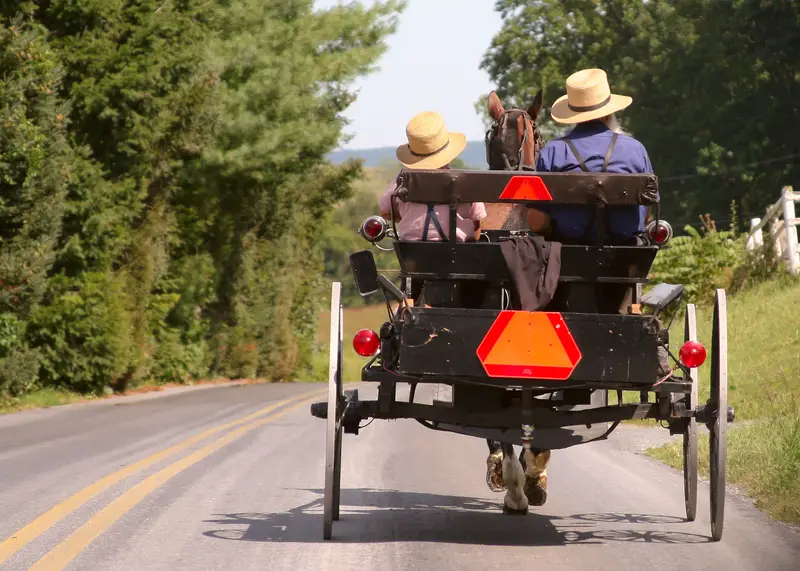
A buggy comes up the shoulder of a back road in Lancaster County, and every phone on the tour bus goes up at once. The driver keeps his eyes forward. Nobody waves. Most visitors go home telling friends the Amish believe a camera steals something from the person in front of it. The real objection is narrower, older, and a lot stranger than that. In many communities, an Amish adult can end up in the background of your vacation photos all day without breaking a rule. What the rule actually forbids is the pose.
The Problem Is Sitting Still, Not The Lens
Being photographed by accident or from a distance is not treated as a sin. The trouble starts when someone old enough to have been baptized into the church willingly faces a camera and holds still for it. That single distinction explains almost everything a tourist finds confusing, including why photos of Amish people exist at all. The standard advice for visitors is to shoot from behind, or while people are working, so that nobody is caught performing for the lens.
Calvin George Bachman made the same point in his 1942 book Old Order Amish of Lancaster County, writing that the main objection was to sitting or willingly posing. That is why Amish passport photos and public-school class pictures including Amish children once existed. They were part of a program, not a personal choice. Once the Amish built their own private schools, the class pictures stopped.
The same loophole is why Amish documentaries get made. Some of the more progressive communities draw a hard line between posed and unposed images, and candid filming leaves everyone a degree of plausible deniability. A man going to market was not posing. He was going to market.
There Are Pictures In Amish Houses
If the whole thing came down to the Second Commandment and its ban on graven images, the inside of an Amish home would look very different. Amish families commonly keep calendars, books, magazines and newspapers with pictures in them. Some Amish sketch. A few have become known for their folk art. Mirrors hang in Amish homes, which produce a likeness of a human face every time somebody walks past.
What gets kept out of the house is the personal photograph, the framed portrait of a family member on the wall or in a wallet. Those are the images that single out one person. The Young Center for Anabaptist and Pietist Studies at Elizabethtown College lists the bans on cosmetics, jewelry and personal photographs together, all of them designed to prevent pride.
The Ban Is Newer Than The Buggies
The earliest known Amish story about a photograph involves Christian Beck, who came to America from Bern, Switzerland. His son John smuggled a dog aboard the ship. The dog had puppies during the crossing, the captain found out, and instead of punishing the boy he picked a puppy for himself and handed John a silver dollar and a daguerreotype of himself. The father took both away, because having the picture was wrong.
Formal rules came decades later, right as the technology did. Amish ministers held general conferences between 1862 and 1878. At the 1863 meeting in Mifflin County, Pennsylvania, Abner Yoder asked whether photographs were to be permitted and spoke against them. The camera was then barely 25 years old. In 1865, a conservative ministers’ meeting in Holmes County, Ohio drew up a Discipline of 11 Articles, and Article 3 reads in part that they “decided not to allow…carrying hidden on one’s person photographic pictures of human likenesses or hanging them on the wall to look at in our houses.”
No scripture is cited in that ruling. No Second Commandment, no graven images. The same discipline also called large mirrors improper, which points at the real worry: showing off inside your own home. Around the turn of the century, some newlywed Amish couples started having wedding pictures taken at photo salons, and displaying them was seen as a failure of humility. In 1910, the Missouri preacher John D. Kauffman put his own concerns about photographs in writing. In 1950, the Amish church of Pike County, Ohio printed its Ordnung in English, and on the subject it needed only two words: “No photographs.”
The Deacon Who Couldn’t Burn The Photos
In 1933, an Amish deacon’s daughter sat for a photograph. She repented, confessed to the congregation and was forgiven. She handed the pictures to her father so he could burn them in the stove, and he could not do it. He said they looked too lifelike. He could not put them in the fire.
Voluntary confessions like hers were still happening as late as the 1980s. That tells you the rule has real weight inside the church, not just at the edge of a cornfield where tourists stand. It also tells you something about the deacon. A man raised to believe the picture was wrong looked at his daughter’s face and could not destroy it.
Soul Stealing Is The Tourist Version
The idea that a photo takes the soul is the explanation outsiders love most, and it has thin roots. Bachman floated a theory that the Amish dislike of pictures traced back to an old European belief that having your portrait painted could kill you, a close cousin of soul stealing, then admitted the connection to modern Amish practice may not exist at all.
It is not pure invention either. Photographer Bill Coleman, in his 1988 collection Amish Odyssey, described shooting a carriage in heavy fog and assuming the distance had made him invisible. As the buggy passed, a woman leaned out and said very clearly, “You have stolen my soul.” Coleman wrote that the hurt stayed with him a long time, and that of all the people who said versions of it to him over the years, it is the woman in the fog he still remembers.
The reasoning Amish writers themselves give runs along a different track. Bachman recorded the common explanation that photographs are evidence of pride, tempting people to look at their own likeness with self-admiration, and that a picture captures only the outward appearance, which is temporary. Elmo Stoll made an even blunter argument in the Amish magazine Family Life in March 1987: the Second Commandment cannot really be about snapshots, since it sat in scripture for thousands of years before anyone built a camera. The idol being warned against in the modern version is the self.
Nobody Speaks For All The Amish
There is no Amish headquarters and no central church government. Every district governs itself through its own Ordnung, the set of rules that covers dress, work, separation from the world and, in most places, photographs. Among the Amish those rules are largely unwritten, which is why the Pike County church printing theirs in English in 1950 was unusual.
Twice a year, members meet in an Ordnungsgemee and state their agreement with the rules before taking communion. If the group is not united, the Lord’s Supper is not observed. Members who defy the Ordnung face discipline from church leaders, and the most severe step a bishop can take is shunning.
Because every district writes its own, the answer to “do the Amish allow photos” changes depending on which farm lane you are standing in. The Swartzentruber Amish, among the most conservative of the Old Order, are among the strictest about cameras of any kind. New Order communities are more relaxed, though still not in the business of posing. The strictest groups count bright clothing, paintings and mirrors as vanity.
The Faceless Doll Story Came From A Magazine
Amish children playing with blank-faced dolls is one of the best known images in all of American folklore, usually explained as the graven image rule applied to toys. Some say it was simply a custom. Either way, Amish dolls with faces sewn or drawn on exist going back to 1900, and buying or making dolls with faces is common today.
Elmer Smith, in his 1961 book The Amish Today, traced the public’s fixation to a single piece of fiction: a short story called “Suzie” that ran in Scribner’s in December 1937, about an Amish girl given a doll by her teacher for Christmas. Her father removes the head. A made-up story in a national magazine hardened into a fact that millions of Americans still repeat.
What Happens At The DMV
Refusing a camera in a country that runs on photo ID creates real friction. Minutes from the 8th Annual Old Order Amish Steering Committee Meeting in Wisconsin in 1974 note that Amish travelers crossing from Canada into the United States did not need photographs, thanks to a document the committee held exempting them “if religiously opposed to photographs.”
The fight reached federal court in 2018, when an Amish couple from southern Indiana with 13 children sued the federal government over officials’ insistence on photographs before the wife, a Canadian, could be approved as a permanent U.S. resident. They were willing to give fingerprints or iris scans, just not a picture, and they were identified in the case only as John and Jane Doe. The settlement in 2019 let her become a permanent resident without submitting photos and allowed her to cross the border without photo ID.
States have been building workarounds. Virginia passed legislation in 2019 creating photo-less ID cards for Amish and Mennonite residents, joining 13 other states with similar laws, and the DMV estimated about 2,000 people would seek them. The cards launched at $80, more than a standard ID, because the community agreed to cover production costs. Virginia has since cut the fee to match a standard card. They cannot be used for voting or driving, which matters less when you were never going to drive. To stop anyone from claiming a religious objection on a whim, Virginia requires proof of exemption from Social Security and Medicare. In 2015, a Pennsylvania Amish man filed suit after he could not buy a firearm without photo identification.
So Put The Phone Down, Mostly
No law stops you from photographing an Amish person in Lancaster County. The county’s tourism office asks anyway, in plain language: take no photographs in which faces are recognizable. Nothing frustrates Amish neighbors more than strangers constantly, and sometimes secretly, trying to get the shot. There are even accounts of tourists paying Amish children to stand for a picture, which is about as low as this hobby gets.
Shoot the barn, the laundry line, the wheels of the buggy, the horses in the field. Those pictures are better anyway, and they cost nobody anything. The whole point of the rule, stated about as clearly as it can be, is that the Amish want to be remembered by the lives they lived and the examples they left, not by physical appearance. Your camera roll was never going to carry that.

