

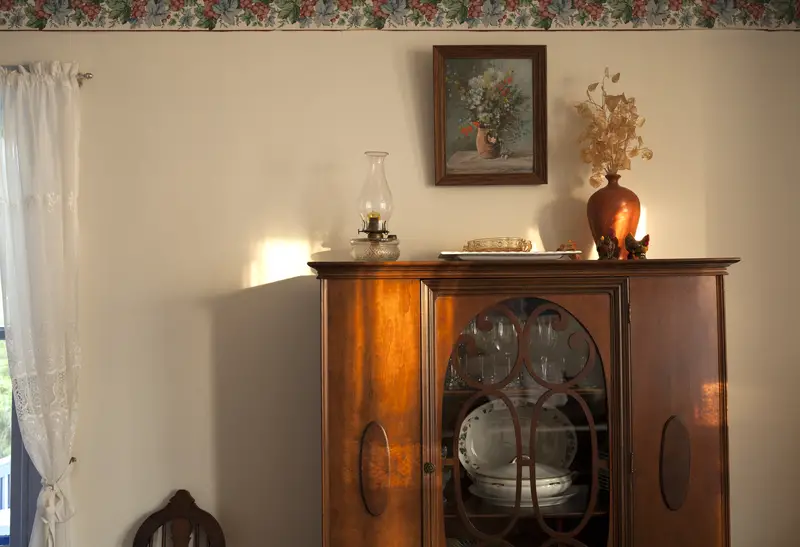
The china hutch nobody in the family wants to inherit is probably the best-built thing in the house, and one of the least valuable. The market for heavy brown furniture has collapsed over the past two decades, and dealers now move sideboards and china cabinets for a fraction of what they fetched at the peak. The dovetail joints, the hand carving and the inlay work still do not show up in the flat-pack stuff most of us buy today. The pieces from this era that did hold their money are sitting a few feet away.
Step into a home owned by someone born between 1946 and 1964 and you are basically walking through a time capsule. Boomers tend to keep a piece from every decade they have lived through, so one living room can hold a 1960s china cabinet, warm midcentury furniture, and 1990s brass lighting all at once. A lot of what younger people roll their eyes at turns out to be well made, valuable, or straight-up trendy again.
The furniture is quietly worth a fortune
That teak sideboard your parents have had since the ’70s and the Eames lounge chair collecting dust in the den are not junk. Genuine midcentury modern pieces have climbed in value over decades, and specialty stores now sell them for thousands. Designers say clients ask for these exact styles constantly, never realizing their own parents own the originals.
The bookshelves tell the same story. Those solid oak shelves were not bought at IKEA. While the rest of us fight with particleboard that bows under a few hardcovers, boomers put money into real wood that lasts generations, often with adjustable shelves and dovetail joints. The rich patina that builds up over 50 years cannot be faked, which is exactly why so much old furniture is gaining popularity again.
A British accountant invented the lava lamp in a pub
The lava lamp, that hypnotic blob of moving color parked in half the dens in America, has a stranger origin than you would guess. It was invented by Edward Craven Walker, a British accountant, in 1963. He got the idea after watching a homemade egg timer bob around in a pub, then turned it into one of the most recognizable objects of the counterculture era.
It caught on fast in homes that wanted to show off a little individuality, and it never really left. You will still find one glowing in a boomer’s bedroom or on a shelf, doing the same slow, unpredictable dance it did more than 60 years ago. Retro lighting like this sits comfortably next to the other psychedelic touches from the ’60s and ’70s that boomers never bothered to get rid of.
Those brass touch lamps still have your fingerprints on them
Polished brass table lamps had their big moment in the 1980s and showed up in countless middle-class living rooms. If your parents or grandparents are boomers, odds are those lamps are still around, accordion-style shades and all, sitting on the same oversized cherrywood end tables they came with.
A lot of them were touch lamps, a detail people forget. Tap the base and the light clicked on. They still carry the smudged fingerprints of every kid who could not resist flipping them on and off. Brass fell out of style for a while as brushed and matte metals took over, but vintage stores now charge premium prices for the exact solid-brass bases boomers have owned for decades.
Interior designers say boomers aren’t playing it safe
The stereotype is that older homeowners stick to beige and never take a risk. Designers who actually work with them say that is only half true. “Boomers often design with nostalgia in mind,” says Angela Johnson of The Johnson & Lopez Group. “You’ll see family heirlooms, antiques, or replicas of items from their youth.”
Others describe boomers as downright bold. Paulina Hospod, then president of AhA! Interiors, says her boomer clients gravitate toward rich hues like forest green and mustard, and that they are not afraid of bold wallpaper or marble. Many mix patterns and textures on purpose. Neutral, she says, is not their go-to.
The collectibles that were supposed to pay for college
Open a china cabinet from this era and you will probably find a shelf of small porcelain figurines, plus a story about how they were going to be worth a fortune one day. Heavy marketing in the 1980s and 1990s promised these collectibles would appreciate. For the most part, they did not.
Beanie Babies got hoarded by parents convinced the little plush animals would fund tuition; most are now worth less than the tag they came with. Pastel Precious Moments figures and cherub-cheeked Hummel pieces once signaled sophistication on a shelf and now read as leftovers of a different time. The lesson buried in all those dusty displays is that “limited edition” printed on a box almost never meant limited.
The orange pot in the cabinet is a workhorse
That heavy orange Le Creuset pot is not just for show. Pieces from the 1960s and ’70s have already survived decades of Sunday dinners and will probably outlast most of what is in your kitchen now. Vintage ones often come in colors that are no longer made, like the sought-after Elysées Yellow, discontinued in the 1970s, and plenty of boomers got theirs as wedding gifts, which makes them practical and sentimental at once.
The crystal in the cabinet carries the same weight. Waterford and Baccarat sets are a long way from basic glassware off a store shelf, catching light in a way that makes even cheap wine look expensive. The heft and balance of proper crystal is part of the appeal, and these cabinet treasures usually come complete with matching decanters and glasses for every kind of drink.
They still keep the phone book and the paper maps
Some boomer habits have nothing to do with style and everything to do with never wanting to be caught unprepared. Thick printed phone books still live in a lot of drawers long after smartphones made them useless. Folded road maps and highway atlases ride around in glove compartments just in case the technology fails.
Then there are the boxes of VHS tapes: old movies, TV specials, and irreplaceable family home videos, often stacked next to a VCR that may or may not still work. Plenty of people keep the printed manual for every appliance they own, filed away for the day something breaks. These hold-onto-everything instincts read as clutter to younger relatives and as basic common sense to the people who spent decades living without a search bar.
The keepsakes they will never part with
Every boomer kitchen seems to have a cabinet of Tupperware dating back to a first apartment, the containers tied to potlucks and family gatherings nobody wants to forget. Handwritten recipe cards handed down through the family sit in a box on the counter, carrying more than ingredients. Each one is a small piece of somebody’s mother or grandmother.
Vinyl records get the same devotion. For a lot of boomers they are the soundtrack of their youth, and the act of dropping a needle on a record beats streaming for anyone who grew up with it. There may even be an upright piano nobody plays anymore, kept because it is a family heirloom and because moving one is such a pain you practically pay someone to take it away. These are the everyday keepsakes that stay put for good.
Doilies and macramé were doing a job
The lace doilies and crocheted armrests scattered around a boomer grandma’s living room look purely decorative, but they were quietly practical. Doilies protected fancy wood tables from the water rings a vase leaves behind. Crocheted covers on sofa arms and chair backs took the wear so the upholstery underneath did not. Many of the women who made them learned to crochet from their own mothers and grandmothers.
Macramé plant hangers pulled the same double duty, holding greenery up off the floor while adding texture to a room, and they have come roaring back as part of the boho-chic look younger shoppers love. The bold floral and geometric wallpaper boomers put up decades ago is having its own revival, with designers charging premium prices for the same vintage patterns that once got mocked.
The avocado-green appliances, the wood paneling in the den, the sunburst clock and the velvet Elvis on the wall still shout “a boomer lives here” the second you walk in. But the joke has quietly flipped. The furniture is built better than what most of us can afford new, the collectibles taught a hard lesson about hype, and half the “outdated” stuff is back in style at a markup. Next time you are tempted to laugh at the hutch, check what it is worth first.

