

You grab a bag of apples off the pile at your local grocery store, toss it in the cart, and move on to the cereal aisle. The whole interaction takes maybe four seconds. You don’t think about it. Nobody does. But that bag of apples has been on a wild ride — passed through farm fields, cooling facilities, packaging plants, distribution warehouses, delivery trucks, and backroom stockrooms before your fingers ever touched the plastic. The number of individual human hands that physically contacted your food before you did is higher than you’d guess, and honestly, it’s a little weird once you start counting.
It Starts With More People Than You Think
Let’s trace the path of something simple — a head of lettuce, or a carton of strawberries. It starts on a farm, obviously. But modern American farms aren’t Old MacDonald operations. The production agriculture industry employed over 2 million workers as of 2018, and many large farms bring on seasonal employees specifically for harvesting because it’s delicate, labor-intensive work. One person picks the fruit. Another person sorts it. Another moves it into bins. Someone else loads those bins onto a truck or conveyor system. That’s already four or five sets of hands, and the food hasn’t even left the farm yet.
After harvesting, the produce goes through a pre-cooling process — a deliberate temperature drop designed to maximize freshness without triggering spoilage. Workers handle the items during washing, during sorting for quality, and again during packing into specialized containers. These containers aren’t just random cardboard boxes. They’re designed to prevent rapid temperature changes and stop the food from absorbing odors or flavors from whatever else is in the truck. Somebody has to pack each one. Somebody has to seal it. Somebody has to stack it. We’re up to maybe eight or nine people now, and the food still hasn’t left the state it was grown in.
The Middle of the Chain Is Where It Gets Crowded
Here’s where things get really layered. The grocery supply chain isn’t a straight line from farm to store. It’s more like a relay race with too many runners. After the farm, your food usually heads to a manufacturer or processing facility. For produce, this might mean additional washing, trimming, or repackaging into consumer-ready bags. For something like a can of soup, it means the raw ingredients go through multiple stages — receiving, processing, cooking, packaging, labeling — each one involving a different set of workers.
Then comes distribution. Food distributors are the middlemen between producers and the stores where you shop. They operate massive warehouses where products arrive from dozens of different manufacturers and get reorganized for delivery to specific retailers. Workers at these facilities receive shipments, inspect them, sort them, move them into cold storage or dry storage, pull them for orders, restack them on pallets, and load them onto outbound trucks. A single distribution center might handle thousands of products a day, and every one of those products gets physically touched by multiple people during the process.
According to researchers at Penn State, the materials handling and movement of food within and between these facilities is critical to every link of the food supply chain. Workers use palletizers, pallet jacks, forklifts, and powered industrial trucks to move products. Every time a pallet is broken down and rebuilt — which happens more often than you’d think — someone is physically touching your food’s packaging. And in many cases, they’re touching the food itself.
Distribution Centers Are Basically Small Cities
Most people have never been inside a food distribution center, but they’re massive operations. These places store everything from fresh meat to frozen pizza to canned beans, and each category has its own temperature requirements. Fresh produce needs one range, dairy needs another, frozen goods need another. Workers have to move between these zones constantly, and the potential for cross-contamination between products from different manufacturers is a real concern that facility managers actively manage through segregation and storage rules.
Here’s a detail that stuck with me: in 2022, rodent infestations at major food distribution centers created some of the biggest food safety incidents of that year. Not at farms. Not at restaurants. At the warehouses in between. The places nobody ever thinks about. Workers at these facilities are responsible for cleaning, removing food debris, managing waste, and keeping up facility hygiene — all while moving products at the pace required to keep grocery store shelves stocked across the country.
By the time your groceries leave a distribution center, they’ve been handled by anywhere from a dozen to twenty or more individual people, depending on the product. And they still haven’t reached the store.
The Truck Driver Is Just One More Person in a Long Line
Transportation is its own whole stage. Produce shipped from California or Mexico to grocery stores across the country has to travel in trucks that meet strict cleanliness standards. Drivers and loading crews have to ensure packaging materials aren’t reused between loads and that the truck maintains the right conditions during transit. Workers monitor temperatures throughout the journey to keep products in a safe range. If something goes wrong — a mechanical failure, a delayed delivery, a traffic snarl — the food sits longer, and more hands may get involved to reroute or reinspect it.
During COVID-19, truck driver shortages made this stage even more chaotic. Suddenly Americans weren’t eating out. They were buying way more groceries, and the system buckled. The pressure didn’t just land on store shelves — it hit every worker along the chain, from the farmer picking produce to the truck driver hauling it to the warehouse worker restacking pallets at 3 a.m.
Then Your Grocery Store Adds Even More Hands
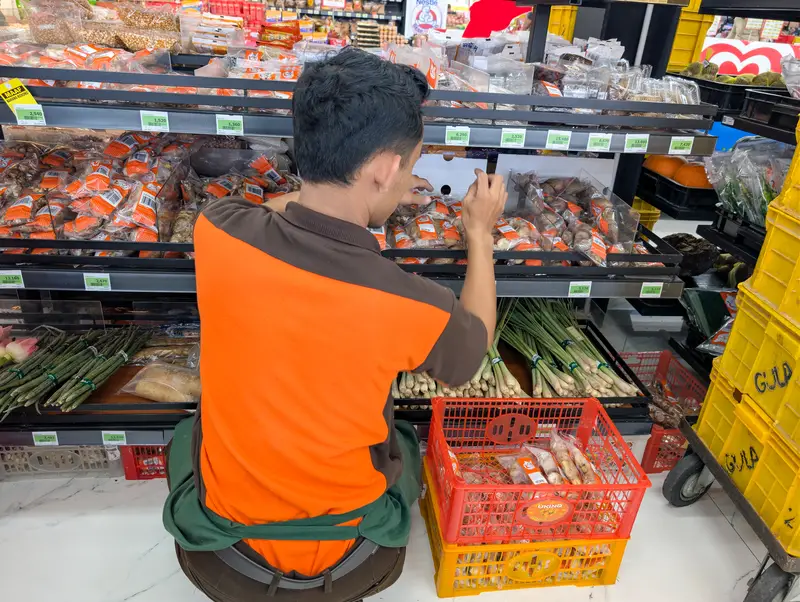
Once the truck arrives at your local store, a whole new crew takes over. Workers unload cartons and pallets, move excess product into walk-in coolers, and begin stocking shelves. Stock clerks receive and store merchandise, use scanners to track inventory, and reorder items running low. When they’re not stocking, they’re cleaning — mopping, sweeping, maintaining the store. Produce clerks specifically are responsible for dating produce when it arrives, making sure goods sell in the order they were received, maintaining correct temperatures and humidity in the stockroom, and keeping unwrapped fruits and vegetables wet on the sales floor so they stay fresh.
Some grocery stores actually wash produce again before putting it on shelves, even if the farm already cleaned it. So that’s yet another set of hands on your food. Then there are the butchers cutting large pieces of meat into steaks and chops, the meat wrappers packaging them, and the checkers scanning everything at the register. About one-fourth of all supermarket workers are store or department managers who supervise all of this.
The food retailing industry in the U.S. employs 4.8 million people. Over 300,000 grocery store workers are specifically classified as food handlers by the Bureau of Labor Statistics. In some areas, like Orange County, California, every single grocery store employee — regardless of their position — is required to obtain a food handler permit. Not just the people stocking produce. Everyone.
So What’s the Final Count?
For a simple piece of fresh produce — an apple, a head of broccoli, a bag of grapes — a reasonable estimate is somewhere between 20 and 30 individual people who physically handled the product or its immediate packaging before you picked it up. For processed foods like a jar of pasta sauce or a bag of frozen chicken nuggets, the number is likely higher because of the additional manufacturing steps involved.
That’s not a scary number. It’s just a real one. The American grocery system moves an almost absurd volume of food — the average supermarket carries about 35,829 different items — and more than 22 million workers across farms, factories, warehouses, and stores help get it there. Grocery stores receive 29 to 30 million visits every single day from Monday through Thursday alone. The average American shops for groceries about six times a month and spends $174 per trip, which is actually a 12% jump from what people were spending per trip in 2022.
All of this happens so smoothly that we never think about it. You walk in, grab your stuff, self-checkout, go home. The entire experience takes most people under 45 minutes — 72% of consumers, actually, according to surveys. But behind that 45-minute trip is a chain of human labor stretching across thousands of miles, involving dozens of hands, all working to get that bag of apples from a tree in California’s Central Valley to your kitchen counter in Ohio or Georgia or wherever you happen to live.
Next time you’re at the store and you absently squeeze an avocado, just know — you’re roughly person number 25 to do that.

