

Interstate 17 in north Phoenix was still thick with commuters at 8:29 a.m. when a silver Tesla sedan sat on the southbound shoulder near Dove Valley Road, a man and a woman inside. Behind it was an older gray Chevrolet pickup with red and blue lights strobing through the windshield. The driver of the pickup, in a red polo shirt, dark jeans and a ball cap, was on the phone with the Arizona Department of Public Safety, reporting the traffic stop he was making.
Troopers arrived and sorted it out fast. The man running the stop had no law enforcement authority and no affiliation with any agency. He was taken into custody at the scene on September 17, 2026, and booked on charges of impersonating a police officer.
State police then put out a public notice about the truck, because they were concerned the same driver, or somebody with a similar setup, may have stopped other motorists. Tucked inside it was advice almost no American driver has ever read: Arizona law still requires you to acknowledge a stop and pull over safely, but you do not have to stop immediately on a lonely, poorly lit shoulder. Hazards on, slow down, keep rolling to a gas station or a police station, and call 911 on the way.
The Giveaway Was Where The Lights Were Bolted
DPS described the pickup’s red and blue lights as mounted above and behind the dashboard, visible through the windshield, and specifically not in the vehicle’s visors. That distinction is not trivia. Real unmarked units run professional-grade emergency lighting, often built to SAE industry standards, usually red and blue LED combinations with flash patterns programmed to department protocol.
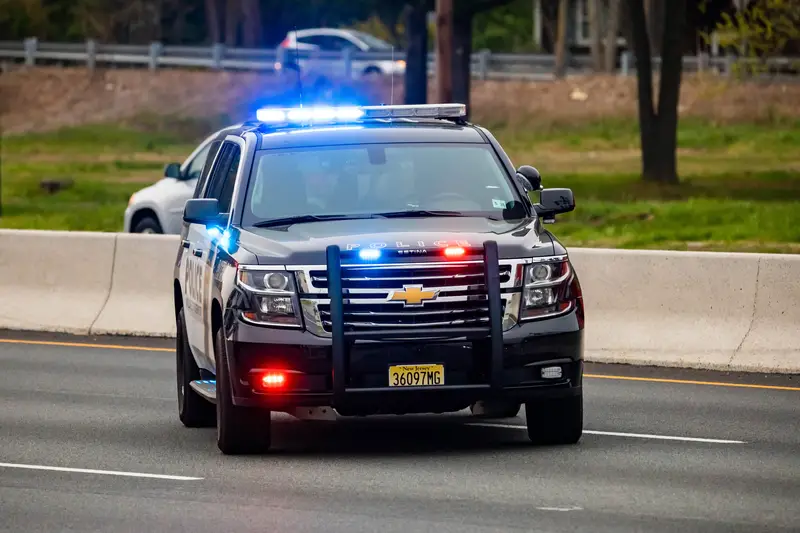
Other markers stack up on a genuine car: a siren or air horn, multiple radio antennas, often a push bumper, and in many jurisdictions government plates. Cheap bars that look hastily installed, or single-color lights of the type sold openly online, are the opposite signal. Light color alone proves nothing, though, because policies differ by state and by department, with some agencies running blue only and others red and blue.
You Still Have To Stop. You Get To Pick The Spot.
Activated lights and sirens from an unmarked car generally obligate you to pull over in all 50 states. Driving away from a real officer is a separate offense, and a serious one. The workaround is not refusal, it is location.
Arizona troopers spelled out the sequence. Turn on your hazards to show you have seen the lights and intend to comply. Reduce your speed and drive to the nearest well-lit, populated area, which they listed as a police station, fire station, gas station or open business. Call 911 while doing it, give your location, and ask the dispatcher to confirm whether a legitimate unit is behind you. Keep your doors locked and your window only partly down until you have seen a marked vehicle, a uniform and visible credentials. As the agency put it, “The steps above are about how you stop, not whether you stop.”
One Driver Lit Up An Undercover Sheriff’s Car
On June 24, 2026, a black Chevrolet Suburban switched on red and blue emergency lights while tailing a vehicle on U.S. Highway 301 North in Thonotosassa, Florida. The vehicle it chose was an undercover Hillsborough County sheriff’s car. Deputies turned around and ran a very real stop on the Suburban.
Detectives say they found the active emergency light setup, an extra two-foot light bar and a handgun inside. Nadi Jabari, 46, was arrested at the scene and charged with false personation, unlawful use of a blue light, and possession of a firearm during the commission of a felony. The charges are allegations and the investigation is ongoing. Officials have not confirmed whether he stopped any other drivers, and where he got the lighting equipment has not been established.
Sheriff Chad Chronister tied it to trust. “When someone falsely presents themselves as law enforcement, they threaten the trust that exists between deputies and the community we serve,” he said, calling the conduct dangerous, deliberate and illegal. His office added its own line for drivers: “If you are ever uncertain whether a traffic stop is legitimate, drive to a well-lit public location and call 911.”
The Light Bar Is Legal To Buy. The Traffic Stop Is Not.
Nothing about owning the gear is exotic. Tow operators, volunteer firefighters, plow drivers and off-roaders all buy LED bars, grille strobes and hideaway flashers legally, and plenty of kits switch colors. The same hardware bolts onto a personal SUV in an afternoon.
Florida wrote its law around exactly that problem. State law reserves flashing blue lights for police and a short list of government vehicles, which is why unlawful use of a blue light is a crime of its own, separate from impersonation. Switch that color on behind traffic and the offense is complete before anyone says a word.
A Maryland Driver Simply Kept Going
At about 4:40 p.m. on May 5, 2026, a motorist on the outer loop of I-695 at Washington Boulevard in Baltimore County saw blue and white flashing lights come on behind him from a black 2014 Ford Explorer. He did not pull over. He called 911 instead.
The Explorer passed him, changed lanes to get in front of him, then exited at Hollins Ferry Road. Still on the phone with police, the motorist followed it to a gas station in the 4300 block of Hollins Ferry Road in Lansdowne. He was later identified as an off-duty military law enforcement officer. Troopers from the Golden Ring Barrack and Baltimore County officers responded, and Eric Baummer, 59, of Mount Airy, the sole occupant, was arrested without incident and charged with impersonating a police officer. The investigation continues.
Worth saying plainly: that ended well partly because of who the driver was. Trailing a stranger to a gas station is not the advice any of these agencies give. The 911 call is the part to copy.
A Dash Camera And A Plate Reader Closed A Washington Case
A driver on S. 3rd Avenue in Everett, Washington, pulled over on January 13, 2026, for a silver pickup with a decal reading “Traffic Control” and blue lights flashing behind him. The man who walked up said he was a security officer and an off-duty Duvall police officer, and that the stop was for speeding. Duvall’s police department later confirmed he did not work there.
The driver had a dash camera running and showed the footage to responding officers. Seventeen days later, on January 30, the Flock license plate reader system flagged the truck’s location in Everett. Officers found the man and booked him into the Snohomish County Jail on suspicion of second-degree criminal impersonation. A camera on a windshield and a camera on a pole did most of the work.
Two Black SUVs And An Interstate Full Of 911 Calls
July 3, 2026 brought multiple 911 calls from westbound I-90 in Grant County, Washington, reporting a black Ford Explorer with emergency lights and police-style equipment pulling vehicles over as it headed toward Kittitas County. Callers suspected the driver of a second black SUV traveling with it was doing the same thing.
Kittitas County Sheriff’s Office deputies later found and seized an Explorer matching the descriptions in Ellensburg and arrested its driver, a 20-year-old Spokane man, on suspicion of criminal impersonation. The SUV had a police-style push bar on the front, and may also have had lights near the headlights or grille and an interior light bar near the rear window. Deputies are still looking for witnesses and for drivers who were stopped, under case S26-09547, and ask anyone with information to contact Kittcom at 509-925-8534 for Deputy Logan Nicholson. Arizona is running a similar appeal through 1-877-4AZ-TIPS.
What A Real Officer Will Never Ask You For
Hardware is only half of it. The U.S. Marshals Service warns that legitimate officers will never demand money, request wire transfers, or ask for your financial information, passwords or social media access during a stop. Any of that, from anyone, in any uniform, and you are dealing with a criminal.
The behavioral flags are just as useful. A real officer gives a name, an agency and a badge number, and explains why you were stopped. An impersonator dodges those questions, flashes a badge too quickly to read, manufactures urgency, or asks you to follow him somewhere unfamiliar. Real officers carry both a badge and an agency photo ID showing a photograph, full name, agency and a unique number, often with holograms or watermarks. And a real officer will wait while you confirm with dispatch. Someone who panics when you reach for your phone has answered the question for you.
The Habit That Costs You Nothing
Five cases across four states in eight months share one pattern: the drivers who came out of it cleanest either stayed on the line with a dispatcher or had a camera running. Nobody got in trouble for taking an extra half mile to stop somewhere lit and busy.
So make it automatic. Hazards on, foot off the gas, phone to 911, and keep moving until there is a gas station canopy or a parking lot with people in it. A legitimate trooper will follow you there and will understand exactly what you are doing. A man with dashboard lights and a ball cap might not want an audience at all.

