

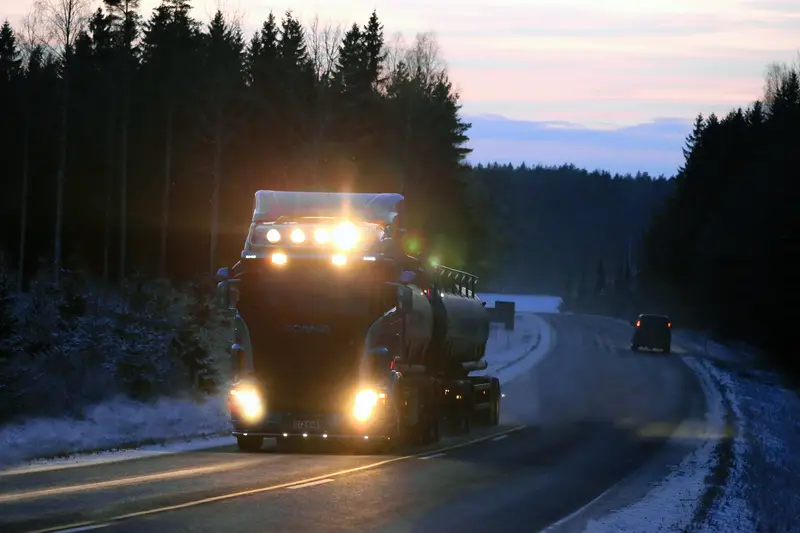
You’re rolling down the interstate at night, you slide past a big rig, and out of nowhere the truck behind you blinks its lights at you. Your stomach drops a little. Did you do something wrong? Is your trunk open? Are the cops up ahead? Here’s the thing most drivers never figure out: truckers have a whole silent language built around their headlights, and the rest of us cruise right past it with no idea what any of it means. Once you crack the code, you’ll never look at a flash in your mirror the same way again.
That Late-Night Flash Usually Means You’re Clear
This is the big one, and it’s the friendliest. When you pass a semi at night, you’re sitting right next to a trailer that can stretch around 70 feet long. From your low seat in a car, you genuinely cannot tell how far ahead of the cab you are. That front bumper feels way closer than it really is. The trucker, sitting up high, can see exactly how much room you’ve got. So when you’ve pulled far enough ahead to slide back over safely, they’ll give you a quick flash to say go ahead. According to drivers who do this for a living, it’s basically them lending you their eyes. If you’re towing a trailer, it’s even more useful, because judging that gap behind you is nearly impossible.
Two Quick Flashes From Oncoming Traffic Means Slow Down
If a truck coming the opposite direction hits you with two fast flashes, there’s a solid chance they just told you a cop is sitting up ahead with a radar gun. How do they know before you do? Truckers talk to each other constantly, and word travels miles up the road long before you’d ever spot the patrol car. The same flash can also mean general trouble: a wreck, stalled cars, construction, or a sudden traffic jam. As one breakdown of these signals puts it, the polite move is simple. Ease off the gas and start paying attention. Whatever they’re warning you about, you’ll be glad you slowed down before you hit it at full speed.
They Can See Trouble You Physically Can’t
A lot of this comes down to height. A semi driver sits about 9 to 10 feet off the ground, which gives them a view down the road that you, scraping along at car level, will never get. They can spot brake lights, smoke, debris, or backed-up traffic way before any of it shows up in your windshield. That’s why a flash from a truck deserves more respect than a flash from the sedan next to you. As one explainer points out, you might even get a quick burst from a truck in your own lane, simply because the driver saw something coming that you had no way of knowing about. Treat it like a free heads-up from someone with a better seat.
The Flashing Behind You Is Probably Not a Compliment
Now for the other side. If a trucker is riding behind you and flashing their brights over and over, that is usually not a kind gesture. Most of the time it means you annoyed them. Maybe you cut them off, merged without a signal, or parked in the left lane without actually passing anyone. There’s also a version where a trucker coming down a hill in the left lane flashes at a slowpoke in front of them, because they don’t want to tap the brakes and lose all their momentum. Here’s my honest advice: just move over. As plenty of folks have learned the hard way, an angry flash can turn into full road rage fast. And arguing with 80,000 pounds of steel is a fight you are never going to win.
The Thank You You Probably Never Noticed
When you let a truck cleanly merge in front of you, you might get a little flash of gratitude. A trucker can’t exactly stick a hand out the window and wave, because they’re way too high up for you to see it. So the lights become the wave. But here’s the cool part. Many semis have something called a running light interrupt switch, wired in for this exact purpose. Instead of blasting you with harsh high beams, the driver hits the switch and you see a soft double-blink of the trailer lights. It’s a polite thank you that doesn’t blind anybody. According to drivers on a long-running trucking forum, flashing the four-way hazards after someone lets them over counts as a thank you too. The catch? Fewer than 30% of truckers bother with the tail-light thank you, so don’t take it personally if you don’t get one.
This Signal Almost Got Drivers Ticketed
The cop-warning flash has actually landed people in legal trouble. Police in Missouri once ticketed a man for flashing his lights to warn other drivers about a radar trap. In 2014, a U.S. District judge tossed that ticket out, ruling that flashing your lights is a form of communication protected by the First Amendment. The rules still bounce around from state to state, though. In Tennessee, warning others about police with your lights is treated as protected free speech. In Louisiana, flashing lights are basically banned unless you’re an emergency vehicle or using them as turn signals. Maryland police have sometimes leaned on a law about obstructing an investigation to write tickets anyway. So while courts have mostly sided with the flashers, your mileage really does vary depending on the zip code.
Before Lights, Truckers Had a Hand Language
This part blew me away. Back before CB radio, on the old two-lane highways, truckers had an entire system of hand and light signals. At night they’d turn on the dome light so the other driver could actually see their hands. First they’d flash the headlights to say a message is coming. Then, according to veteran drivers swapping stories, holding up a log book meant the weigh station was checking paperwork. Palm up meant the scales were open and weighing. One hand covering an eye told the other trucker that one of their headlights was out. And slamming a fist into an open palm? That meant a wreck ahead. They even helped each other pass safely, with the lead truck hanging over the center line and flashing a left signal as long as the road stayed clear. It was a real language, and a lot of it has quietly faded away.
CB Radio Was the Original Group Chat
So how do truckers know about that cop two miles up? A lot of it still runs on CB radio, the technology that turned the highway into one giant conversation. CB was actually invented by Al Gross back in 1945 as a civilian spin-off of the wartime walkie-talkie. Truckers grabbed onto it first, and during the 1973 oil crisis they used their CBs to organize protests and work stoppages over fuel prices and the new 55 mph speed limit. That cemented the CB in American road culture. Movies like Smokey and the Bandit and Convoy made it a national craze. Drivers reported cops as bears, called weigh stations chicken coops, and warned each other about weather and wrecks. Channel 19 is still the main highway channel today. But the CB has faded too. Fewer than a third of truckers still regularly use one, thanks to GPS, smartphones, and electronic logs. Many old-timers call it the original social media.
Their Blind Spots Are Way Bigger Than Yours
Half the reason these signals exist at all is that truckers genuinely cannot see you in huge chunks of road. The blind spot directly behind a trailer can stretch as far as 200 feet. The one on the right side is the worst, reaching across about two lanes. There’s even a 20-foot blind zone right in front of the cab. According to a breakdown from truck accident attorneys, the FMCSA says one-third of all crashes between semis and cars happen inside these blind spots. Add in that a loaded semi can hit 80,000 pounds and takes about 40% longer to stop than your car, and the flashing lights start to feel less like a quirk and more like a survival tool. When a trucker waves you over with their lights, they’re filling in a gap their mirrors simply can’t cover.
How to Flash Back the Right Way
You can join the conversation too. If a truck has its turn signal on and is clearly trying to move into your lane, a single flash of your headlights tells them their path is clear. The driver might flash back to say thanks. Just keep it gentle. Some truckers actually find harsh high-beam flashes annoying, and a quick flick off and on works better than blinding someone. One guide on this suggests treating every signal case by case, because meanings shift by region and time of day. Washington state law even bars high beams within 500 feet of oncoming traffic. So learn the basics, keep it friendly, and next time a rig blinks at you on the highway, you’ll actually know what it’s trying to say.

