

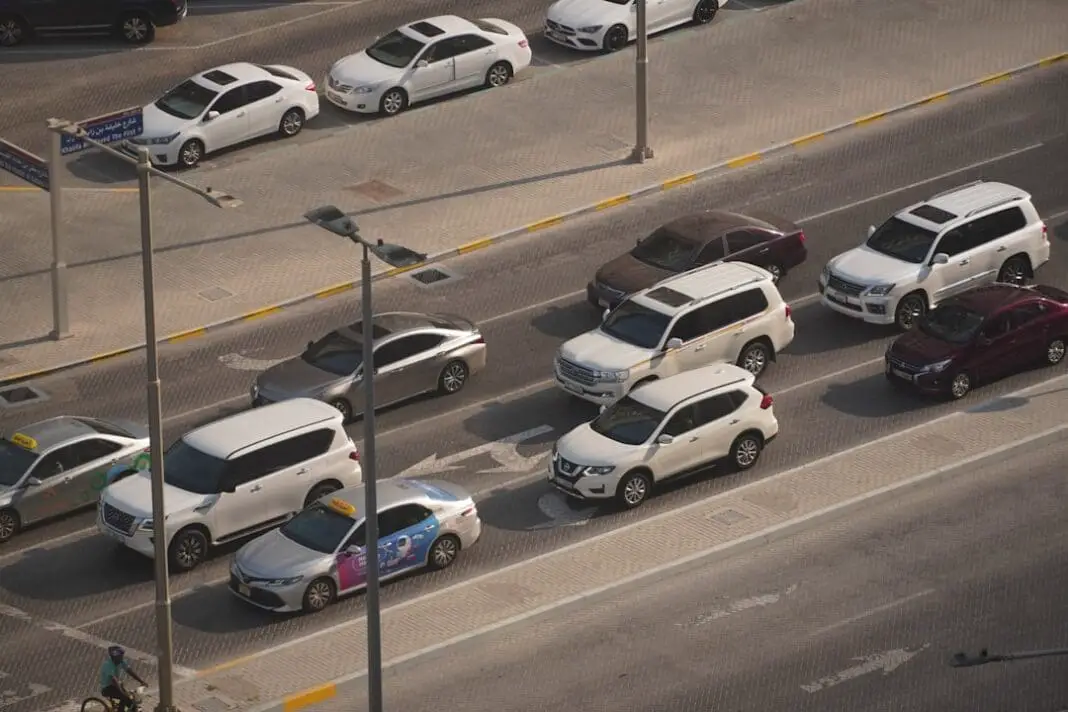
Here’s something that might sting a little: you’re probably driving too close to the car in front of you right now. Not “a little too close.” Dangerously close. The kind of close where if that Honda Civic ahead of you tapped its brakes, you’d be swapping insurance information on the shoulder and wondering what went wrong.
Most American drivers have heard some version of the “keep a safe distance” advice. But almost nobody follows it correctly, and even fewer understand the actual science behind why three seconds is the magic number. It’s not some arbitrary rule dreamed up by a bureaucrat. It’s built on the cold, hard math of how your brain processes danger — and how long your two-ton vehicle takes to actually stop.
Your Brain Is Slower Than You Think
Let’s start with the uncomfortable truth. You are not as fast a reactor as you believe. The National Highway Traffic Safety Administration uses a combined perception-and-reaction time of 1.5 seconds in its stopping distance calculations. That’s the time between a hazard appearing in front of you and your foot actually pressing the brake pedal. During that 1.5-second window, your car is still traveling at full speed. You haven’t slowed down at all.
At 50 mph, that means you cover about 110 feet before your brakes even begin to work. That’s more than a third of a football field. At 80 mph, you’ll cover even more ground while your brain is still going, “Wait, is that car stopping?” This isn’t a matter of being a bad driver. It’s how human neurology works. Your eyes see the brake lights. Your brain interprets them as a threat. Your brain sends a signal to your leg. Your foot moves from the gas to the brake. All of that takes time — time during which your car is hurtling forward.
How the 3-Second Rule Actually Works
The National Safety Council recommends a minimum three-second following distance for passenger vehicles. Highway engineers originally designed roads around a 2.5-second standard, but the NSC tacked on extra time as a safety buffer — and for good reason. Modern drivers are dealing with far more distractions than drivers in the 1960s when the original two-second rule was introduced.
Here’s how you actually measure it. Pick a fixed object on the side of the road — a sign, a tree, a light pole, even a crack in the pavement. When the rear bumper of the car ahead of you passes that object, start counting: “one-thousand-one, one-thousand-two, one-thousand-three.” If your front bumper reaches that same object before you finish, you’re too close. Period. Slow down and let the gap grow.
And you have to say the full words. Counting “one, two, three” takes about one second total. That’s not three seconds. That’s a recipe for a fender bender.
The Old Two-Second Rule Failed — Here’s Why They Changed It
Back in the 1960s, the NSC introduced a two-second-plus rule for following distance. It worked reasonably well for decades. But by the 1990s, the rule was showing its age. Vehicles had gotten bigger and heavier. SUVs and trucks were everywhere. And then came the real problem: cell phones.
Modern distractions — texting, scrolling through Spotify playlists, punching addresses into GPS — have measurably increased the average driver’s reaction time. Research from 2000 showed the average driver needs between 1.33 to 1.5 seconds just to perceive a hazard and begin braking. The updated three-second rule allocates about 1.75 seconds for perception, 0.75 seconds for physical reaction, and adds a half-second safety buffer on top of that. It’s not generous. It’s barely adequate.
At 70 MPH, Your Stopping Distance Is Three Swimming Pools
Numbers make this real in a hurry. At 30 mph, your total stopping distance — perception time plus reaction time plus braking distance — is about 153 feet. That’s roughly half a city block. At 55 mph, it jumps to nearly 346 feet. And at 70 mph, you need approximately 490 feet to come to a complete stop. That’s about the length of three Olympic-sized swimming pools laid end to end.
Think about that the next time you’re doing 75 on I-95 with two car lengths between you and the pickup truck ahead. Two car lengths at highway speed is roughly one second of following distance. You’d need to be a superhuman with zero reaction time and perfect brakes on dry pavement to avoid a collision if that truck stopped suddenly. You’re not a superhuman. Neither am I.
Three Seconds Is Just the Starting Point
Here’s where most people get the rule wrong — they treat three seconds as the answer for every situation. It’s not. Three seconds is the bare minimum for a regular car on a dry road in broad daylight with good visibility and a well-rested driver. Change any one of those variables and you need more time.
Ryan Pietzsch, a program technical consultant for driver safety at the NSC, explained it this way: if you’re driving in snowy conditions on a busy road during rush hour, you’d add one second for the snow, one second for the road surface, and one second for congested traffic. That’s six seconds total. Feeling tired? Add another second. Stressed and fatigued? Add two. In heavy fog, some safety experts recommend tripling the base rule to nine seconds of following distance.
Rain alone can reduce tire traction enough to increase stopping distances by two to ten times, according to NHTSA. The American Meteorological Society has reported that nearly 1,000 fatalities happen every year on American roads because of winter weather conditions. These aren’t freak accidents. They’re the predictable result of people driving like it’s July when it’s January.
Trucks and Motorcycles Play By Different Rules
Driving behind an 18-wheeler? Your three-second rule isn’t enough. The Federal Motor Carrier Safety Administration recommends that trucks themselves maintain at least one second of following distance for every 10 feet of vehicle length at speeds under 40 mph, with an extra second above that speed. For a typical tractor-trailer, that works out to four or five seconds.
As a car driver following a truck, you should match that four-second minimum. There are two reasons. First, a big rig blocks your view of the road ahead, so you’ll see brake lights and hazards later than you would behind a regular car. Second, you have no idea what’s happening in front of that truck. A pileup could be forming that you literally cannot see.
Motorcycles are the opposite problem. They’re smaller, lighter, and can stop much faster than your car. Experts recommend at least four seconds of following distance behind a motorcycle. If a bike stops suddenly and you’re only two seconds behind, you could run them over before your brain finishes processing what happened. That’s not an exaggeration — it’s physics.
Speed Changes Everything
One of the clever things about measuring following distance in seconds rather than feet is that it automatically adjusts to your speed. At 30 mph, three seconds of gap covers less physical distance than at 70 mph. The rule scales with you. But some safety experts argue that even three seconds isn’t enough once you get above 40 mph.
The California Driver Handbook, for example, suggests that if you’re driving above 30 mph, you should extend your following distance by one second for every additional 10 mph of speed. So at 40 mph, you’d want four seconds. At 50 mph, five seconds. At 60 mph, six. By that math, most highway drivers should be keeping five to seven seconds of space — and almost nobody does.
Rear-End Collisions Are the Most Common Crash — And the Most Preventable
Rear-end collisions are the single most common type of vehicle accident in the United States. And in almost every case, the trailing driver — the one who hits from behind — is found at fault. It doesn’t matter if the car in front stopped without warning. It doesn’t matter if their brake lights were out. If you rear-end someone, you were probably following too closely. That’s the legal presumption, and insurance companies treat it the same way.
The frustrating part? These crashes are almost entirely preventable. If every driver maintained a proper three-second gap — adjusted for conditions — the rate of rear-end collisions would plummet. But we’re impatient. We tailgate. We assume we’ll have time to react. And then we don’t.
The Hidden Benefit Nobody Talks About
There’s a benefit to the three-second rule that has nothing to do with safety, and nobody mentions it: it makes driving dramatically less stressful. Tailgating is exhausting. Your body tenses up. Your eyes fixate on the car ahead. You’re constantly micro-adjusting your speed. Your knuckles go white. You arrive at your destination wound up and irritable.
Drop back three seconds and something interesting happens. You can see more of the road. You have time to make decisions calmly. You stop riding your brakes. Your fuel efficiency improves because you’re not constantly accelerating and decelerating. Your whole commute feels different.
Yes, people will merge into the gap you’ve created. That’s the one legitimate complaint about following the rule in heavy traffic. The move is to just ease off the gas slightly and rebuild the gap. Don’t speed up to close it. Don’t get angry. Just reset. Three more seconds is going to cost you, at most, three seconds of your day. That’s a trade worth making.

