

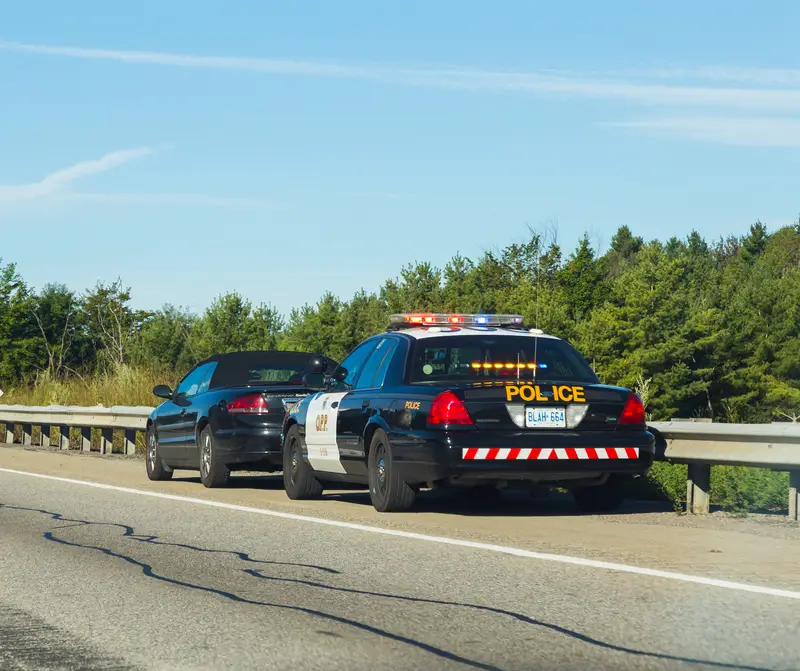
You have probably seen it happen. A cop pulls someone over, climbs out of the cruiser, walks up to the car, and just before reaching the window, taps or presses a hand on the back of the vehicle. Maybe it happened to you and you never thought twice about it. Maybe you caught it in a dashcam clip online and thought, wait, why did he do that? It looks like a nervous habit. A little tap on the taillight for no reason at all. But there is an actual reason behind it, and honestly, once you hear it, you cannot unsee it.
The short version is that it started as a safety move. The longer version involves fingerprints, forensic evidence, a psychological trick, and a habit so old that a lot of younger officers do not even bother with it anymore. Let me break down what is really going on back there.
The main reason is a fingerprint on your car
Here is the answer most people never guess. When an officer presses a hand on your taillight or trunk, they are leaving a fingerprint behind on purpose. Think of it as a signature. That smudge says, I was here, and I stopped this exact car. According to longtime police practice, if the stop goes sideways, that print connects the officer to your vehicle.
Traffic stops can turn ugly fast. Say the driver panics and speeds off. Or worse, something happens to the officer and they never make it back to the cruiser. That fingerprint on the glass becomes a breadcrumb for investigators. A criminal defense attorney told Reader’s Digest that it is an old-school way to tag a car so it can be identified as the vehicle involved in a stop, even if the officer is incapacitated. Glass holds prints really well, which is exactly why the taillight became the go-to spot.
It is not superstition, it is training
A lot of people assume this is one of those things cops just do, like a ritual passed down with no real logic. Nope. In some states it is taught directly in the academy. A spokesperson for the Maryland State Police confirmed that recruits learn the taillight tap during their six months of training to become a trooper. She described leaving a mark on the vehicle as an extra layer of safety, evidence, and accountability.
A retired instructor from the New Jersey State Police Academy said the same thing. The tap leaves fingerprint evidence on the glass to prove the officer was present at the scene. So the next time you see it, know that for a lot of officers, this was drilled into them by an instructor standing over their shoulder. It is procedure, not a twitch.
The sneaky psychological trick most people miss
This one blew my mind. The tap is not only about evidence. It is also a startle move. When you are sitting in your car waiting, you are not expecting a sudden knock or thud on the back of your vehicle. That little jolt of surprise makes you stop whatever you are doing for a second.
Why does that matter? Because if a driver is trying to hide something, stuff a bottle under a seat, or tuck away a weapon, that momentary pause interrupts them. It buys the officer a few extra seconds to walk up and read the situation. As one report explained, the noise causes the driver to freeze up, which gives the officer more time to observe the driver’s mental state and spot anything suspicious in the car. It is a small mind game, and it works because it catches you off guard.
They are also checking your trunk
This sounds paranoid until you think about it. Part of touching the back of the car is a quick check to make sure the trunk is actually latched shut. An Orlando trooper explained to a Florida news station that the goal is to be sure no one is about to jump out of the trunk and that it is properly secured.
Yeah, someone hiding in the trunk. It sounds like a movie plot, but officers approach every car assuming they do not know who or what is inside. When cops intentionally check a trunk, they usually bring a partner. One person watches the driver at the window while the other handles the back. That way nobody gets left exposed, and the driver cannot grab something or stash it while the officer’s attention is split. A quick press on the trunk lid confirms it is closed without the officer having to bend down or take their eyes off the front of the car.
Where the officer stands is no accident either
While we are back here, look at where the officer positions their body. That spot between the trunk and the rear door, the rear quarter panel, is chosen on purpose. Standing there gives the officer a partial barrier between themselves and the people inside. If a weapon goes off from inside the car, the vehicle’s structure might absorb or deflect it.
There is more to the driver-side approach too. Coming up along the driver’s side rear lowers the chance of getting clipped by passing traffic while still letting the officer keep an eye on both the driver and the front passenger. And by keeping a hand on the car, the officer can literally feel it if the vehicle suddenly lurches forward or backward. That physical contact is an early warning system. It is wild how much thought goes into a walk that lasts maybe four seconds.
Cameras are killing the taillight tap
Here is the twist. This whole tradition is fading fast, and the reason is technology. Back when there were no cameras on cruisers, a stop that went wrong left almost nothing behind. If an officer got hurt or disappeared, investigators had very little to work with. The fingerprint on the taillight was one of the only ways to tie a cop to a specific car.
Now? Dashcams, body cameras, and CCTV on street corners record the whole thing in real time. A study found that nearly 70% of police vehicles already had dashcams installed back in 2016, and that number keeps climbing. Body-worn cameras capture the car, the plate, the officer, the driver, and every word spoken. When you have video of the entire stop, a smudged fingerprint on the glass becomes redundant. Roughly half of surveyed officers even said the mere presence of a dash camera improved safety outcomes.
Turns out fingerprints are not as bulletproof as we thought
This part surprised me most. We grew up believing fingerprints were the gold standard, unique to every single person, case closed. That belief is on shakier ground than most people realize. The American Association for the Advancement of Science noted that examiners no longer claim 100% accuracy in fingerprint analysis.
Matching two prints perfectly is genuinely hard, even in a clean lab with good samples. And as it turns out, no one has ever conclusively proven that fingerprints are truly unique to each individual. Now imagine trying to pull a clean, usable print off a taillight that has been rained on, sun-baked, and rolling down the highway. If the pros struggle in a controlled setting, a smudge exposed to the weather is even less reliable. So the technique had a real weakness baked in the whole time.
Why officers care about tiny rituals in the first place
To understand why cops bother with any of this, look at the numbers. Police pull over around 50,000 drivers a day in the United States, which adds up to more than 20 million people a year. Most of those stops are boring and end with a warning or a ticket. But a handful do not.
Federal data paints the picture. In 2024, felonious killings accounted for 64 of the 107 officer deaths in the line of duty, and traffic stops were tied to a big chunk of the shooting incidents that year. A DOJ report found that disturbance calls and traffic stops together made up more than 43% of all officer shooting incidents in 2024. Those grim statistics are exactly why so many small habits exist, from how an officer approaches your window to where they plant their feet. The taillight touch grew out of that same safety-first mindset.
So should you care if it happens to you?
Not really, and that is the point I want to leave you with. If an officer taps your taillight, it does not mean you are in extra trouble or that they suspect something about you specifically. It is a leftover from an era before cameras, kept alive by force of habit and a belief that physical evidence makes a solid backup when technology fails.
Some officers do it every single time. Others never learned it and would look at you funny if you asked. It is one of those quiet traditions hiding in plain sight, the kind of thing you walk past a hundred times and never question. Now you know the whole story. The tap is a fingerprint, a startle tactic, a trunk check, and a piece of history all rolled into one four-second move. Next time you get pulled over, you might just catch yourself watching for it.

