

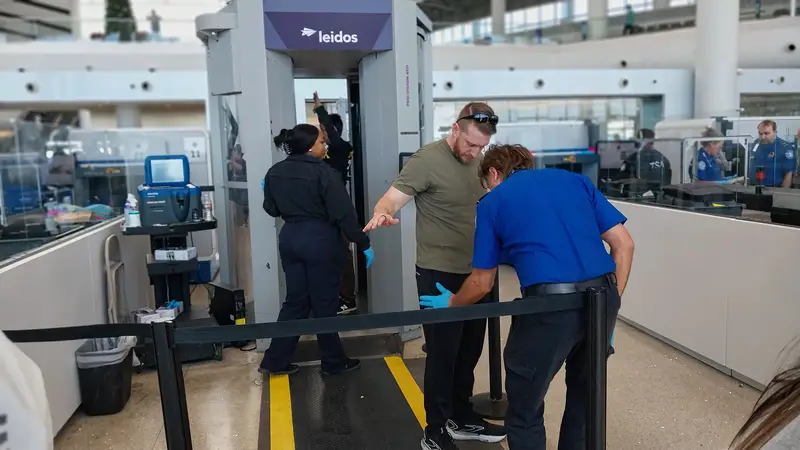
You’re standing at the airport, shoes still on your feet now that TSA finally scrapped that old rule, and everything is going smoothly. Then an officer waves you over. Something flagged on the scanner. Now they want to pat you down, and a small stubborn voice in your head pipes up: what if I just say no? It feels like a reasonable question. You’re a grown adult, nobody has arrested you, and the whole thing feels a little personal. So can you actually refuse? The short answer is yes. The longer answer is a lot more interesting, and a little bit unsettling.
Yes, You Can Say No (But It Won’t Go How You Think)
Here is the fact that surprises most people. TSA officers are federal employees, but they are not police. They are not sheriffs. They have no legal power to grab you and force your arms up. So technically, nothing physical stops you from declining. According to travel experts, that means the choice really is yours. But refusing does not mean you win. It means one thing and one thing only: you are not getting through that checkpoint, you are not reaching the secured part of the airport, and you are absolutely not boarding your flight. The pat-down was never a suggestion. It was the price of admission.
Here’s Exactly How It Plays Out
The moment you refuse, this turns into a small procedure with clear steps. A verified TSA agent laid out the whole sequence. First, a supervisor walks over and tells you plainly that you either submit to the pat-down or you get denied entry. They ask you again. If you refuse a second time, TSA or airport police escort you out, and you do not get to re-enter the checkpoint. You are told to leave the airport property, and you need to actually leave. Do not wander toward the gate. Do not say you’d like to hang around. Both of those things can trigger security measures that shut down the checkpoint and get you detained. As long as you decline politely and walk out, you’re generally fine and no further action is taken.
The catch nobody mentions is what happens after you leave. There may be remarks placed on a profile, and there is no clean timeline for when you can come back consequence-free. If you show up and refuse again, they may be able to detain you, and that would include a search anyway. So refusing does not delete the pat-down from your life. It just delays it and adds paperwork with your name on it.
The Part Where It Can Actually Cost You Money
Walking out calmly is the low-drama exit. Arguing, yelling, or trying to slip past security is where things get expensive. The TSA can hit you with a civil penalty for refusing, and while it’s rare, it does happen depending on the situation. And these are not parking-ticket numbers. TSA’s own enforcement guidance, updated in January 2025, allows civil monetary penalties up to $17,062 per violation for a regular individual. If you rack up multiple violations from the same incident, each one can be priced separately. And it gets steeper. The FAA Reauthorization Act of 2024 authorized TSA to raise the statutory maximum for security-related violations all the way up to $1,200,000 per civil penalty action, a change published at the end of December 2025.
On top of that, civil penalties are completely separate from criminal charges. If you try to reenter the checkpoint or bypass security to reach your gate, the TSA can make a criminal referral to law enforcement. Dropping the criminal side does not cancel the civil fine, and paying the civil fine does not erase the criminal side. They run on two different tracks. All of this over refusing a search that lasts a couple of minutes.
What Sets Off The Scanner (This One Is Genuinely Weird)
Here’s the fact that makes people laugh and then panic a little. You can get flagged for sweating. Yes, plain old perspiration. TSA runs about 1,200 advanced imaging units at nearly 400 airports, and those machines can misread damp clothing. “Perspiration is probably the weirdest thing that can set off the scanners,” said Shawna Malvini Redden, PhD, author of the book 101 Pat-Downs. A TSA spokesperson confirmed in 2025 that sweat can change how your clothes appear on the scanner. So if you sprinted to your gate, or you’re just a person who runs warm, the machine might decide you need a closer look. That means the guy who barely made it through the terminal is a prime pat-down candidate, and it has nothing to do with anything he did wrong.
A pat-down can cover a lot of ground too. TSA says it may include your head, neck, arms, torso, legs, and feet, along with head coverings and sensitive areas like the chest, groin, and backside. You may be asked to adjust your clothing during the process. It’s thorough by design, which is exactly why so many travelers wonder if they can skip it.
You Have More Rights Than You Realize
Here’s the flip side that most travelers never learn. A pat-down comes with real rules built to protect you. The officer must be the same gender as you. The officer has to explain the procedure clearly before touching you, so you can anticipate every move before you feel it. You can tell the officer up front about any disability, mobility issue, or painful spot, and if standing hurts or tires you out, you can ask for a chair. Even travelers over 75 are not automatically exempt if something gets flagged, but they can request alternative screening.
My favorite lesser-known right is the private screening. You can ask to move away from the security line entirely, and during a private pat-down, a second officer of the same gender joins. You’re also allowed to bring a friend or witness with you. If the idea of being patted down in front of a crowd is what bugs you, that option alone solves most of the problem, and hardly anyone knows to ask for it.
PreCheck Won’t Rescue You From This
A lot of frequent flyers assume TSA PreCheck is a golden ticket. And it’s great for speed. Around 99% of PreCheck travelers clear security within 10 minutes, they keep their shoes and belts on, and their laptops and liquids stay in the bag. But here’s the part that catches people off guard: PreCheck does not exempt you from a pat-down. An officer can still pick you at their discretion. TSA runs unpredictable security measures throughout the airport on purpose, and no individual is guaranteed the express lane every single time. So even the traveler who paid for the smoother experience can end up getting waved aside for the full treatment.
When A Pat-Down Actually Crosses The Line
There are limits, and this is where knowing the rules matters. TSA officers do not perform body cavity searches. Pat-downs stay on the external surface of your clothing and body, period. According to legal resources, a pat-down crosses into inappropriate territory when an officer touches sensitive areas with anything other than the back of the hand, squeezes excessively, makes you display intimate parts of your body, or throws out remarks meant to humiliate you. Any sexually charged contact or speech is over the line too.
If you believe a pat-down was handled wrong, you can document exactly what happened and contact an attorney. Suing a TSA officer is not simple, though. You have to show you suffered actual physical damage or economic loss, and you must complete a claims procedure before you can file a private case in a U.S. District Court. It’s a real path, just not a fast or easy one.
The Only Real Way To Avoid It
So what’s the honest bottom line here? The only guaranteed way to dodge a pat-down is to turn around and leave the airport altogether. Former federal transportation officer Caleb Harmon-Marshall put it bluntly: once you’re selected, you don’t really have an option, you have to comply. You can decline, sure, but then you’re driving home instead of flying out. As long as your bags haven’t already gone onto the X-ray belt, you can grab your stuff and go. If they have, you may wait for an agent to clear them first.
One more thing worth knowing, since the whole checkpoint experience keeps changing. Since May 7, 2025, domestic travelers need a REAL ID-compliant license or state ID to board. In July 2025, the Department of Homeland Security ended the shoe removal rule that had been around since 2006. And roughly 255 of the country’s 432 commercial airports now run 3D CT scanners, so you often leave electronics and liquids right in your bag. The screening keeps evolving, but the pat-down rule has not budged. You can say no. You just can’t say no and fly.

