

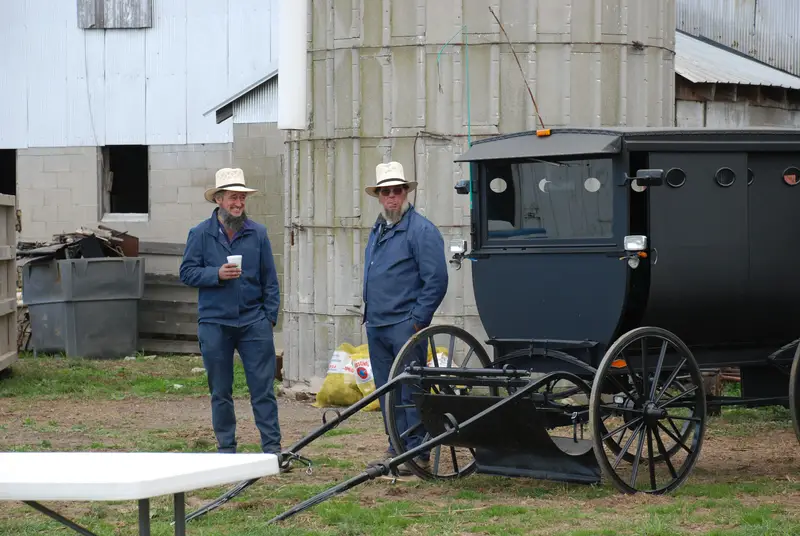
Park outside a hardware store in Amish country and the men walking in look like they came from the same barber. Black felt hats, suspenders, beards hanging well past the collar. Look closer at their faces and something is missing. Every upper lip is shaved clean.
That bare strip of skin is not a grooming preference or a quirk of style. By the most common account it is a quiet protest against soldiers, kept alive by a church that refuses to fight, and it has outlived the armies it was aimed at by more than a hundred years.
The Mustache Was Once Part Of The Uniform
Across Europe the mustache became a soldier’s mark, starting with the hussar regiments of the 1700s. Soldiers were the men who harassed religious minorities like the Amish and the Mennonites over their beliefs. The facial hair became shorthand for the people doing the harassing.
Britain made it official later and in writing. After the Crimean War mustaches became mandatory in the British Army, and the King’s Regulations later laid out the look in plain language: “The chin and the under lip will be shaved, but not the upper lip. Whiskers if worn will be of moderate length.” Shaving your lip was a uniform violation.
The trend started on the battlefield. During the Crimean War, beards, mustaches and sideburns turned into symbols of courage and grit, and civilians back in Britain copied the look to show support for the troops. What the public saw as patriotic, a pacifist farming community saw as the face of violence.
The British rule died in the middle of the First World War. By then it was widely ignored, the general who signed it away disliked mustaches, and gas masks, which need a tight seal against the skin, are often cited too. The requirement was dropped in October 1916.
The Beard Is The Wedding Ring
Amish couples do not exchange rings. Jewelry counts as worldly decoration, so there is no band, no engraving, no jeweler involved. At the ceremony the bishop places his hands on the couple’s clasped hands and gives a blessing, and that is the whole exchange.
The beard does the job the ring would do. Single men stay clean-shaven. Married men grow the beard and are not supposed to shave it again for the rest of their lives. You can stand in a farm supply store and read half the room’s marital status without asking a single question.
The finished style even has a name, though not one the Amish use. Grooming guides call it the Shenandoah or the chin curtain: a beard along the jawline, with sideburns running up to the ears. Many men shave the cheeks for a cleaner line. Nothing above the mouth, ever.
The Founder Was The Hardliner
Jakob Ammann started the movement that became the Amish in the late 1600s, and he was the hardliner in the room. He broke with his fellow Swiss Brethren leaders in Switzerland, Alsace and southern Germany by demanding stricter rules on how people dressed and how they wore their hair. He forbade the trimming of beards. He wanted uniformity in hats, clothing, shoes and stockings. He taught that anyone who lied should be excommunicated and then shunned, and he introduced foot washing into worship.
The logic behind the beard rule is simple. God made men to grow beards, so shaving was a man overruling God’s design. Vanity, in other words, with a razor.
His followers were not living comfortable lives when these rules were set. Anabaptists across Europe were hunted by the authorities, burned, drowned, starved in prison and executed by the sword, which is a large part of why looking different from the state and its soldiers mattered so much.
Nobody Can Show You The Rule In Writing
The Amish live by the Ordnung, a code covering dress, technology, transportation and behavior. It is not a book you can buy. The Ordnung is usually unwritten, passed down by mouth from one generation to the next, which is why it bends slightly from church to church.
No major army requires a mustache of its soldiers now. Facial hair signals nothing about service. The reason the rule was created evaporated generations ago, and the rule stayed anyway, because the ancestors kept it.
Plenty of Amish men cannot tell you the original reason at all. They shave the upper lip because that is what Amish men do, the same way they wear the hat and drive the buggy. Tradition carries it now, not history.
Shaving It Off Starts With A Visit
Outsiders assume a married Amish man who shaves gets hauled in front of the church. That is rarely how it starts. There is no punishment written down for a razor, though every baptized member has vowed to keep the Ordnung and accept church discipline.
For a married man, shaving the beard reads as turning away from his faith and his family, and it gets handled through conversation. Elders or the bishop talk to him. The emphasis is on understanding, forgiveness and encouragement to come back around.
The rule also has a loophole that genetics opens for some men. Not everyone can grow a full beard, and that is not held against anybody. The requirement is about not shaving, not about the amount of hair that shows up. A man with patchy growth who never picks up a razor is obeying the rule completely. If nature handles the problem for him, that is read as God’s will, and what counts is the obedience.
The Beard Clock Runs Differently By Settlement
The marriage rule is the most common version, not the only one. In some settlements men start growing a beard after baptism regardless of whether they are married. In others, the beard waits until a man has married and set up his own household.
A few communities put an age on it. In Allen County, Indiana, a man who has not married starts his beard at 40.
Length varies too. The long, full, untrimmed beard is standard in many communities, but the New Order Amish are the exception and generally keep theirs shorter and neatly groomed. The clean upper lip holds across all of them.
Nineteen Verses, One Very Specific Look
Beards show up in about two dozen verses of the Bible, and the Amish read them literally. The anchor is Leviticus 19:27: “Do not cut the hair at the sides of your head or clip off the edges of your beard.” Psalm 133 pictures precious oil poured on the head and running down Aaron’s beard, an image of unity and blessing.
Scripture also treats a forced shave as a humiliation. In 2 Samuel 10:4-5, Hanun seizes David’s messengers and shaves off half of each man’s beard. The insult was severe enough that David told the men to “Stay at Jericho till your beards have grown” before they came home. In Ezra 9:3, Ezra pulls hair from his own beard in anguish over sin.
The men the Amish look back on, Abraham, Isaac, Jacob and the prophets, almost certainly wore beards. Growing one connects a farmer in Pennsylvania to those figures directly. It also fits the German idea of Gelassenheit, surrendering yourself to a higher authority instead of chasing attention. A man who is not standing at a mirror trimming and fussing is a man practicing humility.
The Haircut And The Hat Are Talking Too
Hair rules apply to everyone, and the governing idea is that nothing should draw attention to you. Amish men keep their hair short and neat. The two common cuts are the bowl cut, which got its name from the bowl used to guide the scissors, and the William Penn cut, named for the famous Quaker, which is similar but longer at the sides, over the ears and favored by more conservative orders.
Hats carry signals too. Wide-brimmed black felt in the cold months, straw in the summer. Brims run broadest in the most conservative churches and shrink toward the progressive end, so the headwear tells you roughly what kind of community a man comes from before he speaks.
The neckbeard, grown from under the chin and long enough to cover the Adam’s apple, is permitted as long as it is kept to an acceptable length. Women face their own restrictions: no curling, no product, no jewelry in the hair, since altering a natural curl is treated as a worldly affectation. Amish girls often play with faceless dolls, a custom usually traced to the commandment against graven images.
A Rule That Outlived Its Own Reason
Strip away the history and the Amish mustache ban is one of the purest examples of tradition running on its own power. The soldiers it was meant to separate them from are long gone. The army regulations that made the mustache a uniform item were repealed. Nothing about a mustache today says anything about war.
The practice survives because the Amish are not trying to look modern, they are trying to look like their ancestors looked and live the way their ancestors lived. In that framework, an outdated reason is not a problem. Continuity is the point. The phrase that gets used is being in the world but not of it, and a shaved upper lip makes that visible from across a parking lot.
So the beard announces a marriage and a man’s place as head of a household. The bare lip announces that he will not fight. Both are doing work that most of us hand off to a ring, a uniform, a bumper sticker or a social media bio. The Amish just put it on their face and leave it there for life.

