

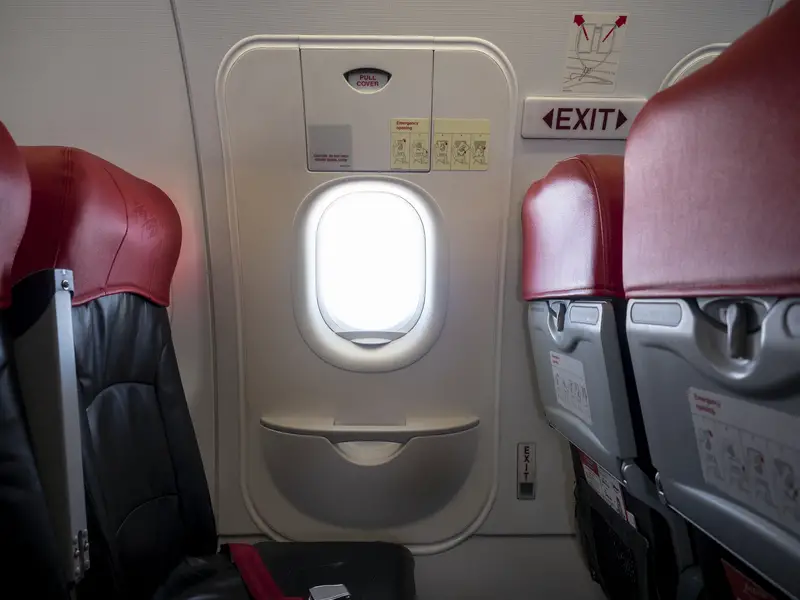
Airplane seating has turned into a low-grade war. Bare feet appear on your armrest. The guy in front drops his seatback into your knees before the wheels are up. Your row neighbors claim both armrests like they paid for them. The people who spend their entire working lives in that cabin have a favorite seat, and it isn’t the window, the aisle or first-class. It’s the exit row, and more specifically, the exit row seat that has no seat in front of it at all.
The Seat Crews Call Daddy Longlegs
Cecily Anderson, a flight attendant for Southwest Airlines, says that exit-row seat with nothing in front of it is her pick and the pick of a lot of frequent flyers. It has been dubbed the “daddy longlegs” seat, and the tall passengers all want it. By her count, a Boeing 737-700 has only one row like that and a 737 Max 8 has two.
Bill Bernal, then president of TWU Local 556, the union for Southwest flight attendants, doesn’t hedge either. “Hands down, my first choice is any seat in the exit rows because they have the most legroom,” he told Reader’s Digest in 2024.
The numbers back them up. A standard economy seat typically gives you 28 to 34 inches of pitch (the space from your seatback to the one ahead) and 16 to 18 inches of width. An exit row hands several of those inches back, and on a five-hour flight that is the difference between arriving fine and arriving angry.
The Row Right In Front Is A Trap
Not every seat near an exit is a prize. The row directly ahead of an exit row is often the worst seat in the cabin: it has no extra space, and it frequently won’t recline at all, because a reclined seatback would block the path to the door. When a plane has two rows serving one exit, the forward row is usually the one that gets locked upright.
Seat maps label both rows the same way on a lot of booking screens, which is how people end up paying extra for a seat that’s worse than the free one three rows back. Pull up a detailed cabin map and confirm there’s actual open floor in front of the seat you’re buying, not just a door beside it.
What It Actually Costs
Airlines price exit rows by route and date, and few publish a list. One travel blogger found United asking $45 to $59 for an exit row seat on a Tucson to San Francisco flight.
JetBlue now sells its exit rows as plain extra-legroom seats, apart from its EvenMore bundle, and prices them by route. Dollar for inch, it’s the best upgrade in economy, and it’s the reason those seats vanish first.
A Lot Of People Aren’t Allowed To Sit There
Exit rows carry rules that most passengers never read until a flight attendant is standing over them asking for a verbal yes. U.S. rules set the minimum age at 15, and airlines elsewhere set their own. There’s no maximum age. You have to be able to lift and operate the exit door, which can weigh up to 60 pounds, and you have to speak the flight’s operating language well enough to follow crew instructions.
Passengers traveling with infants are out. So is anyone using a mobility aid or needing special assistance, and so are pets. Airlines check eligibility at the gate or on board and can move you right then, even if you booked the seat months ago and paid for it. If that happens and you don’t get a comparable seat, you may be due a refund of the seat fee.
The flip side of all those restrictions is the quietest row on the airplane. No toddlers, no dogs, nobody who needs help getting settled. That alone is worth $45 to some people.
One thing that worries first-timers is unnecessary: cabin pressure makes it essentially impossible to open an emergency exit door while the plane is in the air.
What You Give Up For The Legroom
The tray table in most exit rows pops out of the armrest instead of folding down from a seatback. That means the armrest is fixed in place and the seat feels narrower than the one you left behind in row 22. Your bag can’t sit at your feet during takeoff and landing either; it goes in the overhead bin, which is a real annoyance if you like having a laptop or a book within reach.
Exit rows beside a door also run cold, which makes sense when it’s roughly -65 F outside at 35,000 feet. Bring a sweater. If your exit row sits over the wing, the engines are louder and the wing itself blocks most of the view out the window. On most jets the front of the plane is the quietest part, because you’re sitting ahead of the engines.
And you won’t be first off. Mid-cabin seating means a wait, and when ground crews open both the front and rear doors, exit row passengers can end up among the very last people out of the aircraft.
If Someone Beat You To It
Bernal’s backup is a window seat in the front row: extra legroom, a view, and a fast exit on landing. Rosie Awad, a former Virgin Australia flight attendant, went a different direction in a 2023 interview: row 5, at the window, every time. Her reasoning covers the view of the wing, the extra legroom, no emergency exit duties, the ability to keep a bag under the seat in front, a quick walk off the plane, and being among the first rows served during drink service.
Ethan Smith, a flight attendant for an international airline, puts it in row numbers, which vary by carrier. On an Airbus A320, he says, window seats in rows 10 to 12 are usually the ones airlines tag as extra legroom or economy plus, and they cost a fraction of business class. On a Boeing 777, the picks are a window seat in row 26 if you’re in premium economy, or row 31 in regular economy. Both have good views and extra room without putting you next to the galley or the lavatories.
The Seats To Refuse
Smith’s seat to refuse is row 30, which he calls the last row on most Boeing planes. The seat doesn’t recline, it’s next to the lavatory, it’s loud, and there’s usually a bathroom line standing over your shoulder for half the flight. On a 777, the equivalent misery is a middle seat in row 50: cramped, loud, short on overhead bin space and too close to the restroom.
Any seat touching a bathroom wall belongs on the same list. There is one reason to go back there anyway: if you want an empty seat beside you, the rear of the cabin is your best shot, because middle seats at the back are the last ones anybody picks.
Aisle Versus Window Isn’t Even Close
In a Going survey on seat preference, travelers split 53% for the window and 46% for the aisle, with 1% choosing the middle. The behavior gap is bigger than the preference gap. Researchers at Emory University and Georgia Tech tracked passengers on 10 transcontinental flights and found about 80% of aisle passengers got out of their seats during the flight, compared with 43% of window passengers.
That’s the whole decision. If you plan to sleep, take the window and lean into the curved wall. If you’ll be up more than twice, take the aisle and stop climbing over strangers. For a tight connection, sit in rows 1 through 10 on the aisle and don’t negotiate with yourself about it.
Nervous flyers have a different target. Seats over the wing sit at the plane’s center of gravity, the same way the middle of a seesaw barely moves, and they ride the smoothest. The front half is quieter and steadier; the back is noisier and bumpier. For views, you want a window in the front quarter of the cabin or behind the wing, since the wing blocks everything directly beside it.
Check The Map, Then Check It Again
SeatGuru, the color-coded seat map site travelers relied on for two decades, was shut down in October 2025. AeroLOPA and SeatMaps picked up the slack, and they’re worth opening twice: once when you book, and once closer to departure. Airlines swap aircraft constantly, and a swap can turn the exit row you paid for into a standard seat with a different number.
The good exit rows, bulkheads and front-cabin seats are usually gone within days of a flight opening for reservations. Book early, especially around holidays.
Our verdict: on anything over three hours, buy the exit row seat with clear floor in front of it, accept that your bag lives in the bin and your armrest doesn’t move, and take the legroom. On a short hop, skip it and grab an aisle seat near the front instead. You’ll be off the plane before the exit row passengers have unbuckled.

