

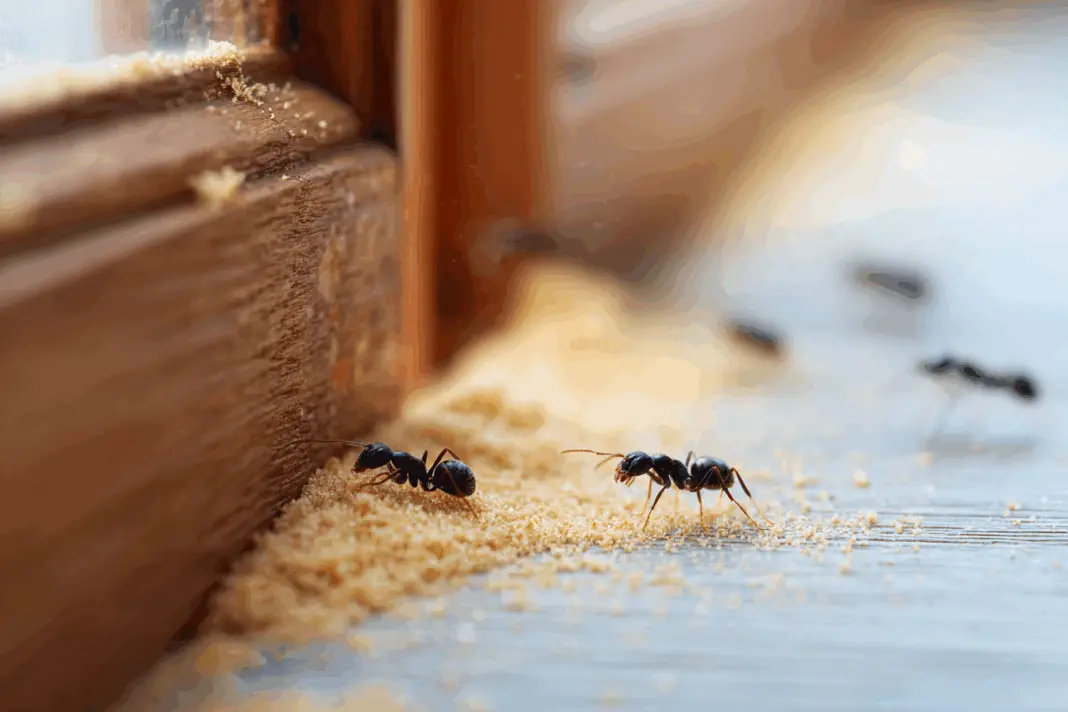
Finding ants marching across your kitchen counter might seem like a minor annoyance, but certain ant species can cause thousands of dollars in structural damage or pose serious health risks. While many homeowners dismiss a few ants as harmless, spotting specific warning signs means it’s time to take immediate action. Some ants carry harmful bacteria, while others can literally eat through the wooden framework of your house. Recognizing the difference between common garden ants and destructive species could save you from costly repairs and potential safety hazards down the road.
Carpenter ants leave telltale sawdust trails
Those tiny piles of what looks like sawdust around your baseboards, window frames, or deck posts aren’t debris from a home improvement project. Carpenter ants create these wood shavings as they tunnel through wooden structures to build their nests. Unlike termites that actually eat wood, carpenter ants excavate it to create smooth galleries for their colonies. The sawdust piles often appear in neat lines along walls or concentrated near wooden beams and ledges where these destructive insects are most active.
Carpenter ants prefer moist, softened wood, making areas around leaky pipes, poorly sealed windows, or damaged roofing prime real estate for infestations. Over time, their tunneling can compromise the structural integrity of wooden beams, floor joists, and support posts. If damaged wooden structures collapse onto electrical wiring, they can create fire hazards that put your entire home at risk. The longer these ants work undetected, the more extensive and expensive the damage becomes, sometimes requiring major structural repairs or complete replacement of load-bearing elements.
Ant trails indicate a full-scale invasion
That single file line of ants walking along your wall isn’t just a coincidence. Ants create pheromone trails that act like invisible highways, guiding other colony members to food sources and potential nesting sites. When you see ants marching in formation toward or away from your home, they’re essentially laying down a chemical roadmap for thousands of their relatives to follow. These trails can persist for days, continuously drawing more ants into your living space as word spreads through the colony about available resources.
The presence of ant trails often means the insects have already established a foothold in your home and are actively recruiting reinforcements. Worker ants scout for suitable locations to expand their territory, and once they find weaknesses in your home’s defenses, they signal for the entire colony to mobilize. What starts as a few scouts can quickly escalate into hundreds or thousands of ants invading your kitchen, pantry, or other areas where they detect food or moisture. Breaking these chemical communication lines becomes crucial for stopping the invasion before it reaches overwhelming proportions.
Flying ants signal reproductive swarms
Discovering small, translucent wings scattered around your home during summer months indicates that reproductive ants are actively seeking new nesting locations nearby. These flying ants shed their wings after mating flights, and finding discarded wings means fertile queens are establishing new colonies in the immediate area. Unlike worker ants that forage for existing colonies, these reproductive ants are literally building new ant cities that could include your home as prime real estate for expansion.
The timing of these swarms coincides with ideal conditions for colony establishment, typically occurring when weather provides the perfect combination of warmth and moisture. Once fertilized queens find suitable nesting sites, they can produce thousands of offspring within months, creating multiple interconnected colonies around your property. These new colonies often communicate and cooperate with each other, making elimination much more challenging than dealing with a single isolated nest. Spotting flying ant activity early provides a critical window for preventing large-scale infestations before they become entrenched.
Wall sounds reveal hidden colonies
Those faint rustling or scratching sounds coming from inside your walls aren’t your imagination. Ants can establish colonies between wall studs, behind wallpaper, or in hollow spaces throughout your home’s structure. The sounds become more noticeable during quiet evening hours when ant activity peaks and household noise decreases. Large colonies produce audible movement as thousands of insects travel through their tunnel networks, creating a subtle but persistent scratching or rustling that indicates significant population density.
Internal wall colonies present particular challenges because they remain hidden from traditional detection methods while potentially causing extensive damage to insulation, wiring, or structural elements. Ants living in walls often create multiple entry and exit points throughout your home, making it difficult to locate and treat the primary nesting areas. They can also damage wallpaper by creating small tears or holes as they travel between their hidden colonies and food sources. The presence of internal colonies typically indicates a mature, well-established infestation that requires professional intervention to eliminate completely.
Stinging species pose serious health risks
Fire ants and other stinging species deliver venom through their stingers that can cause severe allergic reactions in sensitive individuals. Unlike regular ant bites that cause minor irritation, fire ant stings inject venom that creates burning sensations, swelling, and pustules that can become infected if not properly treated. For people with severe allergies, multiple stings can trigger life-threatening anaphylactic reactions that require immediate emergency medical attention.
These aggressive ants defend their territory vigorously and will swarm anyone who disturbs their nests or trails. Unlike other ant species that typically flee when threatened, fire ants attack in coordinated groups, with each individual capable of stinging multiple times. Their venom contains alkaloids that cause tissue damage and intense pain that can persist for hours or days. Children and pets face particular vulnerability to fire ant attacks due to their smaller body size and natural curiosity that might lead them to unknowingly disturb hidden nests in yards or garden areas.
Contaminated food becomes health hazard
Ants crawling through your pantry aren’t just stealing food – they’re potentially contaminating it with harmful bacteria picked up from their travels through sewers, garbage, and other unsanitary locations. While ants don’t carry diseases like some insects, they do transport bacteria on their bodies that can make people sick if ingested through contaminated food or surfaces. These microorganisms can cause stomach upset, food poisoning symptoms, or other digestive issues, particularly in young children or elderly family members with compromised immune systems.
Once ants establish trails through your kitchen and food storage areas, they continuously track contaminants across countertops, inside containers, and throughout your pantry shelves. Even sealed packages aren’t safe if ants find ways to chew through cardboard, plastic, or other packaging materials. The bacterial contamination can persist on surfaces long after the ants are gone, creating ongoing health risks for anyone preparing or consuming food in affected areas. Proper sanitation becomes critical not just for eliminating current infestations, but for preventing future health problems from lingering contamination.
Secondary pest invasions follow ant problems
Ant infestations often attract predatory insects and other pests that view the colony as an easy food source. Spiders, including dangerous species like black widows and brown recluses, commonly follow ant trails into homes where they establish their own populations. These secondary invaders rarely leave voluntarily once they discover the abundant prey and suitable shelter conditions that ant-infested homes provide.
The cascading effect of pest problems means that solving ant issues early prevents much more complex and dangerous situations from developing. Vampire bats, centipedes, and other predatory creatures may also be drawn to areas with high ant populations, creating a diverse ecosystem of unwanted guests in your living space. Each additional species brings its own set of risks, from venomous bites to property damage, making comprehensive pest management increasingly difficult and expensive. What starts as a simple ant problem can evolve into a multi-species infestation requiring extensive professional treatment and ongoing monitoring to resolve completely.
Kitchen infestations spread rapidly
Kitchens provide everything ants need to thrive: consistent food sources, water from sinks and appliances, and numerous hiding spots behind cabinets and appliances. Once ants discover your kitchen, they quickly establish multiple routes between food sources and their nests, creating a complex network of trails that can be difficult to eliminate. Crumbs behind appliances, grease buildup around stoves, and moisture from dishwashers create ideal conditions for rapid population growth and colony expansion.
Kitchen ant problems tend to worsen quickly because these areas provide year-round resources that support continuous breeding cycles. Unlike outdoor colonies that face seasonal limitations, indoor populations can grow exponentially without environmental constraints. Ants adapt to household routines, becoming more active during meal preparation times and learning to exploit weaknesses in food storage systems. Their ability to access areas behind appliances, inside wall voids, and under flooring makes complete elimination challenging without professional-grade treatments and systematic approach to breaking their established patterns.
Moisture attracts destructive species
Bathrooms, laundry rooms, and areas with water damage become magnets for ant species that require high humidity for survival and reproduction. These moisture-loving ants often target homes with plumbing leaks, poor ventilation, or water damage because these conditions create the perfect microenvironment for colony establishment. Carpenter ants particularly favor water-damaged wood that has become soft and easy to excavate for nest construction.
The combination of moisture and organic materials creates breeding grounds for multiple pest species simultaneously. Ants attracted to wet conditions often bring fungal spores and other microorganisms that can cause additional problems like mold growth or wood rot. These secondary issues compound the original ant problem, creating expensive repair situations that extend far beyond simple pest control. Addressing moisture problems becomes essential for long-term ant prevention, but existing water damage may have already provided entry points and nesting sites that require extensive remediation to eliminate completely.
Taking immediate action when you spot dangerous ant species can prevent thousands of dollars in structural damage and protect your family from health risks. Whether you’re dealing with wood-destroying carpenter ants, venomous fire ants, or disease-carrying species, early intervention makes the difference between simple treatment and extensive remediation. Don’t wait for the problem to escalate – contact professional exterminators at the first sign of these warning indicators to protect your home and family.

