

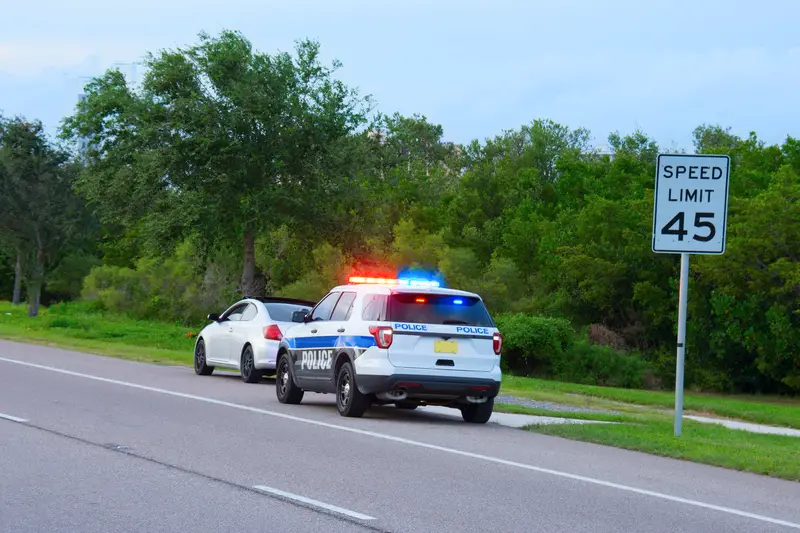
Ask ten people which car color gets pulled over the most and nine of them will say red. There was even a TikTok from a Kia dealership in Indiana that racked up over 714,000 views, where employee after employee said the same thing with total confidence. Red cars, they all agreed, are cop magnets. And they are all wrong. The color that actually gets stopped more than any other on American roads is boring, plain, dad-approved white.
White Wins the Ticket, and It Is Not Close
Here is the math nobody wants to hear. White has been the most popular car color in the country for over a decade. Roughly 35% of all vehicles on the road are white. So when you add up every traffic stop in a given year, white cars pile up at the top of the list simply because there are so many of them. Some studies show white vehicles involved in nearly one-fifth of all citations. Experts call this population bias, and it is the reason the whole “red car” idea falls apart. There are just way more white cars to pull over.
After white, the usual ranking runs red, then gray and silver, then black. But those spots on the list line up almost perfectly with how many of each color are cruising around. White, black, and gray together make up more than 70% of new cars sold worldwide. Red? Around 4 to 5%.
How Red Got Such a Bad Reputation
So if red only makes up a sliver of the cars out there, how did it end up as the poster child for speeding tickets? Blame Hollywood, honestly. Think about Ferris Bueller borrowing that gorgeous red 1961 Ferrari 250 GT. Think about every music video with a crimson Lamborghini. Red became the movie shorthand for speed, money, and breaking the rules. When your brain sees red on a car, it is already primed to think “trouble.”
There is also a real psychology piece to it. Red is a primary color tied to warning signs, stop signs, and fire trucks. Our eyes are wired to snap toward high contrast. In a river of gray and silver traffic, a red car pops. That effect is called visual saliency. If a white car and a red car are both doing 10 over, an officer’s eye naturally lands on the red one first. Not because the cop is targeting red. Because red is harder to miss.
Radar Guns Do Not Care About Your Paint
One of the weirdest myths floating around is that red cars somehow reflect radar differently, like the color makes you show up brighter on a cop’s speed gun. That one is flat-out false. Radar guns work by bouncing radio waves off moving objects and measuring the Doppler effect. LIDAR uses laser light to time distance. Both technologies interact with the metal structure of your vehicle, not the layer of paint sprayed on top of it.
In other words, you could paint your car neon green, glitter purple, or matte black and the radar reading would come back identical. The machine has no idea what color you picked at the dealership. It only knows how fast you are going. So the next time someone tells you red “triggers” the radar, you can smile and let them keep believing it.
The Car Matters Way More Than the Color
Want to actually predict who gets ticketed? Forget the paint and look at the badge on the trunk. Make and model tell you far more than color ever could. A 2021 report crowned the Subaru WRX the most ticketed car on the road, with the Hyundai Genesis Coupe and the Kia Stinger right behind it. A later 2025 report pointed to drivers of the Subaru BRZ, the Genesis Coupe again, the Volkswagen GTI, and the Chevy Cruze racking up more speeding violations than average.
Notice a pattern? Those are sporty, quick, fun-to-drive machines. Sports cars, modified rides, and luxury models with loud exhausts or blacked-out windows stand out, and their drivers tend to push it. It has nothing to do with the color and everything to do with the type of car and the foot on the pedal. A red minivan full of soccer gear is not getting the same look as a tuned coupe weaving through lanes.
No, Your Red Car Does Not Cost More to Insure
This might be the most stubborn belief of all. Tons of people have talked themselves out of buying a red car because they were sure the premium would be higher. Some folks pick a duller color on purpose, thinking they are being smart. They are not saving a dime.
Insurance companies do not have a box on the form for paint color. They never ask. What they actually price on is your driving record, your age, the make and model, the car’s value, and how much it costs to repair. That is it. A red Honda Civic and a silver Honda Civic with the same driver behind the wheel will get the exact same quote. The idea of the “red tax” is a total myth, and it has cost a lot of people the color they really wanted.
The Color You Get Stopped In Is Not the One You Crash In
Here is a fun twist that catches everyone off guard. The color most likely to get you pulled over is not the color most likely to get bent up in a fender bender. Those are two different animals entirely.
A famous Monash University study out of Australia looked at how paint color relates to crash odds. During daylight, black cars showed about a 12% higher crash rate than white ones, with gray around 11% and silver near 10%. The reason is simple contrast. White and silver stand out against dark asphalt, while black and dark blue blend into shadows, especially at dawn and dusk. So the colors that dominate American parking lots, black, gray, and silver, are the ones that get harder to see. You are most likely to be stopped in a white car, but statistically more likely to get tangled up in a wreck in a black one.
Who Actually Buys Red, and Why It Matters
There is one piece of the red story that is not pure myth, and it is kind of clever. Red gets picked more often by younger drivers and by men. It also shows up way more on performance and sporty models than on your average commuter box. Automakers know this, which is why they love pairing red paint with the fast trim lines in their brochures.
So the same person drawn to a bright red coupe is often the same person statistically more likely to speed, take risks, and end up in the enforcement numbers. It is not the red paint earning the ticket. It is the driver who tends to choose red in the first place. The color is a clue about the driver, not a cause of the stop. Correlation dressed up as causation, basically.
Why This Myth Refuses to Die
If the data is this clear, why does everyone still swear by the red car thing? Two words: selective memory. When you drive past a red sports car sitting on the shoulder with flashing lights behind it, that image sticks. It is bold, it is dramatic, it burns into your brain. When you pass a plain white sedan getting the same ticket, you barely register it. Over years of driving, your mind quietly collects all those red-car snapshots and throws out the white ones. That is textbook confirmation bias, and it gets passed down like family folklore.
There is also how cops actually work a stop. When an officer radios one in, they call out the make, the model, or the plate number. Color usually comes second, if it comes up at all. Some officers admit they do not even clock the color until after they have already decided to hit the lights, because the decision was based on behavior. Speeding, drifting lanes, a busted taillight, expired tags. The paint job was never part of the equation.
So drive whatever color makes you happy. Buy the fire-engine red you have been eyeing. The cop behind you is watching your speedometer and your lane, not your color swatch. And if a friend insists red is a magnet for tickets, now you have the whole story to set them straight, from the radar guns to the insurance forms to the boring white sedans quietly leading the pack.

