

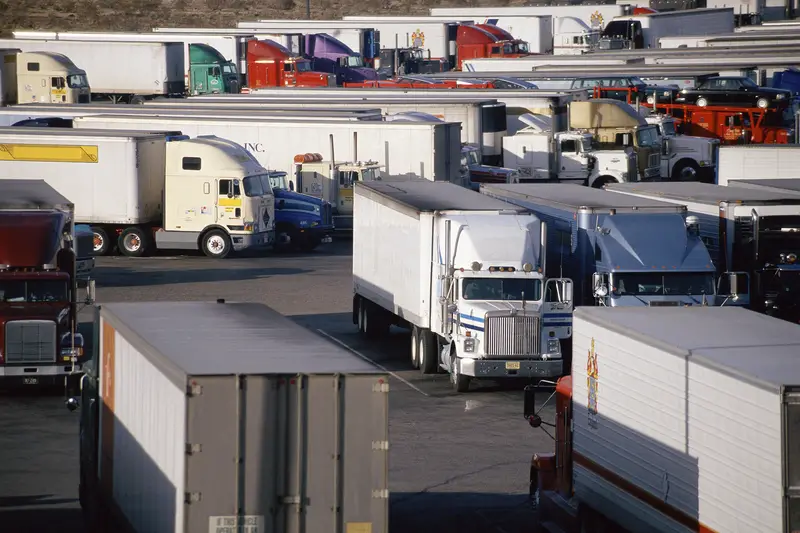
You pull into a packed rest stop, a gas station, or a crowded lot, and there it is: one open space, right next to a parked semi. Jackpot, right? Wrong. That might be one of the worst spots you can leave your car, and not because somebody’s going to ding your door. It’s because the person behind the wheel of that truck may have absolutely no idea your car exists.
I used to think of big rigs as just cars with extra mirrors. Turns out a semi is surrounded by huge zones where your vehicle basically disappears. Truckers call them “No-Zones,” and if your car is sitting in one when that rig starts to roll or swing wide, things go bad in a hurry. Here are the surprising facts that made me start parking a whole lot farther away.
The Blind Spot in Front Is Bigger Than Your Whole Car
Here’s the one that shocked me most. You’d assume a trucker sitting up that high can see everything in front of them. Nope. There’s a dead zone right off the front bumper where a small car, a motorcycle, or a person walking can be completely hidden. Utah’s own truck safety program says that front No-Zone stretches nearly 20 feet ahead of the cab.
And some estimates go way past that. One law firm points out the front blind spot can reach as far as 10 car lengths ahead. Think about that at a red light or a stop sign. If you nose your car in close and cut in front of a truck like you would with another sedan, the driver may never register you were there. When the light turns green and that truck starts moving, you’re the one who pays for it.
The Right Side Is a Two-Lane Monster
If you take one thing away from this, make it this: the passenger side of a semi is the most dangerous place to be. The driver sits on the left, so the entire right side is a giant mystery to them. According to a Maryland accident overview, the right-side blind spot can stretch across two full lanes and run the whole length of the truck, reaching about 30 feet back.
Two lanes wide. Let that sink in. You could be a full lane away from the truck, thinking you’ve got plenty of room, and still be totally invisible. That’s why parking on a truck’s right side, or scooting up alongside it in traffic, is asking for trouble. The driver’s view sits about 9 to 10 feet off the ground, high enough to see over the hood but useless for anything hugging that right flank.
Wait, Trucks Don’t Have a Rearview Mirror?
This one flat out surprised me. Your car has that little mirror clipped to the windshield so you can glance behind you. A semi has nothing back there. There’s a whole trailer in the way, so a rearview mirror would just show the inside of a metal box. That means the driver truly cannot see what’s directly behind them.
The rear No-Zone runs as far as 30 feet behind the trailer, and under some conditions it can stretch to a wild 200 feet. So when you park your car right behind a parked rig to squeeze into a tight lot, the trucker has zero way of knowing you’re there. If they need to back up, and truckers back up constantly, your car is directly in the path of something that weighs tens of thousands of pounds. A backup camera helps, but plenty of trucks still don’t have one, and even those cameras miss stuff.
The Mirror Trick That Tells You Everything
Okay, so how do you know if you’re in the danger zone? There’s a dead-simple test, and once you learn it you’ll use it forever. Look at the truck’s big side mirrors. If you can see the driver’s face in the mirror, they can see you. If you can’t see their face, they have no clue you’re there.
The folks who study these crashes say it plain: check the mirrors, and if you can’t see them, the driver can’t see you. Those mirrors are massive, by the way, some as tall as 25 inches. Even with all that glass, plus convex mirrors that widen the view, the blind spots don’t disappear. So the next time you’re pulling up near a rig, glance at the mirror and hunt for a face. No face, no visibility, move along.
A Parked Truck Is Not a Safe Truck
Here’s the heart of it. People assume a parked truck is harmless, just a big hunk of metal sitting still. But the No-Zone concept applies whether that truck is moving or getting ready to move. The danger zones are exactly the same. Park too close, especially on the right side or directly behind, and you’ve dropped your car into a spot where the driver about to pull out or swing wide has no idea you’re there.
And there’s a nightmare scenario tied to parked semis specifically. Because trailers sit so high off the ground, a smaller car can slide underneath the back or side in a crash. It’s called an underride, and it’s as ugly as it sounds. More than 400 people died in underride crashes in the United States in 2021 alone. Roads and lots aren’t always built with rigs in mind either, so when a trucker parks somewhere they barely fit, everybody nearby has less room and more risk.
The “Squeeze Play” That Traps Cars on Turns
This one is sneaky. To make a right turn, a long truck often has to swing left first, then arc the trailer through the corner. So you see the truck drifting left and think, “Great, I’ll slip past on the right.” Big mistake. As the trailer swings back around, it sweeps into the exact space you just pulled into. This is the squeeze play, and a tractor-trailer can be 70 feet long or more.
The rear wheels of a truck follow a tighter path than the front wheels, a quirk called off-tracking, and it gets worse the longer the truck is. Now add a parked car, a curb, a light pole, or a guardrail on the other side, and your vehicle can get pinned between the trailer and something that won’t budge. It happens most at intersections and on narrow streets. So parking near a corner where trucks turn is another gamble you don’t want to make.
They Physically Cannot Stop Like You Can
Even if a trucker spots trouble, physics is not on their side. A fully loaded semi can take twice the distance a regular car needs to come to a complete stop. Other estimates put it at roughly 40 percent more stopping distance. Either way, that’s a lot of pavement.
So picture the chain of events. You’re tailgating a rig or sitting in its front No-Zone. The truck can’t see you, and if it has to stop fast, it can’t. You’ve got a heavy vehicle that can’t brake quickly bearing down on a car it doesn’t know is there. That’s why following too close, sometimes done on purpose to save gas by drafting, is such a terrible idea. Give a rig a cushion of at least four seconds, which works out to a big gap of empty road.
Blind Spots Cause a Third of Truck Crashes
This isn’t a rare freak thing. Every year, blind spots play a role in nearly one-third of all large truck accidents, according to federal crash data. Truckers are trained to check mirrors every 5 to 8 seconds and to watch their trailer’s swing path on turns, but they’re human. GPS, a delivery manifest, a long shift, and fatigue all chip away at attention.
One fun fact to end on: truckers have a whole light-based language for talking to each other on the road. A flick of the high beams or a tap on the brake lights can say all kinds of things. So if you ever need a rig to know you’re near, a quick flash can help. But honestly? The best move is the simplest one. Don’t park close, don’t linger alongside, and never assume a driver 10 feet in the air can see the little car right below them. Give the big rigs their space, and give yourself some peace of mind.

